
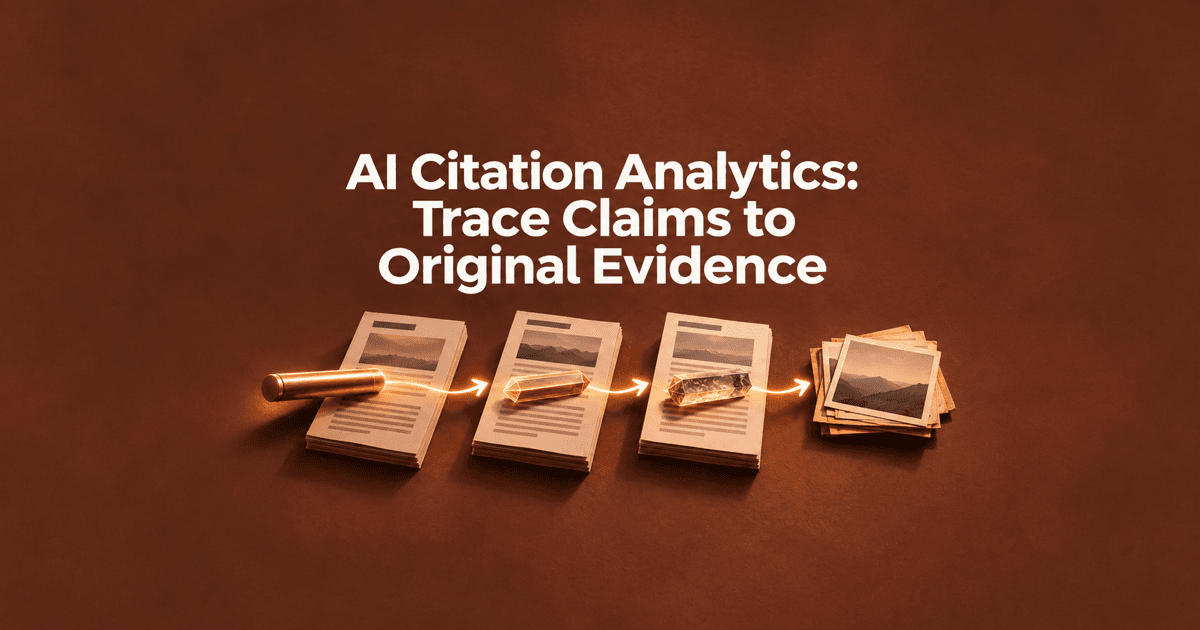
A communications analyst follows a citation from a generated answer to a trade article. That article points to a company announcement, which summarizes a research report. By the time the finding reaches the answer, an observation about a limited sample has become a general claim about the whole market. Several visible links make the statement look well supported, but the team hasn’t located where its meaning changed.
AI citation analytics needs a way to trace that explicit evidence chain. The aim is to preserve the answer’s actual link, follow verifiable attribution, and identify what each retelling adds or removes. This is a claim-review workflow, not an attempt to reconstruct a model’s hidden retrieval process or count copied stories as independent validation.
Ai Citation Analytics: Start With the Link the Answer Actually Shows
Save the visible answer and the exact source link before following references elsewhere. The address shown to the user is the starting observation, even when a later review finds a more useful document. Replacing it with an original study would erase part of what the answer actually exposed.
Write down the claim attached to that link. A citation card at the end of a paragraph may appear to support several statements, and the relationship can be ambiguous. Preserve the surrounding wording rather than assuming the link certifies every sentence nearby.
Separate the observed citation from your proposed evidence path. The first is directly visible in the answer. The second is an analyst’s reconstruction based on attribution found in the linked documents, and its status should remain clear throughout the record.
Use the W3C provenance overview as vocabulary for entities, activities, and responsible parties. Those distinctions help organize the review. They don’t establish that an AI provider internally traversed the same sequence the analyst later followed.
Choose a claim worth the effort before tracing every reference on the page. A consequential number or recommendation deserves more attention than a passing descriptive phrase. Prioritization keeps the review tied to an editorial or business decision instead of becoming an open-ended bibliography project.
Follow Explicit Attribution to the Underlying Evidence
Follow references that a reader can verify. These may be a linked paper, a named dataset, a report identifier, or an explicit statement that one organization supplied the findings. Record the attribution as written and keep the next document’s identity separate from its general publisher domain.
Stop when the connection becomes an inference. Similar wording or a matching statistic may suggest a relationship, but it doesn’t prove one without supporting evidence. Mark the suspected connection as unverified and avoid drawing a solid line in the evidence map.
Inspect whether the linked destination is the document itself or a summary. An announcement may accurately describe a study while omitting details needed to evaluate the claim. Reaching a recognizable publisher isn’t the same as locating the underlying methods and results.
Keep access limitations visible. A missing report, broken link, or restricted document can prevent a complete review. The right response is to identify the gap, not to fill it with the summary’s interpretation and call the original evidence verified.
Use a stopping rule for the initial pass. Stop at accessible underlying evidence, an explicitly unresolved connection, or a document that no longer attributes the relevant claim further. That rule gives the reviewer a practical endpoint while leaving room for a deeper investigation when the decision warrants it.

Map What Each Retelling Adds or Removes
Compare the statement at each confirmed node with the claim in the next retelling. Look for changes in population, timeframe, uncertainty, causal language, and the scope of the conclusion. These shifts can be more consequential than a copied number.
Store the source statement and the analyst’s interpretation separately. A report can describe an association while a summary describes an effect, or a regional sample can become a claim about all customers. The ledger should identify the specific transformation rather than labeling the entire article unreliable.
The following table is a proposed review structure with synthetic examples. It shows how to record changes without presenting an invented study or measured finding.
| Evidence node | Statement to preserve | Possible transformation | Review question |
|---|---|---|---|
| Underlying report | Defined sample and result | Starting evidence | What does the method support? |
| Organization summary | Selected result and context | Limitation omitted | Does the omission change applicability? |
| Trade coverage | Paraphrased conclusion | Association becomes cause | Is causal language justified? |
| Generated answer | Buyer-facing recommendation | Limited result becomes general advice | Does the cited evidence support this decision? |
| Missing document | Only an attributed description remains | Original cannot be inspected | What conclusion must stay unresolved? |
Record faithful retellings too. A chain isn’t necessarily defective because it contains several intermediaries. Some summaries preserve the relevant limitations and improve accessibility without changing the claim’s meaning.
Prioritize transformations that alter the reader’s decision. Minor wording differences may be harmless, while a missing eligibility condition can change who should act on a recommendation. The review should explain that consequence in plain language for the owner who must decide what to correct.
Follow the claim’s meaning, not just its repeated number.
Distinguish Primary Evidence From Independent Validation
An underlying report is closer to the original method, but that doesn’t automatically make its conclusion correct. Review its design, available data, stated limitations, and relationship to the claim. The purpose of reaching it is to inspect those details rather than awarding a universal authority badge.
Separate repeated reporting from independent evidence. Several articles can cite the same report without providing new observations. Their agreement may show that a message spread widely, but it doesn’t establish that multiple independent studies reached the same result.
Treat genuinely independent validation as another evidence branch with its own methods and scope. Compare it with the original claim rather than assuming agreement from a similar headline. Differences in population or outcome can make the apparent validation less direct than it first appears.
The W3C provenance data model provides explicit concepts for derivation and responsibility. Use those concepts to keep the relationship between documents legible. The proposed analyst ledger does not require a publisher to expose machine-readable provenance before its content can be reviewed.
Keep citation-share calculations out of this particular investigation. The question is where meaning changed along a documented attribution path. Deduplicating publications for a visibility denominator is a different task with different counting rules and shouldn’t replace claim-level review.

Keep Unverified Links and Missing Documents Visible
Use explicit statuses for confirmed attribution, suspected attribution, inaccessible evidence, and reviewed evidence. Define what each status requires so another analyst can apply the same distinction. A blank cell shouldn’t carry several incompatible meanings.
Document the exact missing item. A named report without an accessible copy is different from a source that never identifies its underlying study. The first may be resolvable through a publisher or rights holder; the second may remain a provenance limitation.
Don’t infer a provider’s internal process from the public chain. The answer may expose an intermediary even when other documents informed its response. Public attribution review can assess the visible claim and its documented support without claiming to reveal every source the model considered.
Escalate consequential gaps with a focused question. Ask whether the available evidence is sufficient for the intended recommendation, or which original document is needed to evaluate it. That makes the handoff useful to an editor or subject-matter reviewer.
Preserve later discoveries as additions. If the original document becomes available, attach it and revise the assessment with a dated explanation. Don’t remove the earlier access limitation from the history, because it explains the confidence of the original review.
Use Topify to Prioritize Evidence-Chain Reviews
Topify can help identify the answer and source observations that deserve deeper examination. Start with priority buyer questions and inspect the cited URLs available through its citation analysis. For a consequential claim, create an external ledger that starts with the exposed link and follows only verifiable attribution. Record document identity, relevant passages, transformations in meaning, unresolved connections, and the responsible reviewer.
This workflow uses source observations as an entry point rather than claiming the platform reconstructs hidden retrieval or automatically certifies original evidence. The context framework in AI Prompt Intent Signals: How Constraints Reveal What Buyers Actually Want helps identify which missing condition could change the buyer’s decision. Review a small set of high-consequence claims first, then use the resulting cases to improve the team’s evidence rules. The immediate value is a clearer review decision, not a promised increase in citations or a complete map of a provider’s reasoning.
Conclusion
Tracing original evidence is most useful when it shows how a claim’s meaning changes. Preserve the answer’s exposed link, follow explicit attribution, and compare the population, method, uncertainty, and scope at each confirmed node. Repeated coverage can be faithful reporting, but it doesn’t become independent validation merely because several URLs repeat the result.
Begin with one consequential statement and a compact transformation ledger. Stop at confirmed underlying evidence or a clearly identified gap, then assign any unresolved judgment to the appropriate reviewer. Use Topify’s citation analysis to prioritize the source observations entering that process, while keeping visible evidence separate from assumptions about hidden model retrieval.
FAQ
Is the original source always the most reliable source?
No. It provides access to the originating method or statement, which still needs review for relevance and limitations.
Do several articles citing one report provide independent validation?
Not by themselves. They may be separate publications derived from the same underlying evidence.
Can this workflow reveal every document an AI model used?
No. It traces explicit public attribution from the visible citation, not the provider’s complete internal retrieval process.
What should happen when the original report is unavailable?
Record the missing document and limit the conclusion. Don’t treat an intermediary’s description as if the underlying evidence had been inspected.