A brand analyst sees a sudden increase in mentions after adding a short company name to a monitoring project. Reading the answers reveals a problem: some describe an unrelated retailer, and others refer to a product line rather than the parent company. The apparent gain is partly a naming error.
AI brand intelligence depends on deciding which real entity a phrase refers to before counting its appearances. Exact text matching can miss legitimate references and include the wrong organization in the same report. The practical decision is where to draw the identity boundary, what evidence resolves an ambiguous mention, and when a record should remain uncertain instead of being forced into a positive or negative result.
AI Brand Intelligence Needs an Identity Boundary
Define the subject of measurement before creating an alias list. A parent organization, consumer brand, individual product, and regional subsidiary may all appear in one answer. Whether those appearances count together depends on the business question, not simply on corporate ownership.
For a product-launch report, a parent-company mention may be insufficient evidence that the new product appeared. For a corporate reputation review, several products may legitimately belong to one broader analysis. Preserve the underlying entities so both views can be produced without changing the original observation.
Google’s Organization documentation distinguishes a business name, an alternate name, and links identifying the organization. Those properties are useful public identity signals. They don’t guarantee that another AI system will interpret every ambiguous phrase correctly.
Write an inclusion statement in ordinary language. For example, a hypothetical report might count references to the named software brand and its documented former name, but exclude its parent unless the answer explicitly connects the two. Give reviewers that statement before they start scoring.
Build an Alias Register With Exclusions
An alias register records why a name belongs to an entity, not just which words to search for. Include documented abbreviations, former names, and common product references where appropriate. Add exclusions for unrelated organizations or ordinary-language meanings that could trigger false matches.
Use a structure like this to make each decision reviewable. The examples describe fields rather than actual brand identities.
| Register field | What it records | Why the reviewer needs it |
|---|---|---|
| Entity ID | Stable internal identity | Names can change without erasing the subject |
| Entity type | Company, brand, product, subsidiary | Prevents accidental parent-product aggregation |
| Accepted name | Official or documented alternative | Establishes the proposed match |
| Excluded meaning | Unrelated company or generic phrase | Reduces obvious false positives |
| Supporting evidence | Official page or reviewed source | Explains why the mapping is justified |
| Effective period | When the name relationship applies | Keeps historical reports interpretable |
| Decision status | Confirmed, conditional, unresolved | Avoids turning uncertainty into certainty |
Don’t automatically accept every spelling variation. A typo close to the brand name might refer to the intended company, but it might also be another entity. Use the surrounding answer and any available links to make that determination.
Assign responsibility for register changes. Analysts can propose a match, while a brand or product owner confirms relationships that require organizational knowledge. Keep the evidence attached so a later reviewer doesn’t have to repeat the same investigation from memory.
Resolve Ambiguous Mentions From Local Context
An ambiguous word needs contextual evidence. Inspect the nearby product description, category, domain, region, and named people or features. Several consistent signals may establish the entity even when the answer uses a shortened name.
Treat the source of each signal carefully. A link to an official product page is different from an unsupported sentence asserting a relationship. An answer can contain a familiar name and still attribute another company’s capabilities to it, so identity and factual accuracy need separate review.
Use an explicit unresolved state when the evidence doesn’t settle the match. That record can remain visible in a review queue without inflating confirmed mentions. Report the unresolved count alongside confirmed results when it could materially affect interpretation.
A mention isn’t yours merely because its spelling matches.
Consider a fictional brand called “Harbor” that sells logistics software. An answer about coastal hotels should not count toward the software report, while an answer naming its warehouse integration and official domain likely should. This example illustrates contextual resolution; it isn’t a measured accuracy test.

Score the Resolver Before Scaling Counts
Evaluate the matching process against a reviewed sample before trusting a large aggregate. Include obvious matches, obvious nonmatches, shortened names, product references, and genuinely ambiguous cases. A sample containing only easy official-name mentions cannot reveal the main failure modes.
Keep false positives and false negatives separate. Precision asks how many accepted matches are correct; recall asks how many reviewed true mentions were found. Both depend on the reviewed sample and its labeling quality, so neither should be presented as universal platform accuracy.
For an illustrative calculation, suppose twenty records are accepted and sixteen are confirmed correct after review. Precision is sixteen divided by twenty, or 80 percent. If the sample contains twenty actual mentions in total, recall is sixteen divided by twenty as well, but that coincidence comes from the example rather than the definitions.
Review errors by type before changing a rule. A false positive caused by an ordinary dictionary word needs a different response from a missed former brand name. Document the specific adjustment and rerun the same reviewed cases before adding more complicated rules.
Version Decisions When Brands Merge or Rename
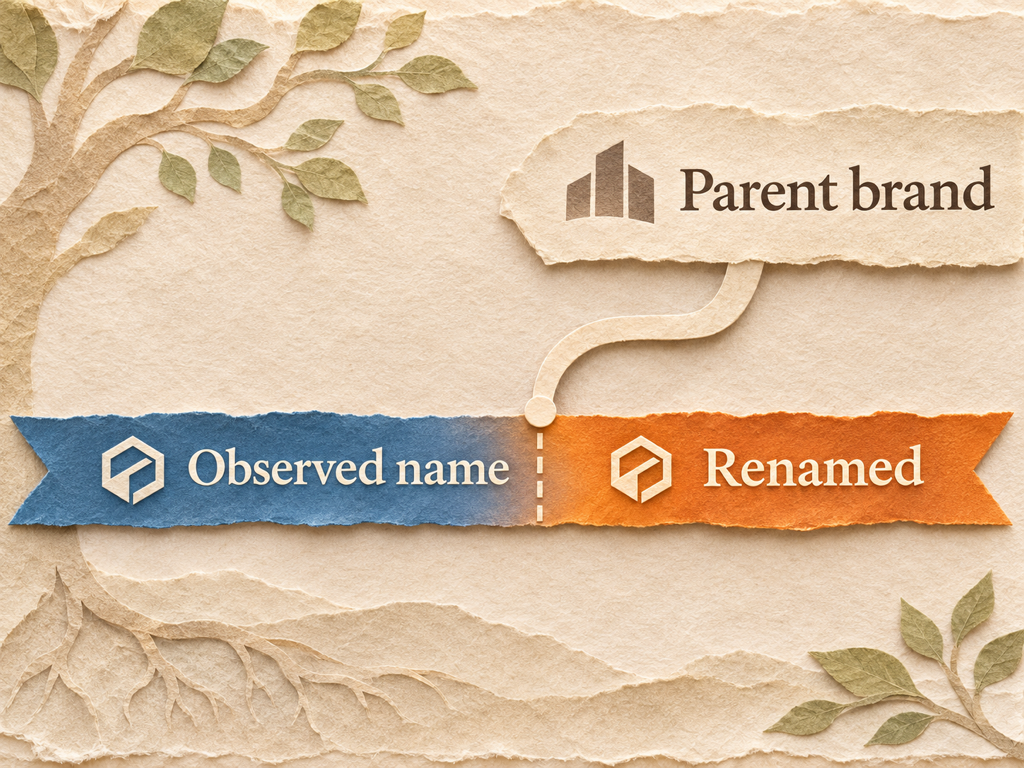
Identity rules can change while the original answer remains the same. A company may rename a product, acquire a brand, or move a product under a different business unit. The report needs a dated relationship rather than a global search-and-replace operation.
Retain the name exactly as observed and store the resolved entity separately. A current corporate rollup can group historical brands for a present-day business question, while an original-period view preserves how they were classified at the time. Label those views so they aren’t mistaken for identical measurements.
An acquisition doesn’t automatically make every earlier mention an appearance of the acquiring brand. Decide whether the report concerns historical market presence, today’s portfolio, or explicit brand language in an answer. Different questions can produce different legitimate aggregations.
The broader brand manager’s playbook provides context for interpreting brand representation. An identity register supplies the narrower control that makes those interpretations traceable when names and ownership relationships evolve.
Sample excluded records as well as accepted matches. A review queue containing only supposed brand mentions can reveal false positives while hiding the references your process never selected. Include some unselected answers that a human considers relevant, then compare how the rules treated them.
Keep a separate confidence explanation rather than relying on an unexplained numeric threshold. A domain match and a vague category resemblance aren’t equivalent evidence. Reviewers should be able to identify which contextual clue settled the case and what would cause the decision to be reconsidered.
The rejected matches are part of the quality assessment too.
Pair Topify Monitoring With an Identity Review Queue
Topify can help locate the answers that need identity review. Its brand monitoring workflow describes supplying brand and product names, setting relevant prompts, and reviewing brand representations. Begin with the identities your reporting question covers, inspect the available answer context, and compare questionable references against your register. The resulting review decisions can tell the team whether a visibility change reflects real appearances or a change in classification.
Keep the register and the review queue as explicit team controls. The public workflow doesn’t establish that every account exposes a configurable entity resolver, accepts all proposed alias rules, or automatically preserves your classification history. Validate the supported settings before relying on them, and retain unresolved examples for manual assessment. Use monitoring output to find relevant observations; use documented evidence to decide what those observations mean for the specific brand, product, or portfolio you are measuring.
Conclusion
A defensible mention count begins with a defensible identity decision. Define the subject, preserve the observed wording, and attach the evidence used to resolve ambiguous names. Keep parent companies, products, and former names distinct until the reporting question justifies grouping them.
Start with a small set of questionable references from your next review. Create an alias register, label confirmed and unresolved cases, and measure the errors in your matching process before expanding it. Pair that register with Topify’s brand monitoring to investigate appearances in context. The next visibility report should explain which entity was counted, under which rule, and how much ambiguity remains, rather than presenting every familiar string as proof of brand presence.
FAQ
What is name resolution in AI brand intelligence?
It is the process of deciding which entity an observed name refers to. It connects wording to a defined company, brand, product, or other subject using contextual evidence.
Should product mentions count as company mentions?
Only when the reporting definition permits that rollup. Preserve product-level records so a broader corporate view doesn’t erase the distinction.
How should an ambiguous name be reported?
Keep it unresolved when the available evidence is insufficient. Show that uncertainty separately rather than silently counting it as either confirmed presence or absence.
Does organization markup guarantee correct AI identification?
No. It supplies useful public identity information, but it doesn’t control every system’s interpretation. Review actual answers and retain evidence for disputed matches.