

Most AI blog generators are solving the wrong problem.
They’re optimized to produce text that sounds human. Fluent sentences, natural transitions, decent structure. That’s fine if you’re writing for a human reader who clicks a link and scrolls through a page.
But that’s not how most people find information in 2026.
AI-powered search now captures nearly 15% of the global search market, and organic click-through rates on traditional SERPs drop by as much as 61% when AI Overviews are present. The real question isn’t “does this content read well?” It’s “will ChatGPT or Perplexity cite it?”
That gap is where most AI blog generators quietly fail you.
Most AI Blog Generators Miss the Part That Actually Matters
Here’s the procurement trap nobody talks about: readability and citeability are not the same thing.
AI engines don’t read your content for enjoyment. They scan for factual density, entity clarity, and structural markers that signal “this is safe to cite.” Research suggests that content cited by AI typically contains 32% more explicit concepts than uncited content, even when the uncited content is linguistically superior.
Most AI blog generators are built entirely around the first dimension. They produce fluent, well-organized drafts. What they don’t do is structure content for machine extraction, integrate Answer Engine Optimization (AEO) logic, or track whether the finished article ever gets cited by the AI platforms your audience actually uses.
The result: high content volume, low AI visibility.
That’s the blind spot this comparison is designed to surface.
The Tools in This Showdown
Five tools represent distinct approaches to the AI blog generation problem. Here’s where each one stands across the dimensions that actually matter in 2026:
| Tool | Writing Quality | Keyword Research | AEO/GEO Support | Agentic Execution | Entry Pricing |
|---|---|---|---|---|---|
| ChatGPT (Plus/Pro) | ★★★★★ | Passive (manual input) | None native | No | $20/mo |
| Jasper AI | ★★★★ | Passive | Basic SEO templates | Partial | $59/seat |
| Copy.ai | ★★★ | Passive | GTM workflows only | Workflow-level | $49/mo |
| Writesonic | ★★★★ | Semi-proactive | Built-in GEO Suite | Partial | $16/mo |
| Topify AI Agent | ★★★★ | Proactive discovery | Native AEO execution | Full agentic | $99/mo |
The columns matter as much as the ratings. Writing quality is table stakes. The real differentiators are in columns three, four, and five.
Writing Quality: Who Actually Produces Publishable Content?
Publishable content in 2026 has to satisfy two audiences at once: human readers and AI extraction algorithms. Most tools are strong on one, weak on the other.
ChatGPT remains the strongest raw writer in this group. It handles complex reasoning, iterative editing, and nuanced creative tasks better than anything else on the market. The problem is structural: every session starts cold, with no memory of previous brand guidelines, keyword strategies, or content gaps. It’s a brilliant freelancer who forgets everything between meetings.
Jasper has evolved from a writing tool into a brand governance platform. Its “Knowledge Assets” feature lets enterprise teams upload internal documents and style guides, ensuring outputs stay on-brand. The trade-off: without careful management, outputs become formulaic. Predictable structure isn’t the same as quality writing.
Copy.ai is strongest in short-form copy. For long-form AEO blog generation, it’s not the right tool.
Writesonic’s Article Writer 6.0 uses live Google data to generate 5,000-word articles pre-optimized for current SERP trends. The quality is solid for SEO-first content. Where it gets interesting is the GEO tracking layer, which we’ll cover in the next section.
Topify takes a different approach to writing quality. Content is modular by design, structured to be parsed by machines. This sometimes trades narrative flow for factual density. But that “encyclopedic” style is exactly what Perplexity and Gemini reward with citations. It’s writing optimized for extraction first, reading second.
Data from 2025 shows 67% of businesses report improved content quality when using AI-assisted workflows, assuming there’s a human fact-checking layer to catch hallucinations. That caveat applies to every tool in this list.
Keyword Research Integration: Does the Tool Know What to Write About?
This is where the gap between tools becomes significant.
The average traditional search query is 3.4 words. The average ChatGPT prompt is 60 words. That’s a 1,700% increase in query complexity, and it fundamentally changes what “keyword research” means.
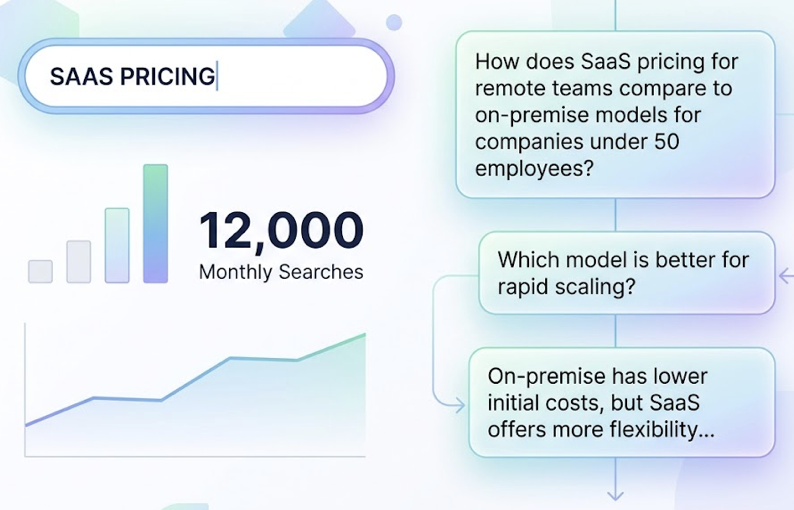
Traditional keyword tools tell you “SaaS pricing” gets 12,000 monthly searches. What they don’t tell you is that the AI conversations actually happening look more like: “How does SaaS pricing for remote teams compare to on-premise models for companies under 50 employees?” Those are the queries getting answered by ChatGPT and Perplexity. That’s where your brand either appears or doesn’t.
Passive tools (ChatGPT, Jasper) require you to bring the keyword. They write what you ask. No discovery, no gap analysis, no competitive intelligence.
Proactive tools identify what users are actually asking AI engines, find where competitors are being cited, and surface content opportunities before you think to ask. Only 11% of domains are cited by both ChatGPT and Perplexity, which means most keyword strategies are flying blind on at least one major platform.
Topify’s High-Value Prompt Discovery sits firmly in the proactive camp. It covers ChatGPT, Gemini, Perplexity, and other major AI platforms, continuously surfacing new opportunities as AI recommendation patterns evolve. You’re not guessing what to write about. You’re targeting queries with documented AI search demand.
AEO Is the New SEO: Which Generator Optimizes for AI Answers?
Traditional SEO targets rank positions. AEO targets extraction probability.
The technical distinction matters. Content must meet what researchers call “machine-justified” standards: structured to give AI the data it needs to prove an answer is correct. Based on analysis of 50,000+ queries, a few structural features consistently maximize citation probability:
- Direct answer format: Answering the query in the first 50-100 words of a section produces a 4x higher extraction rate
- Academic citation density: 3-5 external citations per 1,000 words boosts the “trustworthiness” classifier
- Statistic and quote addition: Original data or expert quotes at the start of sections can boost visibility by up to 40%
- Freshness signals: Visible “Last Updated” text and
dateModifiedschema increase citation frequency by 28%
Most AI blog generators produce none of this natively. They generate text. AEO structure requires an additional layer that most tools expect you to add manually.
Writesonic is one of the few general-purpose tools that has integrated a GEO Suite. It provides a dashboard to track brand mentions across ChatGPT, Gemini, and Perplexity, and applies some structural optimization to its outputs. It’s the most credible “transitional” tool for brands moving from traditional SEO to AEO.
Topify treats AEO as the foundation, not an add-on. Every content output is built on AEO intent from the start. Its Source Analysis feature goes further: it tracks which domains AI platforms are actively citing, identifies where your competitors dominate those citations, and maps the content gaps you need to fill. That’s an optimization loop most tools can’t close.
Beyond Writing: The Topify AI Agent Runs the Whole Content Operation
Here’s the fundamental problem with treating AI blog generators as writing tools.
Writing is maybe 20% of the content operation. The rest is research, strategy, publishing, distribution, internal linking, metadata, tracking, and iteration. Most AI blog generators hand you a draft and stop. Everything after that is still manual.
That’s the gap the Topify AI Agent was built to close.
The workflow looks like this: you set a goal in plain English, say “capture 20% share of voice in SaaS project management.” The agent identifies high-value prompts and competitor citation sources, generates AEO-optimized content, handles technical elements (alt text, metadata, internal links), and publishes directly to Shopify, WordPress, or Webflow. Then it monitors CVR and AI citation rates to feed insights back into the next cycle.
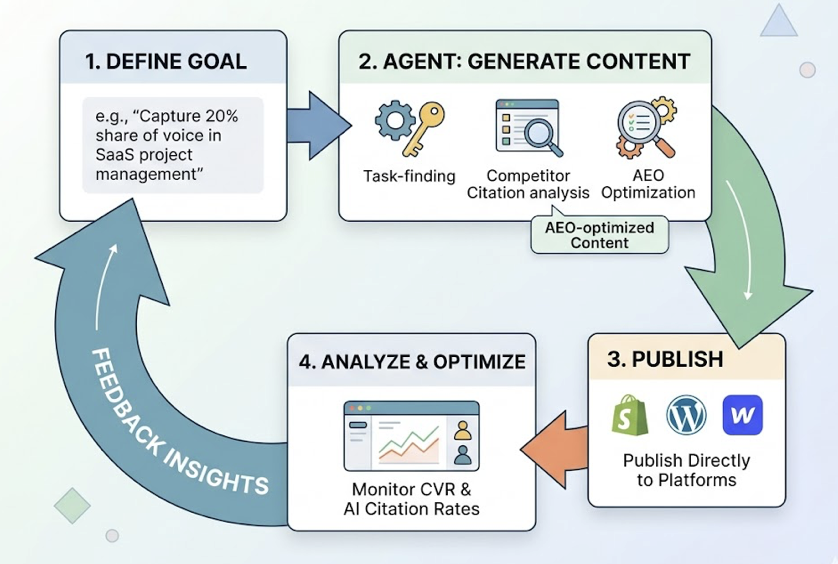
That’s the difference between a writing tool and an execution layer.
Data from 2025 implementations shows teams switching to agentic workflows see an 80-90% drop in research time and a 5x increase in conversion value per session compared to traditional organic traffic. The economics shift from “more content, more time” to “strategic content, automated execution.”
Topify’s pricing reflects three distinct use cases:
| Plan | Monthly Price | Content Output | Automation Level |
|---|---|---|---|
| Basic | $99/mo | Up to 100 products, 50 content generations | Basic SEO syncing |
| Pro | $199/mo | 250 prompts, 100 content generations | 10 Automatic Campaigns |
| Enterprise | From $499/mo | Custom volume | Full Agentic Ops |
It’s built for SaaS brands, marketing agencies, and high-growth content teams that need to scale output without scaling headcount.
Which AI Blog Generator Should You Actually Use?
The honest answer depends on where you are in the content maturity curve.
If you need fast, high-quality drafts to edit yourself: ChatGPT Plus or Claude. Best raw reasoning, lowest cost ($20/mo), requires manual execution of everything else.
If you manage a large marketing team with strict brand guidelines: Jasper. The governance layer and brand voice controls justify the per-seat cost for mid-to-large enterprises.
If you’re transitioning from SEO to GEO and still care about Google rankings: Writesonic. The GEO visibility tracking is genuinely useful for brands in the middle of that shift.
If you’re building an AI-first content operation: Topify. It’s not a blog generator with extra features. It’s an AEO execution layer with a content operation built in. The distinction is significant.
The market is bifurcating between general-purpose assistants and specialized agentic platforms. Most teams will eventually need both: something like ChatGPT for creative and strategic thinking, and something like Topify for execution and AI visibility at scale.
Conclusion
The transition from search to synthesis isn’t gradual. Citation authority and share of AI voice are becoming the primary KPIs for content teams in 2026, while traditional click-through rates decline on nearly every major platform.
The showdown question was “which AI blog generator writes the best content?” The more useful question is “which tool ensures your content gets used by the AI engines that now mediate most information discovery?”
Writing quality matters. But writing quality without AEO structure, without proactive keyword discovery, and without an execution layer to track what’s actually being cited, it produces content that reads well and ranks nowhere.
That’s the gap most content teams are still sitting in.
FAQ
What is an AI blog generator?
An AI blog generator is a software tool that uses large language models to produce written content, typically blog articles, based on keyword input or topic prompts. They range from general-purpose assistants like ChatGPT to specialized platforms like Topify that combine writing with AEO optimization and autonomous publishing.
How does AEO differ from SEO for blog content?
SEO optimizes content for Google’s ranking algorithm, focusing on keyword density, backlinks, and page speed. AEO (Answer Engine Optimization) optimizes content for extraction by AI engines like ChatGPT and Perplexity, focusing on direct answer format, factual density, schema markup, and citation structure. In practice, AEO content tends to be more modular and data-dense than traditional SEO content.
Can an AI blog generator help with keyword research?
It depends on the tool. Passive tools like Jasper and standard ChatGPT require you to provide keywords; they don’t discover them. Proactive tools like Topify perform autonomous High-Value Prompt Discovery, identifying what users are actually asking AI engines and surfacing content opportunities before you think to search for them.
What makes Topify different from other AI blog generators?
Topify operates as an AEO execution layer rather than a writing tool. It combines High-Value Prompt Discovery, AEO-optimized content generation, one-click publishing, competitor benchmarking, and CVR tracking in a single agentic workflow. Most AI blog generators stop at the draft. Topify manages the full content operation.
How does the Topify AI Agent work for content creation?
You define a goal in plain English. The agent identifies high-value AI search prompts, generates AEO-structured content, handles technical optimization (metadata, alt text, internal links), publishes to your CMS, and monitors citation rates and conversion performance. The system continuously refines the strategy based on what’s actually getting cited.

