


AI agents are no longer a research project. They’re handling the workload of entire teams, reshaping how consumers discover brands, and quietly making purchasing decisions on behalf of millions of users.
Here are 20 stats that show exactly where the shift is happening, and what it means for how your brand gets found.
AI Agents Are Already Making Decisions, Not Just Answering Questions
Before the numbers, a quick distinction worth making: AI agents aren’t chatbots with a better interface. Traditional chatbots match patterns and return responses. Agentic AI reasons through goals, builds multi-step plans, and executes tasks using real tools, including CRMs, databases, and payment systems, often without a human in the loop.
That architecture difference changes everything.
Stat 1: Some enterprises are already running AI agents that handle work previously requiring 3 full-time employees, executing complex workflows end-to-end.
Stat 2: AI agents’ task complexity doubles approximately every 213 days. This isn’t linear improvement. It’s compounding capability.
Stat 3: During Cyber Monday 2025, AI agents influenced roughly 20% of global orders, contributing over $67 billion in sales. That’s not AI assisting shoppers. That’s AI acting as the shopper.
These three numbers establish the baseline: agentic AI has moved from prototype to production.
The Market Is Moving Fast: AI Agent Adoption Stats
The investment data confirms what the enterprise deployments already suggest. This market isn’t building slowly.
Stat 4: The core AI agent market is projected to grow from $7.84 billion in 2025 to $52.62 billion by 2030, a CAGR of 46.3%.
Stat 5: When you expand to the full agentic AI ecosystem, including infrastructure, tooling, and adjacent services, the numbers are even more striking. Gartner projects growth from $15.04 billion (2024) to $752.73 billion by 2029, a 118.73% CAGR.
That 50x expansion in five years is not a forecast built on optimism. It’s built on enterprise adoption curves that are already visible.
Stat 6: North America currently holds 39.63% of the global AI agent market share, with financial services, healthcare, and manufacturing leading deployment.
Stat 7: According to Microsoft’s February 2026 report, over 80% of Fortune 500 companies are now running active AI agents built on low-code/no-code platforms. This is no longer a pilot program statistic. It’s a baseline.
Stat 8: 92% of enterprises plan to increase AI budgets over the next three years. The spending isn’t slowing down. It’s accelerating.
What Agentic AI Is Actually Doing Inside Companies
Adoption rates only tell part of the story. The more useful question is: what are these agents actually doing, and what’s changing as a result?
Stat 9: In customer service, AI agents are projected to handle 80% of interactions by 2026, reducing operational costs by approximately 30% while cutting required human interventions by 65%.
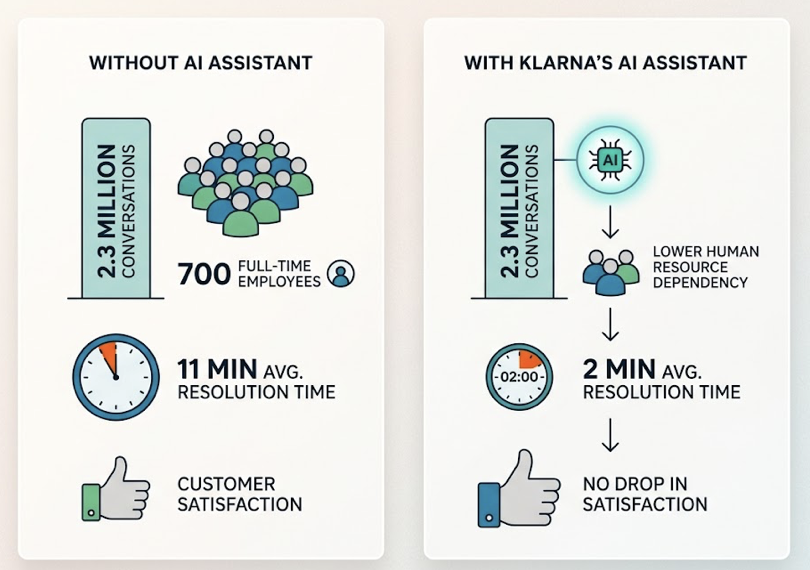
Klarna’s deployment puts a concrete face on that number. In its first month, the company’s AI assistant handled 2.3 million conversations, equivalent to the output of 700 full-time employees. Average resolution time dropped from 11 minutes to 2 minutes, with no measurable drop in customer satisfaction.
Stat 10: In software engineering, 75% of engineering teams have integrated AI agents, resulting in a 43% increase in code commits.
Stat 11: In IT and cybersecurity, adoption sits at 53%, with incident response times reduced by 30%.
Stat 12: In healthcare, AI agents are projected to save the industry $150 billion annually by 2026, primarily by handling administrative workload and reducing staffing gaps.
Stat 13: In manufacturing, AI-coordinated warehouse systems have improved delivery speed by 25% and overall efficiency by 25%.
The pattern across industries is consistent: agents aren’t replacing strategy. They’re absorbing execution.
How AI Agents Are Reshaping Search and Why AEO Matters Now
Here’s where the impact on brand visibility becomes direct.
AI agents don’t just do work inside companies. They’ve also become the primary interface through which millions of people find products, compare options, and make purchase decisions. That shift has broken the traditional search funnel.
Stat 14: 60% of Google searches now end without a single click. When AI Overviews are triggered, that number climbs to 83%.
This is what researchers are calling “the great decoupling”: search volume is still growing, but traffic to brand websites is falling. If your brand isn’t part of the AI-generated summary, you’re not part of the decision.
Stat 15: ChatGPT now has 800 million weekly active users, and accounts for 77% of AI-referred traffic across major platforms.
Stat 16: Google AI Overviews appear in 87% of queries. Gemini has 750 million monthly active users. Perplexity’s monthly active user base grew 89% in Q3 2025 alone.
These aren’t niche platforms anymore. They’re the front page of the internet for a large and growing share of users.
That’s why Answer Engine Optimization (AEO) has moved from a technical curiosity to a core marketing discipline. AEO is the practice of structuring content so AI systems select it as the authoritative answer and cite it as a source. If SEO was about ranking on page one, AEO is about being the answer that gets read aloud.
Stat 17: AI-referred traffic converts at 23x the rate of traditional organic search. The economic value per AI-referred user is 4.4x that of a standard organic visitor.
That’s not a marginal improvement. It’s a different category of traffic quality.
Brand Visibility in AI: Stats That Show the GEO Gap
The data on AI citations reveals a structural problem most marketing teams haven’t addressed yet.
Stat 18: Brand-owned websites account for only 5% to 10% of what AI systems actually cite. The other 90% comes from third-party publishers, Reddit, Wikipedia, and review platforms.
This means your website’s domain authority matters far less than your brand’s presence across the broader information ecosystem. The entities AI trusts are not necessarily the ones you control.
Stat 19: Web mentions (the volume and breadth of references to your brand across the open web) correlate with AI visibility at a coefficient of 0.664. Traditional backlink quality? Just 0.218.
That’s a meaningful gap. The inputs that drove SEO performance for two decades are significantly less predictive of AI visibility than raw brand mention coverage.
Stat 20: 89% of AI Overview citations come from pages ranked outside the traditional top 100 search results. Meanwhile, 26% of brands currently have zero mentions in AI-generated search responses.
That last number is the one that should drive urgency. More than one in four brands is effectively invisible to the AI systems that are now intermediating consumer decisions.
The brands that are investing in Generative Engine Optimization (GEO) are seeing compounding returns. Brands cited in Google AI Overviews report 35% more organic clicks and 91% more paid clicks compared to those that aren’t. IDC projects that by 2029, enterprise GEO investment will be 5x that of traditional search optimization.
What These AI Agent Stats Mean for Your Brand’s Discovery Strategy
The 20 stats above point to one conclusion: AI agents have become the primary discovery layer for a large and growing share of commercial decisions. If your brand doesn’t appear when AI systems synthesize answers, you’ve dropped off the shortlist before any human even starts evaluating.
That’s the gap most brands still can’t see. Because traditional analytics don’t capture it.
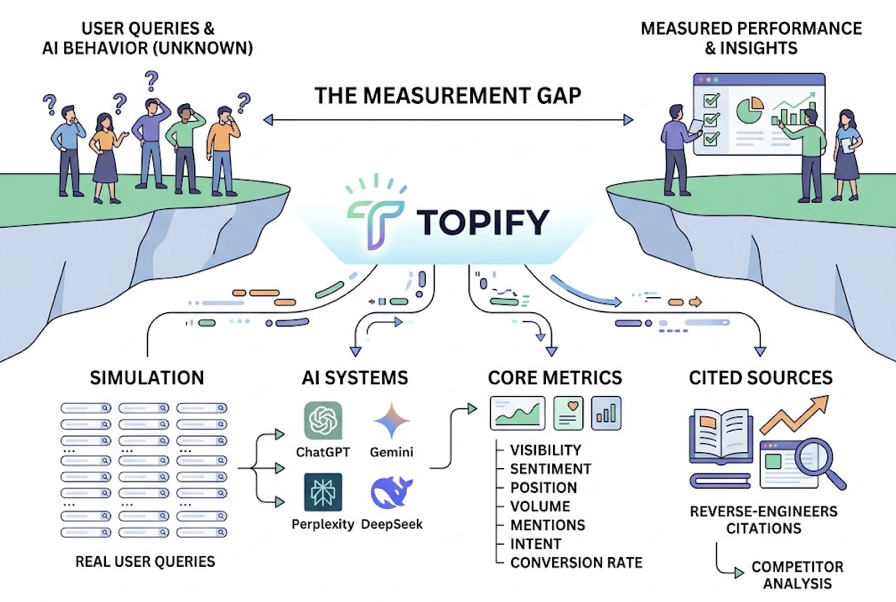
AI responses are non-deterministic. They vary by platform, by query phrasing, by user location, and by the moment in time they’re generated. Standard SEO tools can’t track what ChatGPT says about your brand compared to a competitor. They can’t tell you which high-intent queries you’re missing, or what sentiment Perplexity attaches to your product category.
Topify is built for exactly this measurement gap. The platform simulates thousands of real user queries across ChatGPT, Gemini, Perplexity, DeepSeek, and other major AI systems, tracking seven core metrics: visibility, sentiment, position, volume, mentions, intent, and conversion visibility rate. It also reverse-engineers which domains and URLs AI platforms are actually citing, so teams can identify where competitors are winning and why.
For brands that want to act on the data rather than just read it, Topify’s one-click execution layer lets teams deploy GEO strategies directly from the platform. No manual workflow, no separate toolchain. Some brands using the platform have achieved 196% growth in AI citations within three months.
The window for first-mover advantage in AI visibility is still open. But it won’t stay open indefinitely.
Conclusion
The 20 stats in this article tell a consistent story. AI agents are scaling faster than most organizations’ strategies have adapted. They’re handling enterprise workflows, reshaping how consumers discover products, and in some cases making purchase decisions with minimal human oversight.
The brands that will win in this environment aren’t necessarily the ones with the biggest marketing budgets. They’re the ones that understand where AI systems look for information, what they cite, and how to become part of that process.
Track it. Optimize it. Measure it.
FAQ
What is an AI agent in simple terms?
An AI agent is a software system that uses a large language model to set goals, build multi-step plans, and take real actions, like sending emails, querying databases, or completing purchases, without requiring human input at every step. Unlike a chatbot that answers questions, an AI agent completes tasks.
What’s the difference between an AI agent and Agentic AI?
An AI agent refers to a specific system executing a defined task. Agentic AI describes the broader architectural paradigm: the underlying capability set that includes autonomous reasoning, planning, and tool use. Agentic AI is what makes AI agents possible.
How do AI agents affect brand visibility?
AI agents synthesize answers from multiple sources rather than returning a ranked list of links. Brands that aren’t cited in those synthesized answers effectively disappear from the decision path. Visibility now depends on how well AI systems understand and trust a brand’s entity across the information ecosystem.
What is AEO and how is it different from GEO?
AEO (Answer Engine Optimization) focuses on structuring content to be extracted as a direct answer by AI systems, typically for simple, factual queries. GEO (Generative Engine Optimization) is broader: it covers optimizing a brand’s presence, authority, and sentiment across the full generative AI ecosystem, including complex conversations and deep research contexts. AEO is tactical; GEO is strategic.
What AI Agent stats are most important for marketers to know?
The most actionable stats are: 26% of brands have zero AI mentions; AI-referred traffic converts at 23x the rate of organic search; and brand-owned websites account for only 5-10% of AI citations. Together, they define both the size of the problem and the size of the opportunity.

