

You’ve probably seen the dashboards. Visibility scores. Mention trends. Charts that go up and to the right. But when your CMO asks why your brand lost ground to a competitor on a specific ChatGPT prompt, most AEO tools go quiet.
That’s the gap this review is about.
G2 reviews reveal something most vendor pages don’t: users aren’t frustrated by a lack of data. They’re frustrated by data that doesn’t tell them what to do next. We pulled the signal from G2 ratings, product documentation, and independent testing to answer one question — which AEO tool actually delivers actionable search insights, not just prettier charts?
Here’s what we found across five tools.
Most AEO Dashboards Tell You What Happened. Few Explain Why.
Zero-click behavior now accounts for over 60% of U.S. searches, up from just 26% in 2022. That shift alone would justify a new set of tools. But the bigger problem is that most of the tools built for this moment are still stuck in monitoring mode.
They track whether your brand appears in AI answers. They graph mention rates over time. What they rarely do is explain why a competitor outranked you on a given prompt, or what content change would shift that outcome.
G2 reviews consistently surface this complaint across categories. Users describe it as an “actionability gap” — plenty of visibility data, very little strategic direction. The tools that score highest on G2 aren’t necessarily the ones with the most metrics. They’re the ones that compress the distance between insight and action.
That distinction is what we used to evaluate the five tools below.
5 AEO Tools, Ranked by What Happens After the Report
Here’s a quick overview before we go deeper:
| Tool | G2 Score Range | Platform Coverage | Insight Depth | Actionability | Starting Price |
|---|---|---|---|---|---|
| Topify | 4.8 – 4.9 | Very broad (incl. DeepSeek, Doubao) | 7-metric framework, dark query detection | One-click agent execution | $99/mo |
| Profound | 4.5 – 4.7 | Broad (10+ engines) | Query fanout analysis, 1.3B conversation data | Strong on analysis, lighter on execution | $499/mo |
| Quattr | 4.9 | Core AEO engines | Predictive scoring, GA4/GSC integration | GIGA agent for auto-optimization | Custom |
| ZipTie.dev | 4.6 – 4.8 | Core 3–5 engines | AI Success Score, screenshot evidence | Action recommendations in beta | $69/mo |
| Writesonic (GEO) | 4.5 – 4.7 | Broad (incl. open-source models) | Content generation-focused | Deep CMS integration | $249/mo |
Topify: Where AEO Insight Meets Execution
Topify is built by a team of former OpenAI researchers and Google SEO practitioners. That origin matters because the hardest problem in AEO isn’t tracking — it’s interpretation. Large language models are probabilistic and fast-changing. Most tools sample outputs and call it coverage. Topify claims 95–98% citation accuracy, which puts it in a different technical tier.
The platform covers ChatGPT, Gemini, Perplexity, and Claude, plus regional and emerging models including DeepSeek and Doubao. For brands with global audiences, that breadth isn’t a nice-to-have.
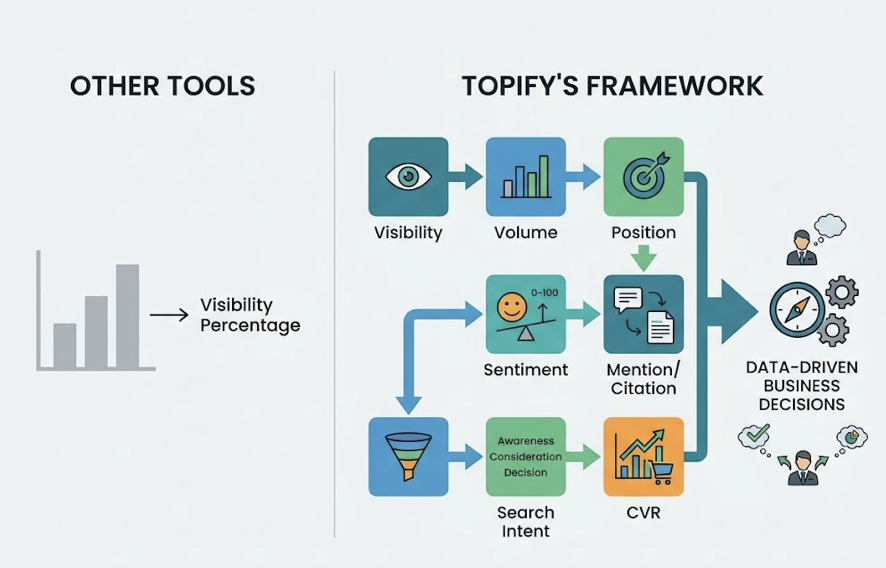
What makes Topify’s AEO insight genuinely different is its seven-metric framework. Most tools give you visibility percentage. Topify tracks visibility, volume, position, sentiment (scored 0–100), mention versus citation distinction, search intent by funnel stage, and CVR — the estimated rate at which AI-referred traffic converts. Each metric maps to a business decision, not just a data point.
The source analysis feature is where it gets specific. When your brand isn’t appearing in an AI answer, Topify reverse-engineers which domains and URLs the model is currently citing instead. That tells you exactly where the content gap is and which third-party channels are influencing the AI’s recommendations.
Then there’s the execution layer. Once the insight is clear, Topify’s one-click agent can generate content and deploy it across relevant channels. What traditionally takes a team several weeks collapses to roughly 72 hours. For mid-size marketing teams that don’t have the bandwidth to act on every insight manually, that’s a material difference.
Starting at $99/month for the Basic plan, Topify covers 100 prompts, 9,000 AI answer analyses, and four projects. For teams scaling up, the Pro plan at $199/month extends to 250 prompts and 10 seats.
Explore Topify’s AI Search Optimization platform →
Profound: Enterprise-Grade Depth for Complex Buyers
Profound serves a different buyer. Its customer base includes roughly 10% of the Fortune 500, and its infrastructure is built accordingly — SOC 2 Type II and HIPAA compliant, which matters for regulated industries like financial services and healthcare.
The standout capability is query fanout analysis. When a user enters an initial prompt, AI systems don’t just answer that one question — they spin out a series of related sub-queries internally. Profound maps that logic chain, which helps enterprise teams understand how complex B2B purchase decisions move through AI reasoning. That’s a level of depth most other tools don’t attempt.
The trade-off is complexity. G2 reviewers note that smaller marketing teams can find Profound’s data volume difficult to navigate without dedicated analysts. It’s built for research-heavy organizations. On the execution side, it leans toward detailed reporting rather than automated deployment. Starting at $499/month, it’s also priced for enterprise budgets.
Quattr: The Unified Command Center for SEO + AEO
Quattr’s positioning is distinct: it doesn’t ask you to choose between traditional SEO and AI search visibility. It manages both in one platform, pulling in Google Search Console and GA4 data alongside AI engine monitoring.
The predictive scoring model is a real differentiator. Quattr estimates how a piece of content will perform in ChatGPT and Google AI Overviews before it’s published. That shifts the workflow from reactive to proactive. Its GIGA AI agent handles internal link architecture automatically, keeping the site structured in ways that help AI crawlers extract information efficiently.
Quattr earned top G2 marks in three categories in the Spring 2025 report: results metrics, ease of use, and relationship metrics. It’s a strong fit for mid-to-large teams that are already invested in SEO infrastructure and want to extend those signals into AEO without starting from scratch. Pricing is custom, which suggests it targets buyers who’ve already committed to significant search investment.
ZipTie.dev: Screenshot Evidence and Verifiable Proof
ZipTie.dev occupies a specific niche: verifiable, visual evidence of AI search performance. Rather than relying on API sampling, it uses real browser rendering to capture Google AI Overviews and related AI answers. That approach produces screenshots — actual proof that a brand appeared, or didn’t.
For agencies managing multiple clients, that’s valuable. Showing a client a dashboard number is one thing. Showing them a timestamped screenshot of their brand appearing in an AI Overview is another conversation.
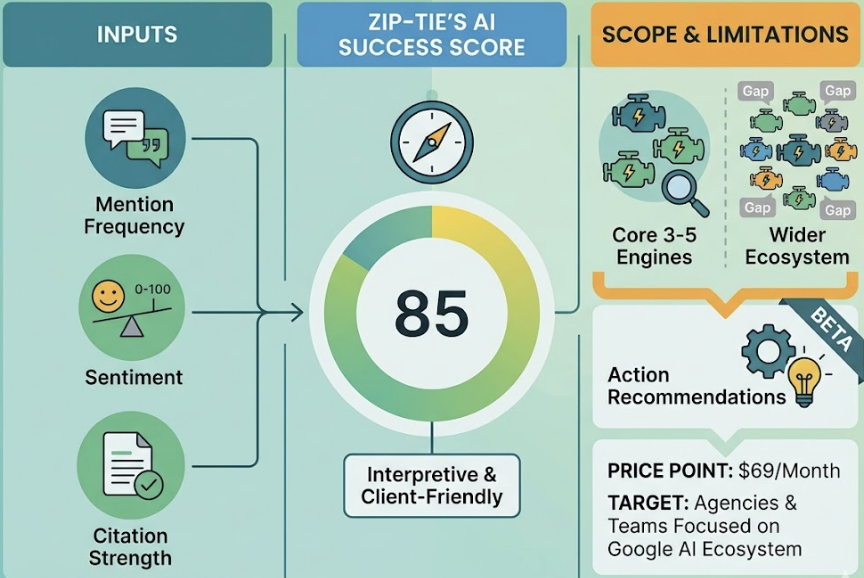
ZipTie’s AI Success Score combines mention frequency, sentiment, and citation strength into one composite number. It’s interpretable and client-friendly. The limitation is coverage: it focuses on the core three to five engines, so brands tracking performance across a wider AI ecosystem will hit gaps. Action recommendations are still listed as beta functionality. At $69/month, it’s an accessible entry point for agencies and teams focused primarily on Google’s AI ecosystem.
Writesonic (GEO): When Content Output Is the Priority
Writesonic approaches AEO from the content production side. Its GEO module is trained on a dataset of 120 million real AI conversations, giving it strong signal for discovering “dark queries” — prompts that appear frequently in AI research sessions but don’t register in traditional keyword tools.
The platform’s strength is the integration between discovery and execution. If you identify a content gap, Writesonic can help you fill it immediately, with publishing workflows that connect directly to most CMS platforms. Where it’s thinner is in the competitive intelligence layer. It doesn’t match the depth of Topify or Profound on tracking why a competitor is winning a specific prompt. At $249/month for the GEO tier, it’s best suited for content-heavy teams whose primary bottleneck is production speed rather than strategic analysis.
The Gap Most AEO Tools Won’t Admit
Here’s the real issue G2 reviews keep surfacing: most AEO tools are better at monitoring than explaining.
Seeing that your brand’s visibility dropped 12% is data. Understanding that the drop correlates with three new competitor pages getting cited on a specific Quora thread, and knowing which content update would reverse it, is insight.
The most telling G2 negative reviews don’t complain about missing features. They describe a specific frustration: “I can see what’s happening but I don’t know what to change.” That’s the actionability gap. And it’s where most platforms, even highly rated ones, still fall short.
The tools narrowing this gap share a few traits. They track citation sources, not just mention counts. They connect AI engine behavior to specific third-party content signals. And they give teams a path from insight to action without requiring a full analyst workflow in between.
According to independent research, early adopters of deep AEO search insights generated 3.4 times more traffic growth than competitors still relying on traditional monitoring. Separately, GA4 integrations that tie AI citation clicks to downstream conversions are showing conversion rates roughly 27% higher than standard organic traffic. Those numbers reframe the cost of a quality AEO tool. It’s not an expense — it’s the measurement instrument for a channel that’s already driving revenue.
Conclusion
The five tools reviewed here are all credible. The right choice depends less on features and more on what your team actually needs next.
If your bottleneck is the gap between insight and execution, Topify is currently the platform that closes it most completely. The seven-metric framework gives you a structured view of AI search performance, and the one-click agent turns that view into deployed content without the usual multi-week workflow. For teams that can’t afford the lag between identifying a problem and fixing it, that speed matters.
If you’re in a regulated industry and need enterprise-grade LLM analysis with full compliance infrastructure, Profound’s query fanout depth and SOC 2 certification are worth the higher entry price.
If you’re managing both traditional SEO and AEO budgets from a single team, Quattr’s unified platform reduces the operational overhead of running two separate workflows.
If you need visual proof for client reporting with a focus on Google’s AI ecosystem, ZipTie.dev’s screenshot evidence and AI Success Score are well-suited to that workflow.
If content production is your primary bottleneck and you need fast dark query discovery with CMS integration, Writesonic’s GEO module is built for that use case.
Bottom line: AEO tools that only tell you what’s happening are losing their value fast. The question to ask any platform isn’t “what do you track?” It’s “what do I do next?”
FAQ
What is AEO insight and why does it matter for AI search?
AEO insight refers to the analysis layer that explains why your brand appears (or doesn’t appear) in AI-generated answers, not just whether it does. As AI platforms like ChatGPT, Gemini, and Perplexity increasingly serve as the first point of information retrieval for users, brands need to understand which content signals influence AI recommendations. An insight-capable tool goes beyond mention tracking to show citation sources, competitive positioning, and specific content gaps.
How reliable are G2 reviews for evaluating AEO tools?
G2 reviews are a useful signal, especially for identifying patterns that vendor marketing doesn’t surface — like the actionability gap described in this article. That said, individual reviews vary in technical depth. The most valuable G2 data tends to come from verified users in specific roles (marketing managers, SEO leads) who describe workflow-level friction rather than general impressions. Cross-referencing G2 scores with feature documentation and independent testing gives a more complete picture.
Can AEO tools replace traditional SEO analytics?
Not yet, and probably not completely. Traditional SEO analytics (GSC, GA4, rank tracking) still capture a large share of search behavior. AEO tools are most valuable as an additional layer, tracking the portion of user intent that’s now being resolved inside AI answers without a click. Platforms like Quattr that integrate both data streams are building toward a more unified view, but the two remain complementary rather than interchangeable for most teams.

