

You open your SEO dashboard on Monday. Traffic looks fine. Then you ask ChatGPT the same question your customers ask, and your brand isn’t in the answer. Your competitor is.
That gap is what AEO tools are built to close. Picking the right one is harder than it should be, because most comparison lists rank on the wrong things.
Most AEO Tool Comparisons Rank on the Wrong Metrics
If a tool tracks ChatGPT, Gemini, and Perplexity, the average comparison list calls it complete. That’s where the problem starts.
Real differentiation lives in three places: the quality of the prompt set being tracked, the depth of source attribution behind each cited answer, and how fast the tool moves from observation to action.
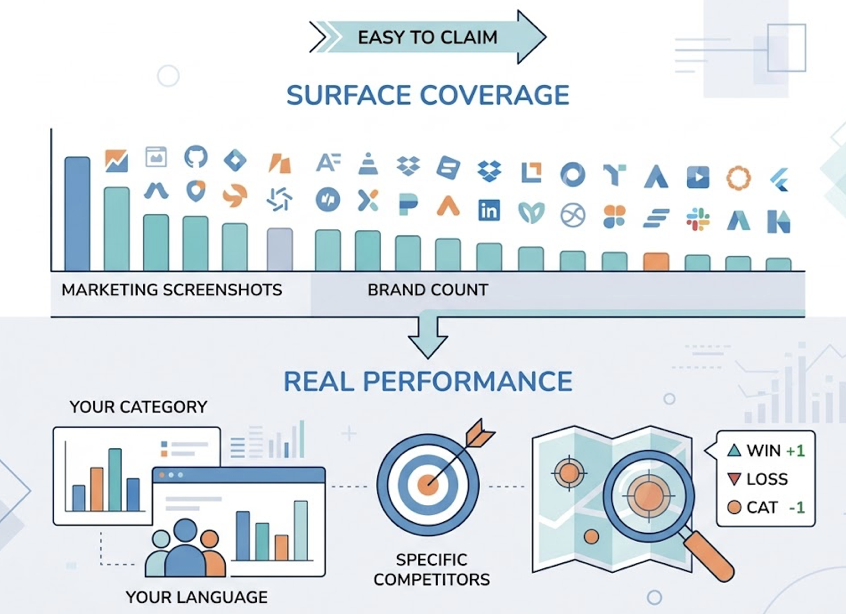
Surface coverage is easy. The number of brands that show up in a vendor’s marketing screenshots tells you almost nothing about how the tool performs in your category, in your language, against your specific competitors.
Here’s what actually matters in 2026.
When AI Overviews appear in a Google result, organic CTR drops from 1.76% to 0.61%, a 61% decline. Paid CTR drops harder, falling 68%. In Google’s AI Mode, the zero-click rate hits 93%. ChatGPT search runs at 98.7%.
So traffic isn’t disappearing. It’s getting absorbed into answers. And the brands cited inside those answers see organic CTR 35% higher and paid CTR 91% higher than uncited brands.
The job of an AEO tool is to tell you, in detail, which of those answers your brand shows up in, and why.
AEO Tools at a Glance: Coverage, Pricing, Core Tracking
Six platforms dominate the AEO conversation right now. Each solves a different shape of the problem.
| Tool | AI Platforms Covered | Starting Price | Core Strength | Best Fit |
|---|---|---|---|---|
| Topify | ChatGPT, Gemini, Perplexity, DeepSeek, Doubao, Qwen + others | $99/mo | Multi-language coverage, source analysis, agency-ready | Agencies, cross-border brands, SaaS |
| Conductor | Major LLMs + traditional search | Custom | Unified SEO + AEO record-of-truth | Enterprise teams |
| Profound | 10+ engines including Grok, DeepSeek | $99–399/mo | Compliance certifications, query fanout | Healthcare, finance, legal |
| AthenaHQ | 8+ engines | $295/mo + credits | Unlimited seats, Action Center | High-volume execution teams |
| Vismore | Major LLMs | Custom | 72-hour insight-to-publish loop | Teams running many sites |
| Omnia | ChatGPT, Perplexity, Google AI | Mid-market | Plain-English action plans | SMBs without analysts |
Pricing tells half the story. The bigger split is execution philosophy: some tools stop at the dashboard, others push you toward an action.
Topify: Full-Spectrum AEO Tracking Across Major AI Platforms
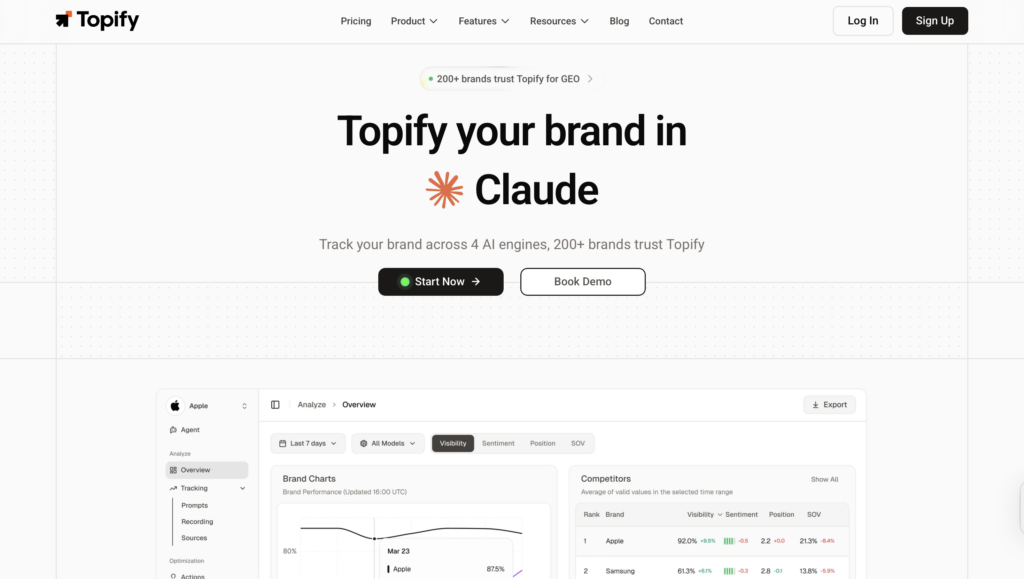
Topify sits in a peculiar position. Its pricing starts at agency-friendly levels, but its tracking depth is closer to what enterprise platforms charge $500+ a month for.
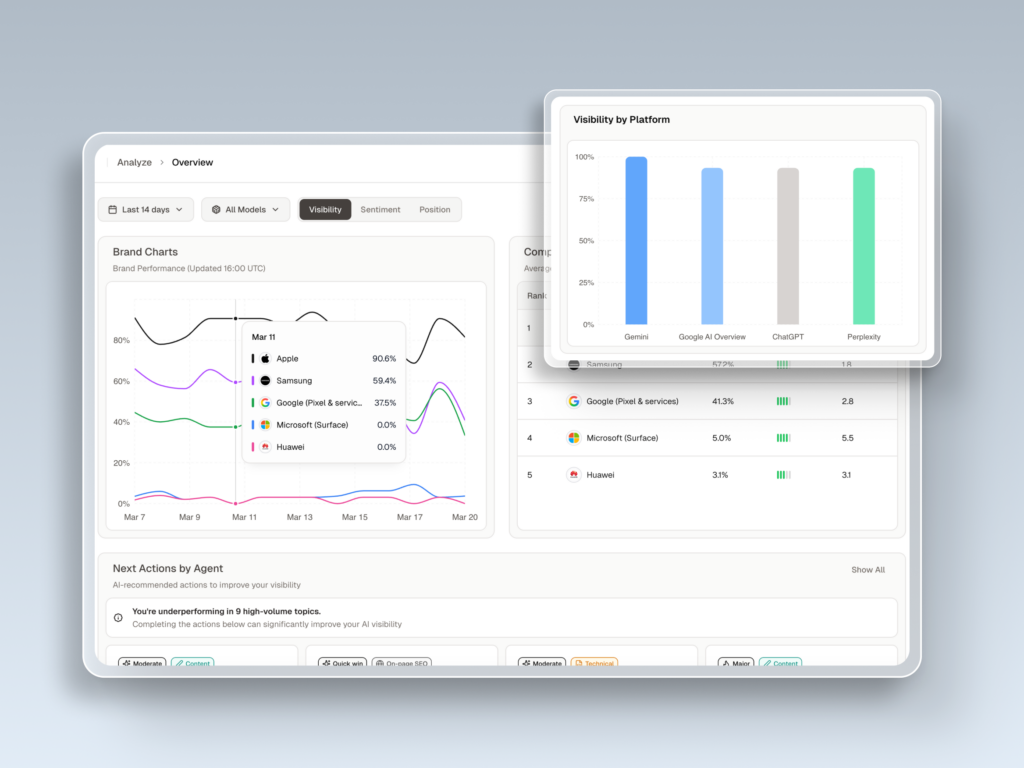
The thing that stands out is coverage breadth. Topify monitors ChatGPT, Gemini, Perplexity, DeepSeek, Doubao, and Qwen. That list matters more than it looks. If your brand operates in any market where Mandarin or cross-border discovery is part of the funnel, Doubao and Qwen aren’t a nice-to-have. Most competing tools in this comparison don’t track them at all.
Three capabilities define how Topify is actually used.
Visibility tracking across seven metrics. Topify scores brand presence on visibility, volume, position, sentiment, mentions, intent, and conversion visibility rate (CVR). The CVR metric is unusual. It estimates how likely an AI mention is to translate into downstream interaction, rather than treating every mention as equal. A neutral fact-mention and a positive recommendation get weighted differently.
Source analysis. When AI engines cite something, Topify reverse-engineers the URL behind the citation. Was it a Reddit thread? A G2 review? A trade publication? Industry research suggests citations from third-party domains carry roughly 6.5x the weight of self-published content. Knowing where AI is pulling from is where the optimization budget should go.
Competitor monitoring. Topify auto-detects which brands AI engines surface alongside yours and tracks their position, sentiment, and citation share over time.
That’s the dashboard side. The piece that matters for time-strapped teams is execution. Topify’s One-Click Execution lets you state a goal in plain English, review a proposed strategy, and deploy without a manual workflow.
Pricing runs $99/mo for the Basic tier (100 prompts, 4 projects, 4 seats), $199/mo for Pro (250 prompts, 8 projects, 10 seats), and $499/mo+ for Enterprise with a dedicated account manager.
For agencies, the multi-project architecture is what closes the deal. You’re not rebuilding a prompt set every time a new client signs.
What Topify Tracks That Most Tools Don’t
Two things, really.
The Mandarin-language AI ecosystem (Doubao, Qwen, DeepSeek) is invisible to most Western AEO tools. If your brand has any APAC exposure, that gap is where you’re losing visibility you didn’t know you had.
And the closed loop between visibility data and content execution. Most AEO tools tell you what’s happening. Topify generates the strategy and pushes it live.
Other AEO Tools Worth Knowing
Each of the following solves a specific shape of the problem. None replaces another cleanly.
Conductor is built for enterprises that need a single source-of-truth across SEO and AEO. Its AgentStack lets teams pull search intelligence directly inside ChatGPT, Claude, and Copilot. The Content Agent claims an insight-to-publish window of under two minutes. The trade-off is custom enterprise pricing, which puts it out of reach for smaller teams.
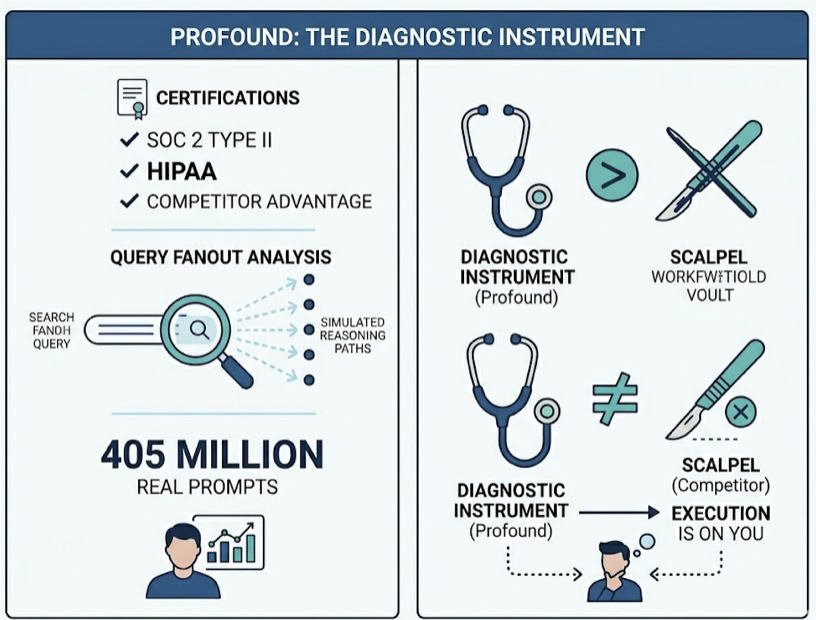
Profound is the tool of choice for regulated industries. It carries SOC 2 Type II and HIPAA certifications, which most competitors don’t have. Its Query Fanout Analysis simulates the reasoning path AI engines take before generating an answer, going deeper than surface citation counts. The platform analyzed over 405 million real prompts to build its baseline. The limitation: Profound is a diagnostic instrument, not a scalpel. It tells you what’s wrong; execution is on you.
AthenaHQ sells on unlimited scale: unlimited seats, unlimited response analyses, no cap on data history. Its Action Center converts visibility data into specific instructions, namely which pages to update, which keywords to build pillars around, and which third-party sites to pursue for citations. Pricing runs $295/mo plus credit-based usage.
Vismore is built for teams managing dozens or hundreds of sites. The grid-style UI handles bulk visibility tracking, and its 72-hour insight-to-publish loop pushes content directly to Reddit, Medium, or LinkedIn. Those are the surfaces where industry data shows AI citations are 6.5x more likely to land than on owned domains.
Omnia simplifies. It tracks ChatGPT, Perplexity, and Google AI features, then turns the data into an impact-ranked action plan. Users report AI engine traffic gains of 30 to 45% within weeks of implementing its recommendations. For SMBs without a dedicated analyst, that simplicity is the feature.
How to Pick the Right AEO Tool for Your Stack
The honest answer: it depends on where you’re losing visibility, not which tool has the most features.
If you’re a single brand operating mostly in English, Omnia or AthenaHQ will give you a fast read on the gap. Both are designed to surface action items without requiring deep AEO fluency.
If you’re an agency managing multiple clients, Topify‘s multi-project architecture and source-attribution depth are hard to beat at the price. The 30-day trial covers ChatGPT, Perplexity, and AI Overviews tracking, which is enough to validate the workflow before committing.
If you’re a cross-border brand, or your audience touches Mandarin-speaking markets, Topify is the only platform in this comparison that natively tracks Doubao, Qwen, and DeepSeek alongside Western AI engines.
If you operate in healthcare, finance, or legal, Profound’s compliance posture isn’t optional. Its query fanout analysis is also genuinely the deepest semantic diagnostic on this list.
If you’re an enterprise marketing team that needs to merge SEO and AEO into a unified record, Conductor is built for that workflow.
A common mistake: picking the tool with the most features. Most teams use 20% of the dashboard and pay for the other 80%. Start with the prompt set that matches how your customers actually search, then pick the tool that tracks that set with the most depth.
Conclusion
AEO tools don’t differ much in whether they can track AI answers. They differ in what they track, how deeply, and what they let you do next.
Coverage breadth matters. Source attribution matters more. Execution speed is what closes the loop.
If you’re picking one tool to start with, Topify gives you a low-risk place to begin: multi-language coverage, source analysis depth, and agency-friendly pricing in one platform. Tools like Conductor and Profound are worth adding once your AEO operation matures into a category-specific or compliance-driven need.
The brands that win in 2026 won’t be the ones running the most prompts. They’ll be the ones acting on what those prompts reveal.
FAQ
What is an AEO tool, and how does it differ from SEO software?
An AEO tool tracks how AI engines like ChatGPT, Perplexity, and Gemini mention your brand in their generated answers. SEO software tracks rankings on traditional search results. The two are related but measure different things. AEO is about citation share inside AI responses, not link position on a results page.
Which AI platforms should an AEO tool track?
At minimum: ChatGPT, Gemini, and Perplexity. If your audience touches Mandarin-speaking markets or cross-border ecommerce, add DeepSeek, Doubao, and Qwen. The brands losing visibility silently are usually losing it on engines no one is measuring.
How accurate is AI answer visibility tracking?
It depends on the methodology. API-based tools pull data directly from LLM endpoints, which produces more stable results than scraping-based tools. Even so, AI answers are probabilistic. The same prompt can return different citations across requests. Reputable AEO tools run multiple samples and average the results.
Can AEO tools track competitor mentions in ChatGPT?
Yes. Tools like Topify auto-detect competitor brands in tracked prompts and show their visibility, sentiment, and position over time. The depth varies. Some tools show which competitors appear, others explain why.
What does an AEO platform typically cost in 2026?
Entry-level plans for individual brands start around $99/mo. Mid-market platforms run $200 to $500/mo. Enterprise platforms with custom integrations and dedicated support typically start at $499/mo and go up from there. Per-prompt pricing is common at the higher tiers.

