

A practical playbook for getting cited in ChatGPT, Perplexity, and Google AI Overviews before your buyers ever build a vendor shortlist.
By the time a B2B buyer joins a discovery call, the shortlist is usually already written. Your sales team sees it weekly: prospects walk in with two or three vendor names, ballpark pricing, and questions that imply they’ve read someone’s case studies in detail. Almost none of that came from your website. Most of it came from ChatGPT, Perplexity, or Google’s AI Overviews, where roughly 80% of B2B winners are now decided before a single rep gets involved. If your brand isn’t showing up in those answers, you’re not losing the deal in the demo. You’re losing it in the research phase. That’s where AEO comes in.
B2B Buyers Now Start in ChatGPT, Not Google
The numbers shifted faster than most marketing teams adjusted. In early 2024, around 14% of B2B buyers were using LLMs during research. By 2025, that figure hit 94%, making AI assistants the default starting point rather than the novelty experiment.
The downstream effect is a compressed buying cycle and a later first sales touch. Average B2B sales cycles dropped from 11.3 months to 10.1 months in a single year. Buyers now contact a sales rep at 61% of journey completion, down from 69% historically, because they’ve already done most of the qualification work themselves.
That’s the gap most marketing teams haven’t priced in yet.
For B2B specifically, the shift cuts deeper than B2C. A typical strategic purchase now involves a buying committee of about 22 people, including 13 internal stakeholders and 9 external influencers, each with their own research patterns and evaluation criteria. Every one of those stakeholders is asking AI different questions. If your content surfaces for the marketer’s prompt but not the CFO’s, you’re partially visible at best.
AEO for B2B Isn’t Just SEO With a New Acronym
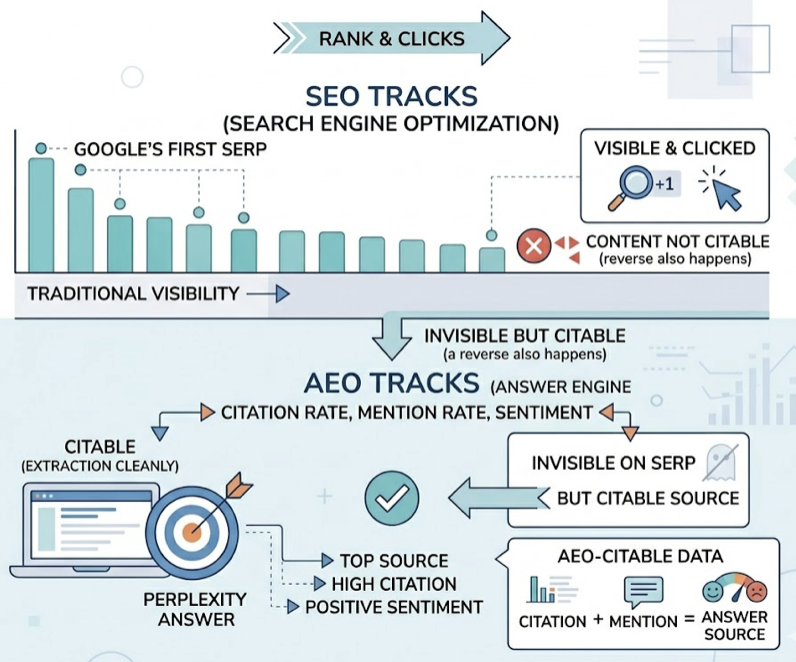
Answer Engine Optimization is the practice of getting your brand cited, quoted, and recommended inside AI-generated answers, not just ranked in a list of links. SEO optimizes for position. AEO optimizes for extraction.
The unit of measurement changes accordingly. SEO tracks rank and clicks. AEO tracks citation rate, mention rate, and sentiment. A page can be invisible on Google’s first SERP and still be one of the top sources powering Perplexity’s answer about your category. The reverse also happens: you can rank #1 for a head term and never get cited because your content doesn’t extract cleanly.
For B2B, three structural realities make AEO different from B2C.
First, decisions lean heavily on third-party authority. Buyers and the AI models they query both trust G2, Capterra, TrustRadius, analyst notes, and community discussion threads. Roughly 85% of citations in B2B-style AI research come from third-party platforms rather than the vendor’s own site.
Second, the prompt surface is enormous. A 22-person buying committee generates dozens of distinct prompt patterns: ROI questions from finance, integration questions from engineering, compliance questions from legal, workflow questions from end users. Each is a separate citation opportunity, and each requires content tuned to that role.
Third, the queries are technical and long-tail. B2B buyers ask AI things like “Does X support SAML SSO with Okta?” or “What’s the typical TCO for [category] at 500 seats?” These rarely match traditional keyword research outputs.
Where B2B Buyers Encounter AI Answers in the Wild
AI answers reach B2B buyers across four distinct surfaces, each with its own behavior and citation logic.
| Surface | Buyer behavior | What it cites most | Why it matters for B2B |
|---|---|---|---|
| ChatGPT / Claude / Gemini | Conversational research, vendor brainstorming | Owned websites (~23%), editorial (~16%), Wikipedia (~8%) | Default tool for early-stage discovery |
| Perplexity | Deep research with visible citations | Reddit (46.7% on comparative queries), reviews, owned sites | Preferred by technical and analytical buyers |
| Google AI Overviews | Intercepts traditional search intent | High-authority editorial, structured content | Captures buyers who still start on Google |
| Internal AI agents (Glean, Notion AI, etc.) | Inside-enterprise research and summarization | Whatever content the AI was trained or grounded on | Important for late-stage validation |
Different surfaces, different rules. A brand with strong G2 presence will dominate Perplexity comparison queries but may underperform on ChatGPT’s general “best of” prompts. Optimizing for one surface and assuming the others follow is the most common AEO miscalculation in B2B.
What AI Cites When It Recommends a B2B Vendor
Most B2B marketers underestimate how much of their AI visibility lives outside their own domain. The citation weight distribution makes the point bluntly.
| Source type | ChatGPT citation share | Perplexity citation share |
|---|---|---|
| Owned website | 23% | ~15% |
| Editorial / media | 16% | ~10% |
| Reddit / forums | 11% | 46.7% |
| Review sites (G2, etc.) | 11% | ~15% |
| Wikipedia | 7.8% | ~5% |
| YouTube transcripts | ~2% | 14% |
Two patterns stand out. First, Reddit’s weight in Perplexity for comparative queries dwarfs every other surface. If your category has an active subreddit, that’s where your evaluative AI presence is being decided. Second, review sites function as compounding citation engines: a 10% increase in G2 reviews correlates with roughly a 2% increase in AI citations across major platforms.
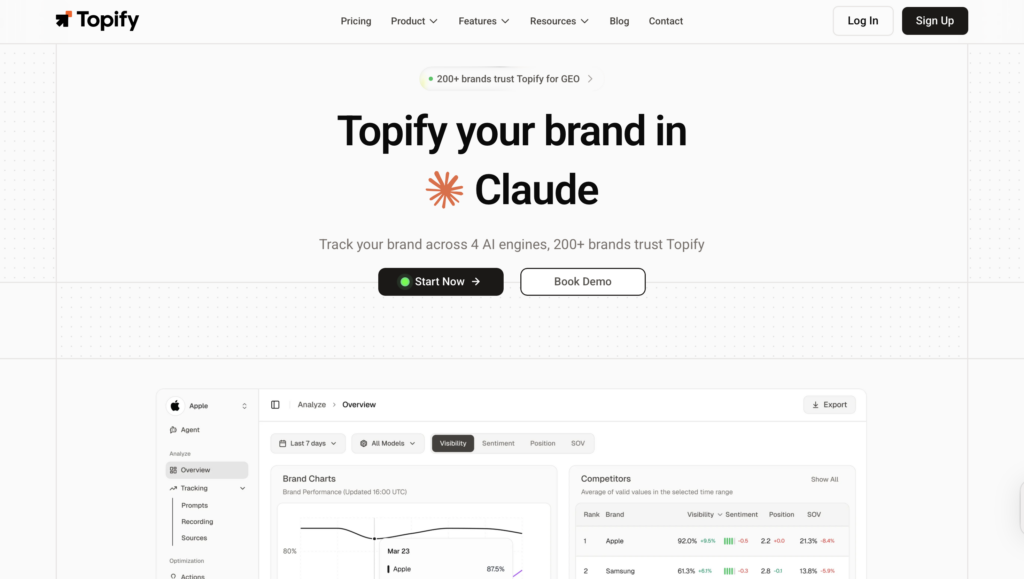
This is where source-level visibility becomes operational rather than abstract. Tools like Topify trace which exact domains and URLs AI engines pull from when they discuss your category, so you can see whether ChatGPT is grounding its answers in your blog or your competitor’s TrustRadius profile.
5 AEO Tactics That Move the Needle for B2B Brands
The tactics that work in 2026 look different from 2024’s GEO playbook. The five below are the ones with the clearest measurable effect on B2B citation share.
Tactic 1: Map the Prompts Your Buyers Actually Ask AI
LLMs don’t process buyer questions as single queries. They fan out a prompt like “best CRM for mid-market manufacturers” into sub-questions about pricing, integrations, manufacturing-specific features, and reviews. Each sub-question is a separate citation opportunity, and most B2B brands rank for the headline prompt but disappear from the sub-queries.
For B2B, the practical move is building a prompt portfolio organized by buying committee role: CFO prompts, IT lead prompts, end user prompts, legal and procurement prompts. Topify’s prompt discovery surfaces the high-volume AI queries in your category, including the long-tail technical prompts your team would never guess from keyword tools.
Tactic 2: Get Cited by the Sources AI Trusts
Owned content alone won’t move citation share much. The leverage is in third-party platforms.
Three priorities. Build systematic review generation on G2, Capterra, and TrustRadius, since review velocity correlates directly with citation lift. Foster authentic Reddit presence in category subreddits, because Perplexity’s comparative answers lean on Reddit consensus harder than any other source. Pursue digital PR placements in publications LLMs already cite as grounding for your category.
Tactic 3: Restructure Content for Extractive Answers
LLMs retrieve fragments, not full articles. About 44% of citations come from the first 30% of a page’s text, and atomic sections of 50 to 150 words are 2.3 times more likely to be cited than long unstructured paragraphs.
The format levers with measured impact include leading with the answer (BLUF format yields about 44% more citations), strict heading hierarchy with clean H2/H3 boundaries (2.8x citation odds increase), tables (present in roughly 80% of ChatGPT citations), and FAQ sections (40% higher citation likelihood).
Page speed compounds these effects. Pages with First Contentful Paint under 0.4 seconds average 6.7 citations, while those above 1.13 seconds drop to 2.1. For LLMs, slow pages aren’t just penalized in user experience terms. They’re skipped during retrieval.
Tactic 4: Own the Comparison Layer
Most B2B journeys end with comparative queries: “X vs Y,” “alternatives to Z,” “best [category] for [use case].” LLMs heavily favor balanced comparison content, including pieces that acknowledge competitor strengths. Pure promotional content underperforms because the model treats it as low-trust.
The counterintuitive play is publishing rigorous head-to-head comparisons that include your category’s leaders, even ones where you don’t always come out on top. This signals editorial credibility to the model and earns citation in queries where buyers are explicitly comparing.
Tactic 5: Track and Respond to AI Sentiment Drift
AI representations of your brand can drift from your actual positioning, especially when training data ages or third-party signals get inconsistent. A premium product can end up described as “budget-friendly” in ChatGPT answers, simply because of how a few high-ranked review snippets phrased things.
The corrective lever is what some teams call a digital cushion: publishing 5 to 10 high-authority pieces (corporate blog, LinkedIn long-form, industry guest posts) that flood the retrieval window with current, accurate framing. AI models exhibit strong recency bias, so content updated within the last two months earns roughly 28% more citations than older material.
How to Tell If Your B2B AEO Is Actually Working
Traditional SEO dashboards don’t measure what matters here. Click-through rates have dropped as much as 61% on queries where AI Overviews appear, and 75% of AI Mode sessions end without an external click at all. Tracking only sessions and rankings misses the entire pre-click decision layer.
A useful B2B AEO measurement framework tracks seven things:
- Mention Rate: how often your brand appears in category-relevant AI answers, with a target above 30% for primary category prompts.
- Citation Rate: how often your domain is cited as a source, ideally above 50% for technical queries you should own.
- Position: where your brand sits in the AI’s recommendation order relative to competitors.
- Sentiment Score: how the AI describes your brand, scored against your intended positioning.
- Share of Voice: relative AI presence vs. competitive set across platforms.
- Source Mix: which domains and URLs the AI pulls from when answering about your category.
- CVR (Conversion Visibility Rate): predicted likelihood that an AI answer routes a user toward branded interaction. SaaS averages around 14.2%.
These should be tracked by buyer persona and use case, not just at the brand level. A CFO-focused prompt set, an engineering-focused set, and an end-user set each tell different stories.
Topify is built around this measurement structure. It tracks all seven metrics across ChatGPT, Gemini, Perplexity, DeepSeek, and other major engines, surfaces which sources AI is citing about your category, monitors competitor positioning in real time, and alerts on sentiment drift before it becomes pipeline damage. The point isn’t dashboards. It’s catching the gaps between what you think AI is saying about your brand and what it actually says.
The AEO Mistakes Most B2B Brands Are Still Making
The pattern of mistakes is consistent across categories.
Treating AEO as an SEO extension. Same KPIs, same content briefs, same tools. The result is content that ranks but doesn’t extract, and a team that can’t explain why pipeline from organic is flat.
Tracking only ChatGPT. Perplexity dominates technical and comparative B2B research, Google AI Overviews intercepts traditional search journeys, and internal enterprise AI agents drive late-stage validation. Single-platform tracking gives a single-platform picture of a multi-platform problem.
Operating without source-level visibility. Most teams know they want to “show up in AI.” Few can name the five domains AI cites most often when answering category questions. Without that, you can’t tell whether the gap is on your site or in the ecosystem around it.
Hiding pricing. About 57% of SaaS brands don’t surface pricing publicly, which forces AI to either hallucinate or skip the question entirely. CFOs are involved in 79% of B2B purchases, and they ask price questions early. Opaque pricing pages get punished in AI answers far more than they did in Google rankings.
Ignoring sentiment monitoring. Around 62% of AI citations are “ghost citations” where your domain is referenced but your brand isn’t named in the answer. That’s traffic without equity. The fix is monitoring how AI describes you, not just whether it links to you.
Conclusion
The first impression of your brand is now AI-mediated for the majority of B2B buyers. By the time a prospect reads your homepage, they’ve already absorbed a synthesized opinion from ChatGPT, Perplexity, or Gemini, and that opinion came from sources you may or may not know about.
AEO for B2B isn’t a content tactic. It’s the new shape of demand generation in a research environment where 94% of buyers consult LLMs and 80% of winners are decided before sales gets a meeting. The starting move is auditing your current AI presence: which prompts mention you, which cite you, which sources are doing the work, and where the gaps live by buyer persona.
Tools like Topify make that audit a continuous workflow rather than a one-off project. The teams winning AEO right now aren’t necessarily writing more content. They’re tracking what AI says about their category, fixing the source-level gaps, and adjusting before competitors notice.
FAQ
What’s the difference between AEO and GEO for B2B?
AEO (Answer Engine Optimization) and GEO (Generative Engine Optimization) overlap heavily and are often used interchangeably. AEO emphasizes the structural and extractive aspects of getting cited in AI answers, things like BLUF formatting, atomic content, and schema markup. GEO emphasizes the broader ecosystem signals (third-party reviews, Reddit consensus, editorial mentions) that influence AI recommendations. For most B2B teams, the practical work is the same: get cited, get described accurately, and track both.
How long does it take to see AEO results for B2B brands?
Initial visibility shifts can show up within 30 to 60 days, especially when a brand fixes content extractability issues or launches a focused review-generation effort on G2 or Capterra. Sustained mention rate growth in competitive categories typically takes 90 to 180 days, since LLM training and retrieval indexes update on rolling cycles.
Should B2B brands optimize for ChatGPT or Perplexity first?
Depends on where your buyers actually research. Perplexity skews toward technical, analytical, and senior buyers and weights Reddit and review sources heavily. ChatGPT has broader reach across all roles. Most B2B teams should track both from day one, but if pressed to prioritize, optimizing for the surface your specific buyer persona uses is the better call than picking by raw market share.
Does AEO replace traditional SEO for B2B?
No. AEO is built on top of SEO. Without crawlable, indexable, technically sound content, AI engines can’t ground their answers in your material in the first place. Think of SEO as the discoverability layer, AEO as the extractability layer, and ecosystem signals as the trust layer. All three compound.
How does AEO affect B2B sales cycle length?
AI-mediated research compresses cycles by accelerating qualification but raises the bar for what content has to do. Buyers contact sales later (61% of journey vs. 69% historically) but with stronger opinions and shorter validation phases. Brands with strong AEO arrive at the discovery call with the buyer already favorable. Brands without it arrive defending against a competitor’s preloaded narrative.

