

You search for “best project management software” on ChatGPT. A confident paragraph comes back, naming three tools, explaining why each one fits different team sizes. No links to click. No ads to scroll past. Just an answer.
If your brand isn’t in that paragraph, you don’t exist for that user at that moment.
That’s not a ranking problem. That’s an AEO problem.
AEO Isn’t SEO. Here’s the Difference That Actually Matters
SEO optimizes for position. AEO optimizes for citation.
Traditional SEO earns you a spot in the blue-link list. Answer Engine Optimization (AEO) earns you a spot inside the AI’s generated response, as the source it synthesizes, paraphrases, and recommends directly to the user.
The user journey has changed. It used to be: search, click, browse, convert. Now it’s: ask, get answer, convert. That compression removes the click entirely, and with it, most of what traditional SEO was built to capture.
According to Gartner’s research, traditional search volume is projected to drop 25% by 2026 as queries shift to AI-driven answer engines. ChatGPT now has 900 million weekly active users, and Perplexity handles 780 million monthly queries. About 60% of Google searches already end without a single click.
That’s not a blip. That’s a structural shift in how people get information.
Here’s what makes AEO different at its core: while SEO relies on keyword matching and backlink authority, AEO is built around entity-centricity and intent alignment. AI engines don’t rank pages. They extract facts, synthesize them, and generate a response. Your job is to be the source they extract from.
How AI Answer Engines Decide What to Say
Most modern answer engines run on Retrieval-Augmented Generation (RAG) architecture. When a user submits a query, the system runs a real-time web search, pulls relevant text chunks from multiple sources, and feeds them into a large language model for synthesis.
This means AI engines are, at their core, wrappers around traditional search infrastructure. They still rely on indexing and ranking signals. But they add a semantic re-ranking layer on top, which changes what actually gets surfaced.
Different platforms weight sources differently. Claude favors Brave Search results, with an 86.7% result relevance rate. ChatGPT pulls from Bing and Google via SerpAPI, but shows only 27% direct relevance and relies heavily on semantic re-ranking. Perplexity blends multiple sources and prioritizes real-time, frequently updated content. Google AI Overviews leans on Reddit, which accounts for 21% of its citations.
You can’t run one optimization strategy across all four. Each engine has a different back-end preference.
When an AI engine evaluates which sources to cite, it scores content on four dimensions: factual density (specific numbers, named entities, verifiable claims), structural clarity (tables, headers, lists), information gain (does this page say something not already covered?), and source authority (is this site cited by .gov, .edu, or top-tier industry research?).
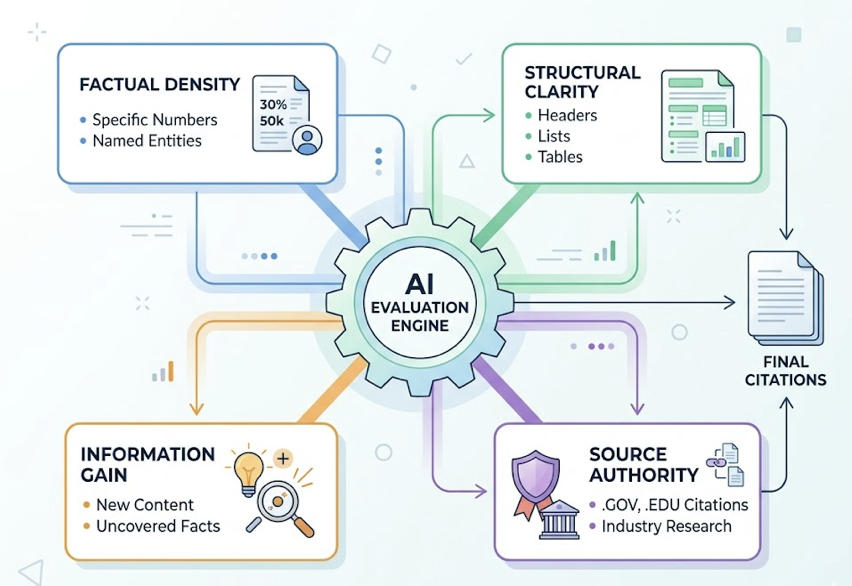
Vague marketing copy gets ignored automatically. Concrete, well-structured, externally validated content gets cited.
The 3 Signals That Make Your Brand AEO-Ready
Signal 1: Content Authority and Entity Clarity
AI engines don’t do keyword matching. They try to understand what your brand is, what it does, and how it relates to adjacent concepts. If your content doesn’t make those relationships explicit, you’re invisible.
Practically, this means leading with the answer. Put the core response in the first 100 words. Use clear entity statements: your brand name, your product category, and what you do, defined without ambiguity. Apply the 15-25 word citation rule: wrap your key facts in short, self-contained sentences that AI extraction algorithms can pull cleanly without reformatting.
Signal 2: Structured Markup
Schema.org markup is how AI systems translate your content from human-readable text into machine-interpretable data. Websites that implement structured data are cited by AI engines at more than twice the rate of unstructured pages.
The most impactful markup types for AEO are FAQPage (direct-answer visibility), Product/Offer (commercial comparison cards), HowTo (instructional searches), and Organization (brand knowledge graph). There’s also an emerging standard, llms.txt, specifically designed to signal AI-crawlability.
Signal 3: Third-Party Consensus
AI engines don’t just trust what you say about yourself. They cross-reference. They look for consensus: are other authoritative sources saying the same things about your brand?
In B2B SaaS, over 35% of LLM citation links come from just 10 third-party sources, with Reddit and G2 dominating. If industry review sites, trade media, and community forums are all discussing your brand positively, AI engines treat that as corroboration and push you higher.
The most durable third-party signal you can build: original research. When your brand publishes proprietary data, AI engines are forced to cite you as the primary source. You become unavoidable.
AEO in Action: What It Looks Like When It Works
These aren’t hypothetical outcomes.
A B2B SaaS company executed a focused AEO program and grew AI-referred trial sign-ups from 575 to 3,500+ per month within 7 weeks. The levers: fixing broken Schema markup, publishing 66 data-heavy articles targeting buyer-intent queries, and establishing a presence in top-ranked Reddit threads where their LLM training data was being pulled from.
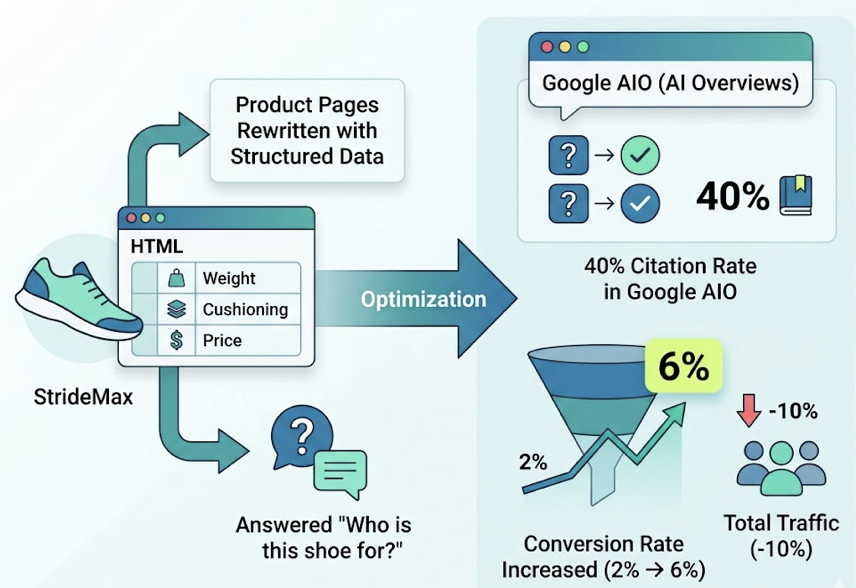
StrideMax, a running shoe brand, held the top Google ranking for “best marathon shoes” but was completely absent from ChatGPT and Perplexity recommendations. They rewrote product descriptions into HTML data tables with weight, drop height, cushioning material, and price. They opened every product page with one sentence answering: “Who is this shoe for?” The result: 40% citation rate in Google AIO for long-tail queries, and conversion rate jumping from 2% to 6% despite a 10% drop in total traffic volume.
FinFlow, a fintech app, was getting hurt by a 2022 security incident that AI engines kept surfacing in response to safety questions. Their fix wasn’t PR spin. It was building a schema-rich compliance page with ISO certifications and current encryption standards, then using Topify’s Sentiment Analysis to track how AI descriptions of their brand shifted over time. Their AI sentiment score moved from 35/100 to 85/100. Customer acquisition cost dropped 18%.
That last case illustrates something important: AEO isn’t just about getting mentioned. It’s about controlling the narrativeAI engines attach to your brand.
You Can’t Optimize What You Can’t Measure
Traditional SEO tools like Ahrefs and SEMrush track rankings. They don’t track what ChatGPT says about your brand this week versus last week. That’s a fundamental blind spot.
Effective AEO measurement runs on three metrics. Visibility: what share of relevant AI prompts actually surface your brand? Position: are you the first recommendation, or a footnote at the bottom? Sentiment: when AI describes your brand, what words does it use?
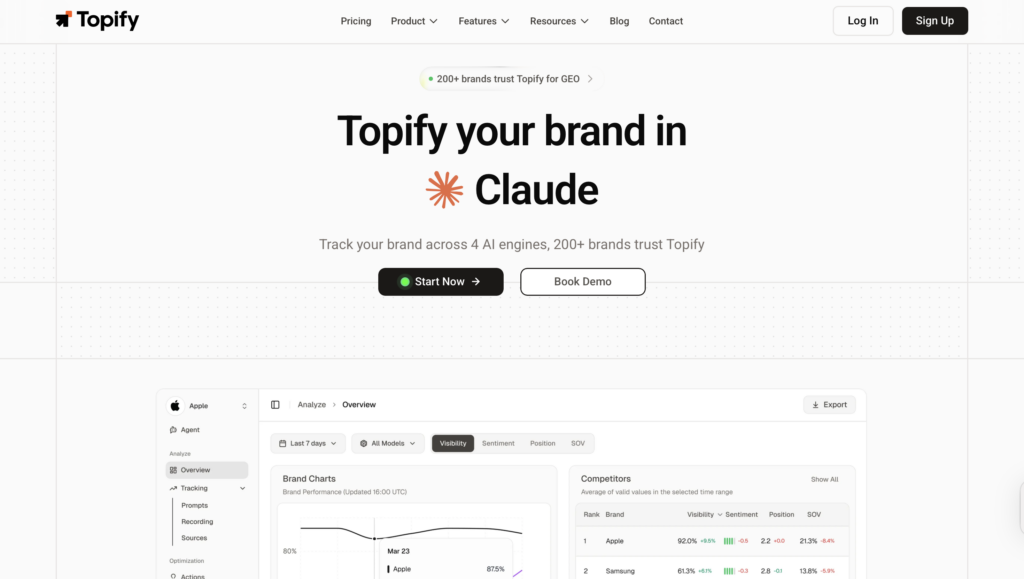
Topify was built specifically to make these metrics trackable and actionable. It monitors brand performance across ChatGPT, Gemini, Perplexity, DeepSeek, and other major platforms. Its Source Analysis module shows which third-party domains are driving AI citations for your brand (and your competitors). Its Gap Detection feature identifies prompts where competitors get cited and you don’t, then generates content briefs directly.
For teams just starting out, the Basic plan at $99/mo covers 100 prompts, 4 projects, and foundational source analysis across the major AI platforms. The Pro plan at $199/mo expands to 250 prompts and 10 seats, suited for growing marketing teams running competitive benchmarking. Enterprise starts at $499/mo for custom model coverage and API integration.
The measurement layer is what separates AEO as a discipline from AEO as a guess. AI referral traffic has grown 600% since January 2025. That growth doesn’t show up in your standard analytics the way organic search does. Without purpose-built tracking, you’re flying blind.
How to Start with AEO: A 3-Step Checklist
Step 1: Audit your current AI visibility (Days 1-14)
Manually run 20 core commercial queries in ChatGPT, Perplexity, and Google AI Overviews. Track how often your brand appears and in what context. Ask “Who is [your brand]?” and “How does [your brand] compare to [competitor]?” If AI produces inaccurate or missing information, your entity signals are insufficient. Check your robots.txt to confirm you’re not blocking GPTBot, PerplexityBot, or other AI crawlers.
Step 2: Optimize content structure and external authority (Days 15-60)
Rewrite your top 10 traffic pages with answer-first structure. Convert narrative product descriptions into structured tables with concrete specifications. Deploy FAQPage and Product Schema on core service and product pages. Submit original data-backed press releases to the publications AI engines already cite. Build a presence in the Reddit communities where your buyers ask questions.
Step 3: Build continuous monitoring (Day 60 onward)
Deploy automated tracking for your AI visibility share and its weekly movement. Refresh key statistics every quarter. AI engines show a meaningful preference for content updated within the last 13 weeks. Use gap analysis monthly to adjust where you’re producing new content.
The window for early-mover advantage in AEO is still open. It won’t be for long.
Conclusion
AEO isn’t replacing SEO. It’s extending the competitive surface.
SEO still drives long-tail traffic and website discoverability. AEO captures the moment when a user asks a direct question and gets a direct answer, with no browsing involved. That moment is increasingly where high-intent conversion begins.
AI-referred visitors convert at 4x the rate of traditional organic search visitors. The reason is straightforward: by the time a user acts on an AI recommendation, the consideration phase is over. They trust the answer. Your job is to be the answer they trust.
The brands showing up in AI-generated responses in 2026 aren’t there by accident. They built factual density into their content. They implemented structured markup. They earned third-party citations. And they measured all of it.
That’s what AEO looks like in practice.
FAQ
What’s the difference between AEO and GEO?
AEO focuses on specific answer features like Google AI Overviews and featured snippets, aiming to become the single cited answer. GEO (Generative Engine Optimization) is a broader framework for optimizing content across the entire generative AI ecosystem, not just one search surface.
Does AEO replace SEO?
No. SEO remains the foundation for website visibility and long-tail discovery. AEO targets high-intent, conversational queries where users want a direct answer, not a list of links. They work best as complementary layers.
Which AI platforms does AEO apply to?
The primary platforms are ChatGPT, Google AI Overviews/Gemini, Perplexity, and Microsoft Copilot. Voice assistants like Siri and Alexa also apply AEO logic. Vertical AI agents in healthcare, legal, and finance are growing application areas.
How long does it take to see AEO results?
Initial signals typically appear within 2-6 weeks of optimization, particularly in long-tail queries. Cross-platform, category-level visibility usually takes 3-6 months as AI models update their knowledge bases and establish trust weighting for your brand.

