An analytics lead receives a report that combines every recognizable search origin with assistant referrals under one AI traffic total. The headline looks useful until a stakeholder asks which visits came from a conversational answer and which came from an ordinary search result. The underlying source field records an origin, while the report claims a much more specific experience.
LLM referral traffic needs a source boundary that the captured evidence can support. A familiar referring host, a campaign parameter, and a channel label are different signals, and none should silently erase the others. The immediate decision is how to classify the observed visit without inventing the search surface or question that preceded it.
Set a Source Boundary for LLM Referral Traffic
Define which observed sources belong in the report before calculating a total. Recognized assistant referrals can form one group, documented Google-origin traffic another, and unresolved evidence a third. The grouping rule should explain its inputs and its limits.
Google Analytics’ current channel definition distinguishes AI Assistant traffic from Organic Search and excludes Google’s AI Overviews and AI Mode from the AI Assistant channel. Treat that documented distinction as a reason to preserve separate reporting fields, rather than relabeling every search-related visit as an assistant referral.
Keep the raw observed source beside the normalized category. A later channel-definition change or classification correction should be reviewable without rewriting the original record. Record the rule version and the date it began governing the report.
A source category should describe the evidence, not the story you hope to measure.
Use a synthetic record to test the boundary. A landing request with a Google origin and no additional evidence can support a Google-origin classification. It doesn’t, on its own, identify the interface element that sent the visitor.
Read Origin-Only Referrers Correctly
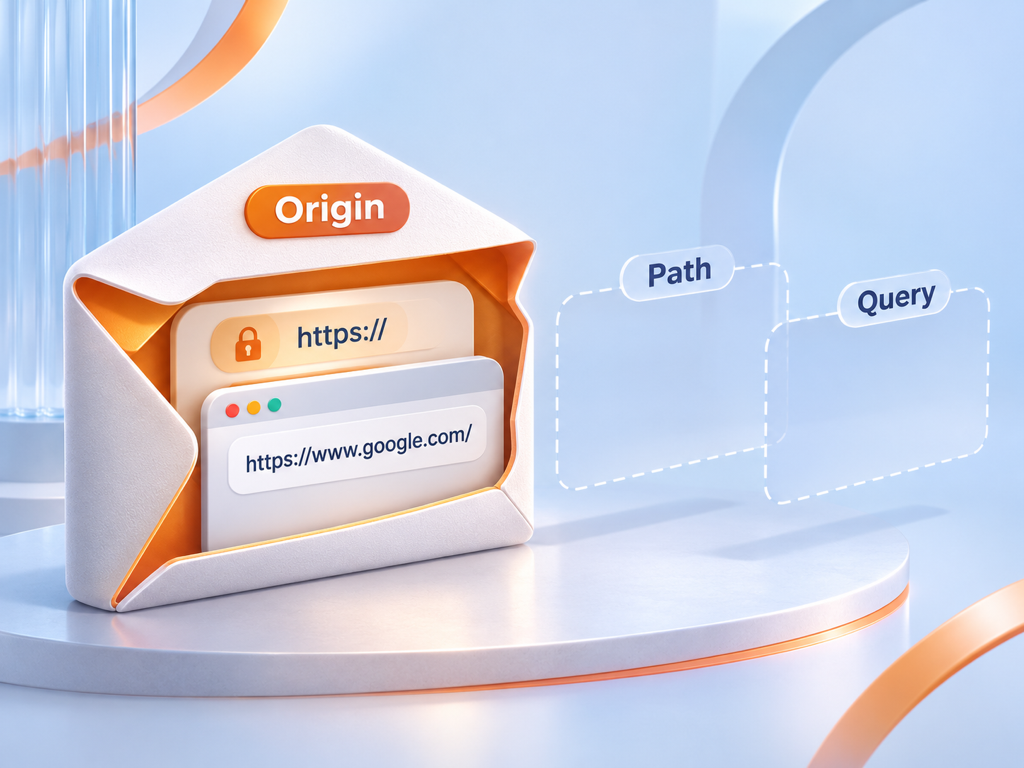
Google’s referral documentation describes an origin policy that sends scheme and host without the referring path or query. The header therefore doesn’t provide the user’s search terms. Preserve that information limit when describing the visit.
The practical inference is narrower than a product-surface claim. An origin-only value doesn’t encode whether the visitor clicked a particular generated answer, a conventional result, or another relevant surface sharing that origin. Don’t create an AI-surface label from missing path information.
Distinguish a request header from a JavaScript field in your collection notes. Your server log and browser analytics may expose different evidence at different moments. A discrepancy needs a collection explanation before it becomes a source-classification conclusion.
Record which request you inspected. A landing-page request is the relevant observation for this review, whereas a later image or script request can carry your own page as its referrer. Counting resource requests as visits changes both the unit and the apparent source mix.
Don’t try to reconstruct a private search query from a source field that doesn’t contain it. Use the appropriate aggregate search reporting for query analysis, with its own scope and limitations. Keep that dataset separate from individual visit records unless a legitimate shared key and supported method exist.
Handle Google App and Local-Domain Variants
A source rule should account for documented variants without becoming an unrestricted string match. Google’s guidance lists web and local-domain origins as well as a specific Android-app form. Use the current examples to design a reviewed classification rule rather than matching any string containing a familiar brand name.
Have an implementation owner parse the value according to its documented form. A hostname that merely contains google as part of an unrelated domain isn’t equivalent to an official origin. Keep unexpected formats in an unresolved queue until the rule can be justified.
The table below is a synthetic rule-review matrix. It describes the strength of an interpretation, not a measured traffic distribution or a substitute for the analytics platform’s own channel processing.
| Observed input | Review category | Conclusion not supported by this input alone |
|---|---|---|
| Documented Google web origin | Google-origin evidence | A particular AI result or search query |
| Documented Google app form | Google app-origin evidence | A complete in-app journey |
| Independently documented assistant signal | Assistant evidence | Every earlier discovery interaction |
| Blank referrer | Source unresolved from this field | No external influence occurred |
| Unrecognized look-alike host | Unverified source | Official provider identity |
| Conflicting parameter and referrer | Conflicting evidence | One signal can safely be discarded |
Keep the rule’s coverage visible. A small set of documented patterns may intentionally leave some records unclassified. That is preferable to a broad pattern that produces a confident but poorly supported source label.
Keep Blank and Conflicting Signals Unresolved
A blank referrer is a missing observation from that field. Google’s documentation notes that browser, operating-system, and privacy behavior can omit it, and that client-side tracking may miss visits. Don’t translate that absence into proof that a visit had no search or assistant influence.
Preserve conflicting signals in separate fields. A campaign source value and an observed referrer can disagree because they describe different parts of the implemented journey. Investigate the actual landing path before selecting a normalized reporting category.
Write an explicit precedence policy for the report. It might prioritize a particular documented signal for a defined purpose, but it should retain the other input and explain why the rule applies. A precedence policy is an analytical choice, not a claim that discarded evidence never existed.
Unknown isn’t a spare category for assigning otherwise inconvenient visits.
Avoid resolving disagreements by changing production channel settings during an article-style audit. First reproduce the case with approved synthetic navigation and inspect the implementation. Any configuration change needs a concrete owner and a reviewable expected effect.
Compare the source record with the broader LLM referral workflow when choosing the reporting scope. Session source, first-user source, and attribution credit can differ without implying that the observed header was incorrectly captured.
Test the Classification With Synthetic Visits
Build a compact fixture for every classification rule. Include the observed input, expected category, supporting documentation, and the inference the rule must not make. Test both a valid case and a nearby look-alike case.
Include blank and conflicting inputs deliberately. A system that classifies only clean examples may still fail on the records most likely to create a misleading headline. The expected result can be unresolved, provided the workflow retains the evidence and assigns a review owner.
Keep test visits separate from business reporting. Use approved test procedures and identifiers that don’t contain personal details. A successful synthetic classification demonstrates the rule under those conditions; it doesn’t estimate how often real visitors follow that path.
Have another analyst review a sample without being told the desired category. Ask them which conclusion the input actually supports. Where reviewers disagree, improve the rule description before increasing automation or adding more source patterns.
Version the fixture alongside the rules. When official source formats or analytics definitions change, rerun the relevant cases and preserve the previous result. This gives a later reporting review a way to distinguish source behavior from a classification-method change.

Publish Separate Source and Influence Views
Topify describes examining brand presence and cited sources through its AI-search analytics feature. Use a defined question set and relevant pages to establish the visibility question. Then report captured referral sources through the separate analytics or log workflow that observes the click.
The analyst’s action is to compare those aggregate evidence layers without claiming that one identifies every interaction in the other. The output can guide a decision to investigate answer coverage, a landing path, or a source-classification problem. The public feature description doesn’t establish that Topify reads your server headers, replaces GA4 channel logic, or identifies the precise Google surface behind an origin-only referrer. Keep the normalization rules and their manual checks with the analytics owner. When visibility and referral trends differ, report the disagreement as a question to investigate rather than automatically assigning the missing visits to a preferred AI category.
Show an evidence note beside the headline. Name the included source groups, the unresolved share when available, and the rule version. A stakeholder should be able to understand what the number counts without reconstructing the entire implementation.
Conclusion
An origin-only referrer supports a narrower conclusion than a detailed account of the preceding search experience. Keep Google-origin evidence, documented assistant signals, blank fields, and conflicts distinguishable. Preserve raw inputs and test the classification rule before combining categories into a business headline.
Choose one source segment alongside your AI-search visibility review and write a small synthetic classification fixture for it. Include a valid origin, a look-alike, a blank value, and a conflict. Ask another analyst to identify what each record can prove. The immediate goal is a report whose source labels remain defensible while leaving unobserved AI influence outside the referral total instead of hiding it in an invented category.
FAQ
Does a Google referrer identify an AI Overview click?
Not from the origin alone. That value doesn’t encode the specific result surface, so a finer classification needs additional supported evidence.
Does the referrer contain the user’s search query?
Google’s documented origin-only policy doesn’t include the search query. Use appropriate search reporting for aggregate query analysis instead.
Why can the referrer be blank?
Browser, operating-system, and privacy behavior can omit it. A blank field is insufficient to conclude that no external discovery occurred.
Can source parameters and referrers disagree?
Yes. Retain both signals, inspect the navigation path, and apply a documented reporting rule without erasing the original evidence.