


Most content published today will never be read.
Not because it’s poorly written. Because nobody searched for it.
Sixty percent of all Google searches now end without a single click to an external website. AI Overviews went from covering 6.49% of queries in January 2025 to 13.14% by March, and that number has kept climbing. The window where good content automatically earns traffic has closed. What replaced it is a more competitive environment where keyword research isn’t optional prep work. It’s the foundation everything else is built on.
This guide walks through the full process: what keyword research actually involves, which metrics matter, how to find low-competition opportunities, which tools to use, and how to extend your strategy into AI search where the highest-converting traffic now comes from.
Why 90% of Pages Get Zero Organic Traffic
The data on this is uncomfortable.
When an AI Overview is present on a Google results page, the click-through rate for the top-ranking organic result drops between 34.5% and 58%. By late 2025, the average CTR for a position-one informational result had fallen to 0.039, down from 0.076 in 2023. That’s not a minor shift. That’s the economics of organic traffic cut in half.
HubSpot is the clearest case study. Between late 2024 and mid-2025, its monthly blog traffic dropped from 13.5 million to roughly 6 million visits. The cause wasn’t algorithmic punishment. It was strategy. Years of targeting broad, high-volume informational keywords with weak product relevance. When AI began answering those generic questions directly on the SERP, the clicks evaporated. HubSpot now reports that only 10% of its leads come from traditional blog traffic.
The failure mode here is specific: publishing content without validating that people are searching for it in a way that leads to your site. Keyword research is exactly what prevents that.
What Keyword Research Is — and What It’s Really Measuring
Keyword research is the process of identifying the exact words and phrases your target audience uses when searching, so you can create content that answers those queries better than anything else ranking.
That’s the operational definition. The strategic one goes deeper.
What you’re actually doing is search intent analysis. Every query has a reason behind it. “Project management software” is browsing. “Best project management software for remote teams under 20 people” is close to a purchase. The surface-level words are almost irrelevant compared to the mental state of the person typing them.
Intent breaks into four categories: informational (learning something), navigational (finding a specific site), commercial (comparing options before deciding), and transactional (ready to act now). Match the wrong content type to the intent, and you can rank #1 and still convert at near-zero.
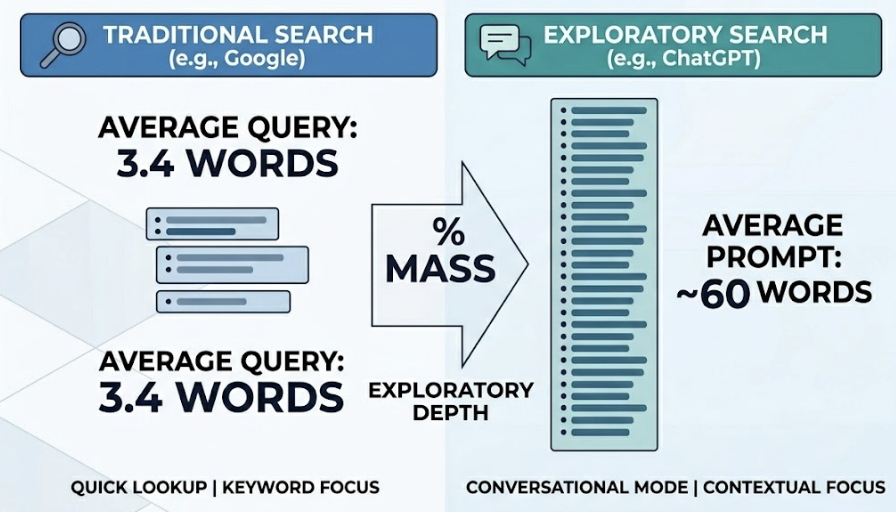
Here’s a number worth sitting with: the average Google query is 3.4 words. The average ChatGPT prompt is approximately 60 words. That gap reflects how differently people search when they’re in an exploratory, conversational mode versus a quick Google lookup. Keyword research in 2026 has to account for both channels.
The Metrics That Actually Matter When Evaluating Keywords
Opening a keyword tool and sorting by volume is the most common mistake beginners make. Volume is one signal. It’s not the strategy.
Search Volume tells you how many people search a term per month. High volume is attractive, but it almost always means high competition. For a new site, chasing high-volume keywords is a reliable way to produce content that ranks on page 8.
Keyword Difficulty (KD) is a 0-100 score estimating how competitive a term is. The important nuance: keyword difficulty is relative to your domain’s authority. A KD of 40 might be a realistic target for a site with 2,000 referring domains and completely out of reach for one with 50.
Search Intent is arguably more important than either metric above. Filter every keyword through intent before adding it to your list.
CPC (Cost Per Click) shows what advertisers are willing to pay for a click. High CPC signals high commercial value, even if volume is modest. A keyword with 400 monthly searches and a $12 CPC is often more valuable than one with 4,000 searches and a $0.40 CPC.
Trend direction matters more than snapshot volume. A keyword at 1,500 monthly searches but growing 35% year-over-year is a better investment than one at 4,000 searches in slow decline.
On long-tail keywords: three or more words, more specific, typically lower competition. They account for over 70% of all web searches and drive 92% of the keywords with meaningful purchase intent. The conversion math is decisive. A recent keyword study found 1-word queries convert at 0.17%, while 6-word queries convert at 1.94%. More specific searches come from more decided buyers. Beginners should start here.
How to Do Keyword Research: A 5-Step Process
Step 1: Define Your Seed Keywords
Seed keywords are the broad topic categories your business operates in. If you sell HR software, seeds might include: HR software, employee onboarding, payroll management, performance reviews, workforce planning.
Start from your product, your customer’s job title, or the specific problems your service solves. Aim for 10-15 seeds. Don’t filter yet.
Step 2: Expand Using a Keyword Tool
Run your seeds through a keyword research tool and generate a full list of variations. Useful expansion patterns to look for: questions (“how to run performance reviews remotely”), comparisons (“HR software vs spreadsheet”), modifier-based long-tails (“for small teams,” “free,” “for startups,” “2026”), and problem-first queries (“employee turnover tracking”).
Pull everything at this stage. You’ll filter in the next step.
Step 3: Filter by Search Intent
Go through your expanded list and assign an intent category to each keyword. For each one, ask: if someone types this, what kind of content are they expecting to find? A blog post? A comparison page? A product landing page? A how-to video?
Only keep keywords where you can create the content type that matches the intent. A transactional keyword pointing to a blog post is wasted effort regardless of how well you write it.
Step 4: Find Low-Competition Opportunities
This is where keyword research becomes strategy. To find low competition keywords, filter for KD under 20 and look at the actual pages ranking for each term. If the top results have weak backlink profiles, outdated content, or poor intent alignment, that’s a real opening.
For a new website specifically, targeting keywords with KD under 20 and monthly volume between 100-1,000 is the most efficient path to early traction. Product-specific long-tail keywords convert nearly 2.5x higher than broad category terms. Specificity isn’t a concession. It’s an advantage.
Step 5: Prioritize Into a Content Calendar
Run your shortlist through three filters: business relevance (does this keyword connect to something you actually offer?), competitive feasibility (can you realistically rank within 6-12 months given your current domain authority?), and conversion potential (will traffic from this keyword lead somewhere meaningful?).
Build those keywords into a content calendar with target publish dates, intended formats, and a primary CTA for each piece. Keyword research without execution is just a spreadsheet.
The Best Keyword Research Tools in 2026
| Tool | Best For | Starting Price | Keyword Database | AI Search Coverage |
|---|---|---|---|---|
| Google Keyword Planner | Beginners, AdWords users | Free | Google-native data | None |
| Ahrefs | Specialists, agencies | $129/mo | 28.7 billion keywords | Brand Radar (add-on) |
| Semrush | Multi-channel teams | $139.95/mo | 27.9 billion keywords | AI Toolkit (included) |
| Ubersuggest | Freelancers, SMBs | $29/mo | 6 billion keywords | Basic |
Google Keyword Planner is where most people should start. It’s free, pulls directly from Google’s index, and using it for organic research is well-documented despite being built for paid ads. The main limitation: volume data comes in broad ranges rather than precise estimates. Good for direction, not precision.
Ahrefs is the professional standard. Its backlink index covers 43 trillion links and the Site Explorer is the most reliable tool for competitive analysis. At $129/month, it’s built for teams with active SEO programs.
Semrush at $139.95/month is the stronger choice for teams needing SEO plus content marketing plus competitive intelligence in one platform. Its keyword database (27.9 billion) is comparable to Ahrefs, and the interface is more accessible for non-specialists.
Ubersuggest at $29/month covers the fundamentals well enough for solo creators and new sites. It’s not as deep, but for a free keyword research tool in 2026, it’s the most practical entry point outside of Google’s own tools.
Start with Google Keyword Planner. Move to Ahrefs or Semrush when you’re ready to compete seriously.
The Keyword Gap Traditional Tools Can’t See
There’s a blind spot in every traditional keyword tool. They only measure Google.
AI platforms including ChatGPT, Gemini, and Perplexity are now meaningful discovery channels, and the traffic quality coming from them is unlike anything from organic search. Ahrefs research found that AI-referred visitors generated 12.1% of signups despite making up just 0.5% of total traffic. That’s a conversion multiplier of roughly 23 times compared to standard organic visits.
The reason is intent filtering. By the time someone clicks a citation link in a ChatGPT answer, they’ve already refined their need through a multi-step conversation. They’re not browsing. They’re verifying.
The problem: when someone asks ChatGPT “what’s the best project management tool for a 15-person engineering team,” that query leaves no footprint in Ahrefs or Semrush. Researchers now call these “dark queries.” You can’t optimize for them without knowing they exist. The average ChatGPT prompt is 60 words, which means these are highly specific, high-intent searches that traditional volume databases will never capture.
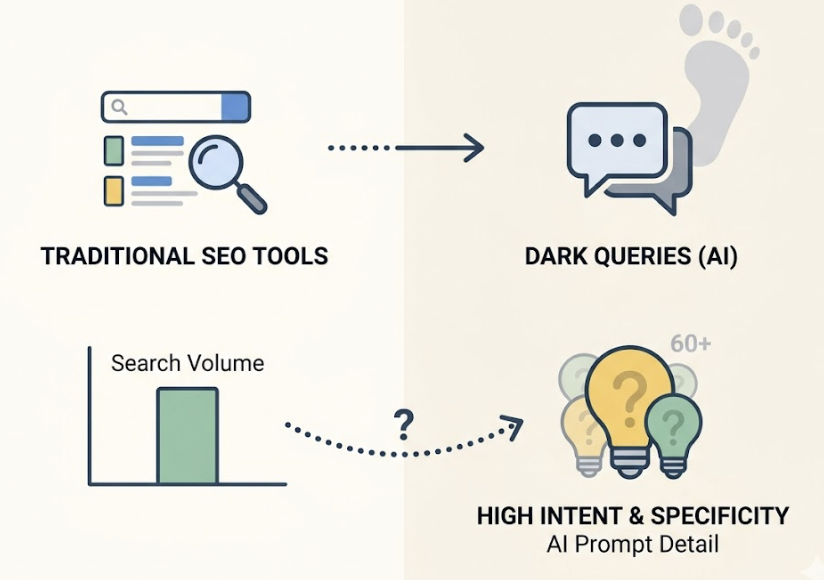
This is what keyword research for AI search optimization requires a different layer of tooling for. Topify tracks high-value prompts across ChatGPT, Gemini, Perplexity, and other major AI platforms, surfacing the exact queries driving brand recommendations in AI answers. Its AI Volume Analytics identifies which prompts generate significant AI search traffic in your category. High-Value Prompt Discovery continuously surfaces new opportunities as AI recommendation patterns shift.
For teams already running traditional keyword strategy, Topify’s Source Analysis adds something no traditional tool provides: visibility into which domains AI platforms are actively citing for your target queries. That tells you what content is earning AI visibility right now, not just what’s ranking in Google. By 2028, over $750 billion in consumer spending is projected to flow through AI-powered search channels. The brands building prompt-level visibility now will hold compound advantages when that volume arrives.
The Keyword Strategy That Compounds: Topic Clusters
One-time keyword lists don’t scale. They produce a set of disconnected pages with no structural advantage.
The architecture that consistently outperforms is the topic cluster model: a comprehensive pillar page (2,500-4,000+ words) covering a broad topic, supported by 8-15 cluster pages going deep on specific subtopics, all bidirectionally linked. The performance data on this is consistent. Clustered content generates 30-43% more organic traffic than standalone articles and is 3.2x more likely to be cited by AI platforms.
That last number matters more than most SEO guides acknowledge. 86% of all AI citations come from sites with five or more interconnected pages on a topic. Bidirectional internal linking between cluster pages increases AI citation probability by 2.7x. The cluster structure doesn’t just help Google. It signals topical authority to every platform doing entity-based retrieval.
For competitor keyword research, the process is: enter a competitor’s domain in Ahrefs or Semrush Site Explorer, filter their top pages by estimated organic traffic, then identify which keywords are driving results. Cross-reference against your own content. Run a Content Gap analysis to surface keywords they rank for that you don’t. Those gaps are the highest-priority opportunities on your list.
Review keyword performance quarterly. Pages that have been live 12+ months without meaningful traffic should be consolidated, redirected, or substantially updated. Add new cluster content as your domain authority grows and harder keywords become winnable.
Conclusion
Keyword research is not a pre-launch checklist item. It’s an ongoing system for understanding what your audience searches for, how their intent maps to content types, and which opportunities your site can realistically compete for right now versus in 12 months.
The fundamentals remain: search intent analysis, keyword difficulty assessment, long-tail targeting, and competitive gap research. What’s expanded in 2026 is the scope. AI search platforms account for a small but disproportionately high-value slice of discovery traffic, and that slice is growing faster than traditional organic. Topify sits at exactly that intersection, giving teams visibility into the prompt-based queries that traditional tools can’t see.
Start with the five-step process in this guide. Build your topic cluster architecture. Then extend your keyword strategy into AI search before your competitors do.
FAQ
How do I do keyword research for a new website?
Start with 10-15 seed keywords derived from your core product or service. Expand using Google Keyword Planner (free) and filter for keywords with KD under 20 and monthly volume between 100-1,000. Target long-tail phrases with clear informational or commercial intent. Structure your first 10-15 pages around a pillar topic with supporting cluster content, not isolated standalone articles.
What is search intent in keyword research?
Search intent is the reason behind a query: informational (learning), navigational (finding a specific destination), commercial (comparing options), or transactional (ready to act). Matching your content format to the correct intent is often more important than the specific keyword itself. A page targeting a transactional keyword needs to be a product or landing page, not an educational blog post.
How do I choose the right keywords for a blog?
Prioritize informational and commercial-investigation keywords. Look for questions your audience is asking, comparison-style queries, and “how to” searches tied to your topic. Use keyword difficulty as a feasibility filter, and verify that the top-ranking content for each keyword is actually blog-format before committing to writing. If the top results are all landing pages, you’re targeting the wrong intent.
How do I find high-volume, low-difficulty keywords?
In Ahrefs or Semrush, filter by Volume above 500 and KD under 20. Sort by Traffic Potential rather than raw volume to find keywords where the top-ranking page pulls in broad related traffic. Always cross-check the SERP manually. If the top results have weak backlinks, outdated content, or poor intent alignment, that’s a real opportunity regardless of the KD score.
What’s the difference between short-tail and long-tail keywords?
Short-tail keywords are 1-2 words (“CRM software”): high volume, high competition, low conversion rate. Long-tail keywords are 3+ words (“CRM software for freelance consultants”): lower volume, lower competition, significantly higher conversion. Long-tail keywords account for 70% of all searches and drive 92% of high-intent queries. Start there.
How do I do competitor keyword research?
In Ahrefs or Semrush, enter a competitor’s domain in the site explorer and filter their top pages by organic traffic. Identify the specific keywords driving each page, then run a Content Gap analysis to find keywords they rank for that you don’t. Those gaps are your most actionable starting points.

