

You’ve spent years building domain authority. Your DA is 75. You rank on page one for a dozen competitive keywords. Then someone asks ChatGPT to recommend the top tools in your category, and your brand doesn’t appear once.
That’s not a bug. That’s the gap between SEO Score and GEO Score, and it’s costing brands more visibility than they realize.
Your Domain Authority Means Nothing to ChatGPT
Here’s the thing most marketers still haven’t fully processed: large language models don’t consult your backlink profile when deciding what to cite. They don’t check your DA, your PageRank, or your Core Web Vitals. Those signals were built for crawler-based engines. Generative AI operates on a completely different logic.
What AI models look for is “topical entity density” and “information gain.” A niche site with focused, data-rich content and frequent citations within its field can outrank a DA-80 domain in AI-generated answers. High domain authority is a Google signal. It’s not a GEO signal.
That’s the foundational misread most brands make: they assume GEO is just SEO with a new name. It’s not. They measure entirely different capabilities.
What SEO Score Actually Measures
SEO Score reflects a page’s potential to rank in traditional search results. Tools like Moz, Ahrefs, and SEMrush evaluate it across a few consistent dimensions: technical health (Core Web Vitals, mobile-friendliness, HTTPS), content relevance (keyword alignment, heading structure), backlink profile, and crawlability.
The underlying logic is simple. Help Google or Bing determine whether this page deserves a top-10 position for a given query. SEO Score is the answer to that question, expressed as a number.
Its strengths are real. Organic traffic growth, click-through rate optimization, keyword ranking maintenance: these are all downstream of a healthy SEO Score. But SEO Score tells you nothing about whether an AI will cite you. That’s a separate question entirely.
What GEO Score Actually Measures
GEO Score measures the probability that your content gets cited in an AI-generated answer. It’s a machine-readability metric, not a human-popularity metric.
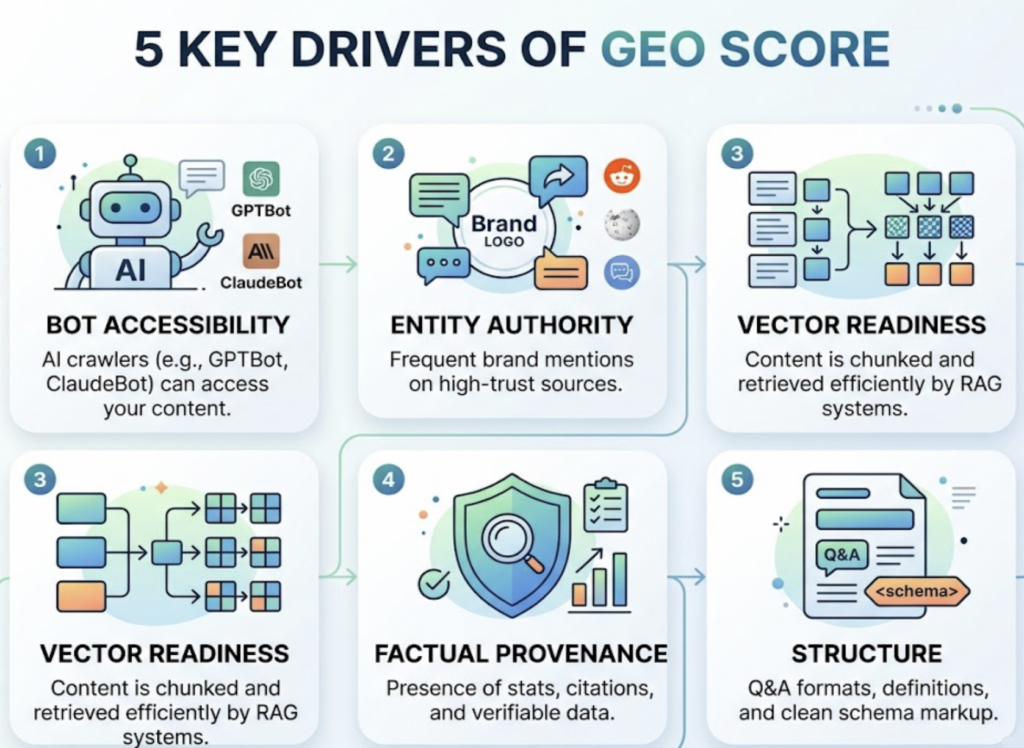
The specific signals that drive GEO Score fall into five categories. Bot accessibility: whether AI crawlers like GPTBot and ClaudeBot can actually access your content. Entity authority: how frequently your brand is mentioned across high-trust sources like Reddit, Wikipedia, and niche forums. Vector readiness: how well your content can be chunked and retrieved by RAG (Retrieval-Augmented Generation) systems. Factual provenance: the presence of statistics, authoritative citations, and verifiable data. Structure: whether you’re using Q&A formats, clear definitions, and schema markup that AI parsers can extract without friction.
Princeton University research confirmed the weight of these signals. Across 10,000 queries, content that cited authoritative sources saw a 40% boost in AI visibility. Adding statistics drove a 37% increase. Expert quotations added 30%. The research also found that websites ranked fifth in traditional search saw a 115% visibility jump when they applied citation-based GEO tactics, while top-ranked sites that ignored GEO actually lost ground.
That’s the equalizer effect. GEO doesn’t care who had the most backlinks five years ago.
You can get an immediate baseline read on where your site stands with Topify’s GEO Score Checker. It runs a multi-dimensional analysis and gives you a starting point before you touch anything else.
Side by Side: What Separates the Two Scores
| Dimension | SEO Score | GEO Score |
|---|---|---|
| Measures | Search engine ranking potential | Probability of AI citation |
| Core signals | Backlinks, DA, keyword density | Content structure, entity authority, factual density |
| Optimization goal | Top 10 “blue links” | Cited as source in AI-generated answers |
| Primary tools | Moz, Ahrefs, SEMrush | GEO Score Checker, Topify |
| Conversion mechanism | Click on a ranked link | Click on a citation inside an AI response |
| Stability | Relatively stable | Highly dynamic, shifts with model updates |
| Strategic focus | Technical health + authority | Information gain + machine-readability |
One more difference worth calling out: AI-referred visitors convert at approximately 14.2%, compared to 2.8% for traditional organic search. That’s a five-fold gap. Users who click a citation in a ChatGPT or Perplexity response have already been pre-qualified by the AI’s synthesis. They’re not browsing. They’re deciding.
Why “Both” Is Not Optional in 2026
Some teams have responded to the rise of AI search by pivoting fully to GEO. That’s the wrong move, and the data makes it clear why.
As of early 2026, AI search tools have captured between 12% and 15% of global search market share, up from roughly 5% at the start of 2025. Gartner projects that traditional search volume will decline 25% by the end of 2026. That’s a real and measurable shift. But 75-85% of queries still go through traditional engines.
More importantly, the two channels are technically interdependent. ChatGPT sources approximately 87% of its citations from the top 10 Bing organic results. Google’s Gemini AI Overviews primarily cites pages that already rank in the top 10 on Google. If your site doesn’t have basic SEO health, it may never enter the retrieval pool that generative models draw from.
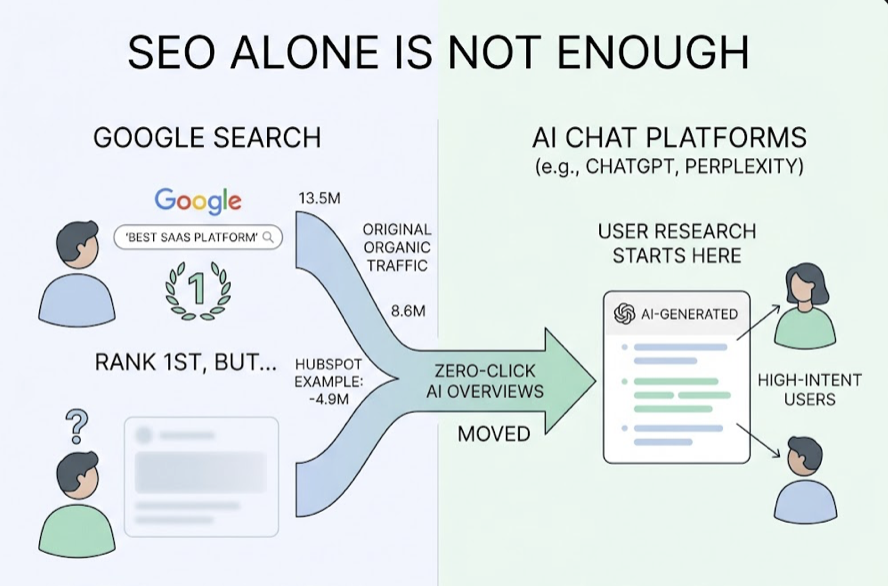
On the flip side, SEO alone won’t save you. A brand can rank first on Google for a competitive keyword and remain completely invisible in ChatGPT or Perplexity, platforms where an increasing share of high-intent users are starting their research. The HubSpot case made this concrete: the company saw organic traffic drop from 13.5 million to 8.6 million as top-of-funnel informational queries were captured by zero-click AI overviews. The traffic didn’t disappear. It moved channels.
The bottom line: SEO Score and GEO Score aren’t competing metrics. They’re parallel ones. Ignoring either means you’re leaving a meaningful portion of your addressable market on the table.
GEO Score Is a Baseline, Not a Monitoring System
Here’s where a lot of teams get stuck. They run a GEO Score check, feel good about the number, and move on. But a GEO Score is a static snapshot. It reflects your content’s cite-worthiness at a single point in time.
The actual AI citation landscape is volatile. The same prompt that surfaces your brand today may surface your competitor tomorrow if they publish fresher data or a more concise answer. AI platforms update their retrieval logic. New prompts emerge. Competitors optimize in real time.
That’s the limitation the score can’t solve on its own.
The brands that are pulling ahead in 2026 are treating GEO as a continuous monitoring problem, not a one-time audit. That means tracking not just whether you have a high score, but whether you’re actually appearing in AI responses, how often, where in the response, and with what sentiment.
Topify tracks exactly that across ChatGPT, Perplexity, Gemini, DeepSeek, and other major AI platforms using seven core metrics: Visibility Rate (how often you appear across relevant prompts), Position Score (where in the recommendation order), Sentiment Score (tone of the AI’s description), Intent Coverage (spread across informational, comparative, and transactional queries), Source Citation Frequency (which of your URLs are being pulled), Share of Voice benchmarked against competitors, and Conversion Visibility tied to referral traffic.
The workflow that makes sense right now: use a GEO Score Checker to establish your content baseline, then use Topify to track whether that baseline is translating into actual citations, and where those citations are shifting over time.
Most brands currently have an AI citation rate near zero. Reaching 10-12% citation frequency across relevant category queries is considered top-tier performance for 2026. You can’t close that gap if you don’t know where you’re starting from or how it’s moving.
Conclusion
GEO isn’t SEO rebranded. It’s a separate measurement of a separate capability: can an AI find your content, understand it, trust it, and cite it in the answers it generates for your potential customers?
The misunderstanding that GEO is just “SEO 2.0” is exactly what lets more agile brands with smaller domains outrank legacy players in AI-generated responses. You don’t need ten years of link building to win on Perplexity. You need factual density, structural clarity, and consistent presence across the right information channels.
Check your GEO Score first with Topify’s GEO Score Checker to see where you stand today. Then build the monitoring layer to track where you’re moving, because in a landscape where AI models update their retrieval logic without announcement, a one-time score is just the starting line.
FAQ
Q: Is GEO Score the same as AEO (Answer Engine Optimization) score?
They’re closely related but not identical. AEO focuses on becoming the direct answer: featured snippets, voice assistant responses, zero-click results. GEO is broader. It covers how AI models perceive and recommend your brand across conversational interactions generally, including the technical RAG pipeline that governs retrieval. Think of AEO as a subset of GEO, focused on format and conciseness.
Q: Can I have a high GEO Score but a low SEO Score?
Yes. A site with excellent, well-structured, data-rich content can score well on GEO while having a thin backlink profile that limits Google rankings. That brand might get cited regularly by Perplexity or Claude, while remaining invisible in Google’s AI Overviews, which skews heavily toward existing top-10 organic results. The scores measure different things and don’t move in lockstep.
Q: How often should I check my GEO Score?
A static GEO Score check is worth doing at least monthly. But in competitive sectors like SaaS, fintech, or B2B software, monthly snapshots aren’t enough to catch shifts in citation patterns as they happen. Real-time monitoring through a platform like Topify is the more useful setup for brands where AI visibility directly affects lead generation.
Q: What’s a good GEO Score to aim for?
There’s no universal benchmark, but context matters: most brands are currently at near-zero AI citation rates. Reaching 10-12% citation frequency across relevant category prompts puts you in the top tier for 2026. The GEO Score tells you whether your content is structurally ready to be cited. Hitting that citation rate is a function of ongoing optimization.
Q: Does improving my SEO Score automatically improve my GEO Score?
Not necessarily. Building more backlinks improves your Google rankings but doesn’t make your content more machine-readable. If your top-ranked pages are dense, unstructured text without statistics, clear definitions, or cited sources, your GEO Score will stay low regardless of your domain authority. The two scores require distinct optimization work.

