


Your domain authority is solid. Your keyword rankings are holding. But none of that tells you whether ChatGPT is recommending your competitor instead of you the next time someone asks for a tool in your category.
That’s the gap a GEO score is built to expose. And the good news: you don’t need a paid platform to run your first diagnostic. A handful of free tools can generate a baseline report in under 10 minutes. Here’s exactly how to use them.
Your Google Rankings Don’t Predict Your GEO Score
Only about 12% of URLs cited by ChatGPT and Perplexity actually come from the Google Top 10. That number should stop most SEO teams in their tracks.
Traditional search was built for the “ten blue links” model. Success meant backlinks, keyword density, and crawlability. Generative engines work differently. When someone asks ChatGPT a question, the model runs a synthesis process, pulling segments from multiple sources and reassembling them into a single answer. It’s looking for content that’s “extractable,” not just authoritative.
The result is a visibility paradox: a brand can rank at position zero on Google and still be completely invisible in AI responses. That’s why a GEO score exists as a separate metric, and why checking it starts with a different diagnostic process entirely.
What a GEO Score Actually Measures
A GEO score is a composite metric that evaluates how “citable” and “extractable” your content is for large language models. Most free checker tools score across six distinct dimensions.
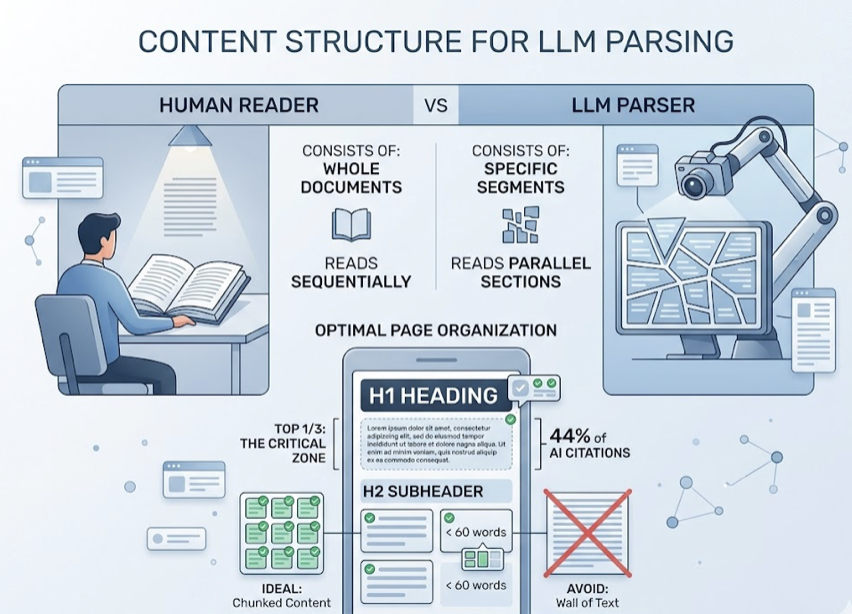
Content Structure measures how well your page is chunked for machine reading. LLMs don’t consume pages as whole documents. They parse sections and pull specific segments. Short declarative paragraphs under 60 words, with a clear heading hierarchy (H1-H4), score significantly higher than walls of text. Research shows that 44% of AI citations are drawn from the top third of a page, making that first scroll the most critical zone.
Schema Markup is the machine-readable bridge between your content and the AI’s interpretation of it. Pages with comprehensive JSON-LD schema are cited approximately 89% more often than those without it. FAQ, Article, HowTo, and Organization schema are the highest-impact implementations.
Authority Signals (E-E-A-T) reflect whether your content demonstrates verifiable expertise. AI engines are risk-averse. They prefer citing sources with explicit author bylines, linked professional profiles, and clear organizational credentials. Generic content without a byline is a structural liability.
Semantic Clarity evaluates how precisely your content defines concepts. Vague marketing language actively lowers this score. Direct factual language, with clearly stated definitions and a summary section, gives the LLM a ready-made synthesis to extract.
Competitive Positioning measures your Share of Voice relative to competitors across the AI’s response universe. LLMs are 6.5 times more likely to cite a brand through an external authoritative source than through the brand’s own domain. If competitors dominate Reddit threads and industry publications, your content score won’t offset that gap.
Factual Density is often cited as the most influential dimension. The Princeton and Georgia Tech research (Aggarwal et al., 2023) found that adding statistics to content can improve AI visibility by up to 40%. Specific data points, verifiable figures, and expert quotations make content far more “quotable” to a synthesis engine.
Step 1: Pick Your Free GEO Score Checker
Four tools cover the main diagnostic needs without requiring a paid account.
| Tool | What It Checks | Free Tier | Best For |
|---|---|---|---|
| RateMyGEO | 5-metric report scored against ChatGPT, Claude, Perplexity | Fully free, no signup | Beginners wanting a complete first report |
| Geoptie | 6-dimension holistic audit (technical + content) | Free standalone audit, no signup required | Technical SEOs and SMBs |
| Frase | Content structure and semantic coverage | Limited scans | Content writers focused on citability |
| HubSpot AEO Grader | Brand sentiment and recognition across 3 AI models | 100% free, brand name input | Marketing leads tracking brand perception |
For a first-time GEO audit, RateMyGEO is the clearest starting point. It’s built for tactical execution and generates actionable recommendations rather than just scores. Geoptie is the better choice if your priority is technical validation, specifically crawlability and structured data compliance.
Step 2: Run Your First GEO Audit in Under 10 Minutes
The process is faster than most traditional SEO audits because GEO checkers focus on a single page’s “answer-readiness” rather than site-wide crawl data.
Using RateMyGEO:
Open the tool and paste your target URL. The focus should be a specific landing page or blog post, not your homepage. The tool simulates how bots like PerplexityBot or GPTBot actually perceive the page, which is why URL-level analysis matters more than domain-level.
The scan takes roughly 60-90 seconds. While it runs, the tool checks for three high-impact signals specifically: the presence of FAQ sections with clear question-answer pairs, author credentials linked to a biographical schema, and statistical evidence within the first 200 words.
Once complete, you’ll see a composite score from 0 to 100, broken down by dimension.
Using Geoptie for Technical Validation:
Geoptie is worth running in parallel for its technical layer. Paste the same URL. The tool specifically checks whether AI crawlers are blocked (robots.txt issues), whether your schema is correctly implemented, and whether the content passes the “interpretability” threshold. These are binary fixes if you find failures, and they tend to have the fastest ROI of any GEO improvement.
Step 3: Read the Report Without Getting Lost
Score ranges follow a consistent threshold across most GEO diagnostic tools.
86-100 (Excellent): Your content is already structured for AI citation. The priority here is recency. About 50% of content cited by generative engines is less than 13 weeks old. A high score doesn’t mean passive management works.
61-85 (Good): You’re AI-ready but likely losing ground on competitive positioning or factual density. These aren’t structural failures. They’re optimization gaps that require targeted content engineering rather than a rebuild.
Below 60 (At-Risk): Content in this range is often invisible to generative engines. The most common causes are long paragraphs without H2/H3 hierarchy, missing or broken schema, and a complete absence of external citations or author authority signals.
Decoding specific low scores:
If your Structure score is low, the fix is usually linguistic. Break paragraphs into 2-3 sentences. Add a bulleted “Key Takeaways” section at the top of the page. The “Cite Sources” approach identified in Princeton’s research produced a 115.1% visibility boost for lower-ranked websites. That’s the gold standard for this dimension.
If your Schema score is low, it’s a technical fix that can often be deployed via a plugin like Rank Math. Implement Article and FAQ schema first. It’s a binary change with immediate machine-readability gains.
If your Authority score is low, the issue is external footprint. Generic content without author attribution, expert quotes, or links to academic or government sources loses the credibility signal LLMs rely on. Citing a named expert with a title is more effective than citing an unnamed study.
One Blind Spot Free Tools Can’t Catch
Here’s what every GEO score checker measures: the quality of your content as an input to AI systems.
Here’s what none of them measure: whether AI is actually mentioning your brand in live responses.
These are two separate questions. A brand can have a score of 85 on RateMyGEO and still have a mention rate of zero. That happens when the external footprint is weak: your content is technically AI-ready, but competitors dominate the Reddit threads, press coverage, and industry reports that LLMs actually pull from. Since AI models trust third-party authoritative sources 6.5 times more than your own domain, a high content score doesn’t guarantee your brand appears when the query is asked in real time.
The calculation is: Visibility Rate = (Queries mentioning the brand / Total queries in the test set) × 100. Free checkers don’t run that calculation.
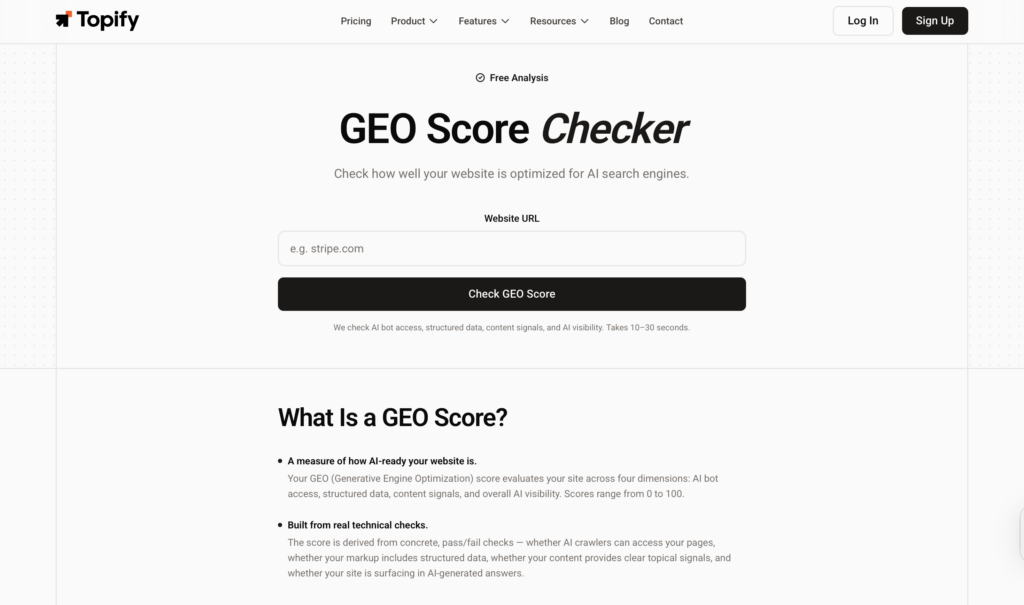
That’s where Topify’s GEO Score Checker fills the gap. While tools like RateMyGEO analyze what your content looks like to AI, Topify tracks what AI actually says about your brand across ChatGPT, Gemini, Perplexity, and other platforms in real time. It monitors Sentiment (is AI recommending you or merely mentioning you as a budget alternative?), Position (where do you rank in AI responses relative to competitors?), and Source Analysis (which third-party domains are shaping how AI describes your brand?).
Content score and mention rate are two legs of the same diagnostic. You need both to understand where you actually stand.
Turn Your Score Into a 3-Tier Action Plan
Not all GEO improvements deliver the same return. Prioritize by effort-to-impact ratio.
Tier 1: High ROI, Low Effort (fix this week)
Schema markup is the fastest lever. Implementing Article and FAQ schema is often a one-hour technical task that immediately improves interpretability. Also check robots.txt to confirm GPTBot and PerplexityBot aren’t accidentally blocked. That’s a binary fix with massive implications for your mention rate.
Tier 2: High ROI, Moderate Effort (content engineering)
Factual enrichment is the “gold standard” for citation likelihood. Go through your highest-traffic pages and systematically add specific statistics, named expert quotes, and data-backed claims. Rewrite section intros to lead with a direct answer in the first 40-60 words. That “answer-first” structure is what RAG systems pull most reliably.
Tier 3: Long-Term Investment (authority building)
Your external footprint determines your competitive positioning score. Industry publications, guest contributions, and presence in community discussions (Reddit, forums, Quora) are the sources LLMs trust most. This dimension can’t be optimized overnight, but it’s the one that protects your mention rate from competitors who are actively building it.
Conclusion
A GEO audit isn’t a one-time project. It’s the starting point for a new measurement discipline. Free tools like RateMyGEO and Geoptie give you the content-layer baseline: what your pages look like to AI bots, where the structural and technical gaps are, and which fixes will move the needle fastest.
That said, content score and brand visibility aren’t the same metric. Checking your GEO score is step one. Understanding whether AI is actually recommending you, and how often, is step two. The brands building durable AI visibility are running both diagnostics. Start with the free audit, fix the quick wins, then layer in the mention-rate tracking to close the loop.
FAQ
What’s a good GEO score?
Scores above 85 are considered excellent across most diagnostic frameworks, indicating content that is best-in-class for AI citation. Scores between 61 and 85 are solid but require competitive optimization. Anything below 60 typically signals structural or technical issues that make the content invisible to generative engines.
How often should I check my GEO score?
Run a comprehensive GEO audit quarterly. Because models like Perplexity and ChatGPT exhibit a recency bias (50% of cited content is under 13 weeks old), citation performance can shift faster than traditional SEO rankings. For core high-intent queries, tracking brand mention frequency weekly is worth the overhead.
Do GEO score checker tools work for all content types?
Yes. Free checkers can analyze blog posts, landing pages, service pages, and e-commerce product pages. AI Overviews are increasingly triggered for commercial and transactional queries, not just informational ones, so GEO optimization applies across the full content funnel.
Is GEO score the same as AI search visibility?
No, and this distinction matters. A GEO score measures the quality of your content as an input to AI systems. AI search visibility measures whether your brand actually appears in AI responses. You need both diagnostics to get a complete picture. Free tools typically cover the former; platforms like Topify cover the latter.
Can I check a competitor’s GEO score?
Yes. Most URL-based tools like Geoptie accept any public URL, so competitive benchmarking is possible. Understanding why a competitor scores higher in Structure or Schema often reveals specific technical improvements you can replicate quickly.

