

If your brand ranks #1 on Google, that’s no longer enough. Research shows that sites holding the top organic position appear in AI Overviews for the same query only 33.07% of the time. That’s not a rounding error. That’s a structural gap between where your brand lives in traditional search and where it actually shows up when someone asks ChatGPT, Gemini, or Perplexity for a recommendation.
A GEO rank tracker closes that gap. Here’s what it measures, why it’s harder to run than standard SEO tools, and how to put one to work.
Your Google Rank Doesn’t Tell You What AI Recommends
Traditional SEO tools track position in a list. AI search doesn’t work that way.
When a user asks “what’s the best project management tool for remote teams,” they don’t get ten blue links. They get a synthesized answer, and your brand is either in it or it isn’t. There’s no page two. There’s no position five. There’s cited, mentioned, or absent.
Only about 17% of AI Overview citations come from the traditional top-10 organic results, according to BrightEdge data. That means the other 83% of AI recommendations are driven by factors that standard rank trackers don’t measure at all. High domain authority, keyword-optimized pages, and clean technical SEO don’t automatically translate into AI citations. The rules are different.
This is the core problem a GEO rank tracker is built to solve.
What a GEO Rank Tracker Actually Measures
A GEO rank tracker monitors four distinct dimensions of AI search performance. Each one captures something that traditional tools miss entirely.
Position is where your brand lands relative to competitors in an AI-generated recommendation list. If someone asks for the top CRM tools and your brand is mentioned third, that’s your position. It’s not a page ranking. It’s a recommendation sequence.
Visibility measures how frequently your brand appears across a defined set of target prompts. Because AI outputs are probabilistic, the same prompt can produce different answers across different sessions. A reliable GEO rank tracker runs each prompt multiple times to calculate a statistically valid visibility score, not a single snapshot.
Sentiment tracks how AI describes your brand when it does mention you. The difference between “a cost-effective option” and “a reliable choice for enterprise teams” matters for conversion. Natural language processing parses the tone and attributes attached to your brand across thousands of AI responses.
Prompt Coverage maps which search scenarios actually trigger your brand’s appearance. This includes category queries (“best tool for X”), comparison queries (“A vs. B”), and problem-based queries (“how do I solve X”). Gaps in prompt coverage reveal where competitors are winning visibility that should be yours.
Together, these four metrics form the complete picture of your AI search position.
Why Tracking AI Rank Is Harder Than Tracking Google Rank
AI search monitoring introduces technical challenges that don’t exist in traditional SEO.
The first is non-determinism. Large language models generate outputs probabilistically. Even identical prompts produce different results across sessions because of sampling algorithms built into the model architecture. A single manual test tells you almost nothing. You need automated, large-scale sampling to get a number you can trust.
The second challenge is cross-platform fragmentation. The three major AI platforms don’t cite the same sources or follow the same logic.
ChatGPT draws roughly 48.73% of its citations from directories and aggregator sites like Yelp and TripAdvisor. It’s optimized toward third-party consensus, not brand-owned content. Google Gemini pulls approximately 52.15% of citations from official brand websites, particularly pages with structured data and clear Schema markup. Perplexity skews heavily toward community signals, with about 46.7% of citations sourced from Reddit and similar platforms. It also applies a recency weighting, favoring content updated within the past 30 days.
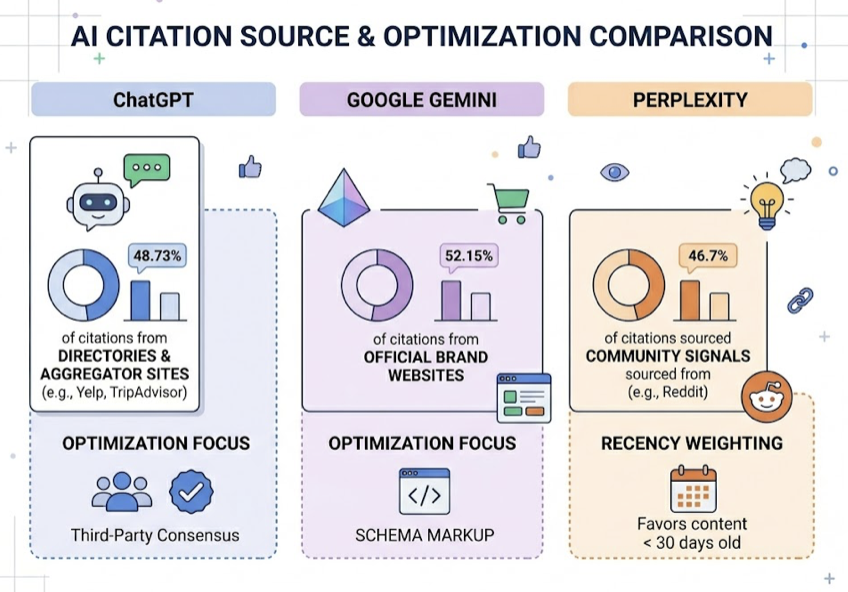
Your brand can be visible on Perplexity and invisible on ChatGPT. That’s not a bug. It’s a reflection of fundamentally different citation logic across platforms. Monitoring only one gives you a false read on your overall AI search position.
The third challenge is infrastructure. Google provides Search Console. Most AI platforms don’t offer equivalent visibility tools for brands. That makes third-party GEO rank trackers the only viable path to systematic monitoring at scale.
How to Start Tracking Your Brand’s AI Search Rank
Getting a GEO rank tracker up and running takes four steps. Each one builds on the last.
Step 1: Define Your Target Prompts
Start with prompt research, not keyword research. Think through the natural language questions your audience types into AI chat interfaces. A strong prompt library covers at least three categories: direct brand queries that check factual accuracy, competitive comparison queries that reveal whether your brand appears as an alternative, and informational queries where you want to be positioned as a category authority.
Plan for 50 to 100 prompt variations per core category. That volume sounds high, but AI search is probabilistic. Narrower prompt libraries produce data that’s too thin to act on.
Step 2: Choose the Platforms to Monitor
ChatGPT covers the broadest general search audience. Gemini integrates deeply with Google’s ecosystem and Android. Perplexity dominates the research and professional use case. Missing any one of them means missing a distinct segment of your target audience.
Platform gaps are also diagnostic. If your brand scores well on Perplexity but poorly on ChatGPT, that’s a signal that your third-party review and directory presence needs work. The cross-platform comparison is the data, not just the individual scores.
Step 3: Set Up Automated Tracking
Manual monitoring doesn’t scale. AI platforms update their retrieval logic continuously. Perplexity’s content refresh cycle operates in hours, not weeks. Checking rankings manually once a month means operating with data that’s already stale.
Topify’s AI search position monitoring handles this automatically, running your prompt library across ChatGPT, Gemini, Perplexity, and other major platforms from a single dashboard. Its Position Tracking feature monitors your brand’s rank relative to competitors in real time, and the Competitor Monitoring module flags when a rival moves ahead on prompts where you previously held an advantage.
The platform also surfaces near-top opportunities using Search Console integration, identifying prompts where your brand is close to breaking into AI citations but not yet appearing consistently.
Step 4: Read the Data and Act
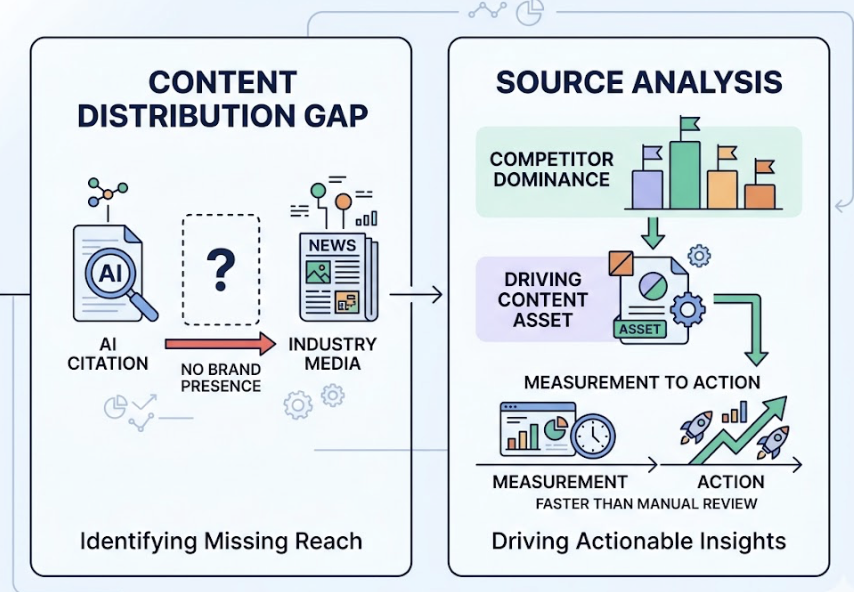
When your GEO rank tracker shows a drop in citation rate, the next question is why. Source Analysis answers that. It identifies the specific URLs and domains that AI platforms are pulling from and whether your brand’s content appears in those citations.
If AI is citing an industry media outlet heavily but your brand has no presence there, that’s a content distribution gap. If a competitor is dominating a specific prompt category, Source Analysis shows which of their content assets is driving that visibility. The data goes from measurement to action faster than any manual review could.
What Actually Moves Your AI Search Rank
Three factors have a measurable impact on AI citation rates. Understanding them shifts GEO from monitoring into optimization.
The first is fact density. Research consistently shows that content containing specific statistics, named data sources, and concrete figures gets cited at significantly higher rates. Content with original data is cited approximately 3.5 times more often than general-purpose content that relies on descriptive language instead of numbers. Replacing “a highly effective email marketing strategy” with “email marketing with an average ROI of 36x” changes how AI evaluates and extracts that content.
The second factor is third-party validation. AI systems have a built-in preference for information that appears verifiable and externally confirmed. Citations from recognized research institutions, direct quotes from named industry experts, and references to primary data sources all increase what researchers call “credibility weighting” in AI retrieval. Brand-owned content that references authoritative external sources performs better than brand-owned content that doesn’t.
The third factor is content structure. AI doesn’t read pages the way humans do. It extracts passages. Content organized into clear, 200 to 400-word blocks with descriptive headings and FAQ Schema allows AI to pull specific fact units without ambiguity. Dense walls of text, regardless of their quality, are harder for retrieval systems to parse accurately.
High domain authority still matters, but it’s no longer sufficient on its own. An outdated, poorly structured page from a high-DA site will often lose to a current, well-structured page from a lower-authority source. The GEO optimization lever has shifted from link building toward what practitioners call fact engineering.
Common Mistakes When Teams First Track GEO Rankings
Most early-stage errors fall into five patterns.
Trusting a single screenshot. One manual search result tells you almost nothing about your brand’s actual AI search rank. LLM outputs are probabilistic. A single positive result could be statistical variance. Without automated sampling across dozens of sessions, you don’t have a rank. You have an anecdote.
Ignoring competitor movement. If your brand’s citation rate holds steady at 15% but a competitor climbs from 10% to 40% over the same period, you’re losing relative share even though your absolute number didn’t change. GEO is inherently competitive. Absolute metrics without competitor context are incomplete.
Checking too infrequently. Monthly monitoring is effectively no monitoring for fast-moving AI platforms. Algorithm updates, competitor content launches, and platform indexing shifts can meaningfully change your position within days. Weekly automated tracking is the minimum viable frequency for most categories.
Conflating Google AI Overviews with AI Mode. These are distinct products with different citation logic. Research shows the URL overlap between what appears in Google AI Overviews and Google’s AI Mode is only 10.7%. Tracking one and assuming the other follows is a measurement error.
Skipping competitor source analysis. Knowing that a competitor outranks you is less useful than knowing why. When GEO rank data is paired with source analysis, teams can identify the specific content assets driving a competitor’s visibility and build a response strategy based on evidence rather than guesswork.
Conclusion
You can’t manage what you can’t measure. That’s especially true in AI search, where brand recommendations happen in generated text rather than ranked lists, and traditional analytics tools have no line of sight into what’s actually being said.
A GEO rank tracker isn’t a nice-to-have addition to an SEO stack. It’s the foundational measurement layer for any brand that wants to know where it stands in AI-driven discovery. Position, visibility, sentiment, and prompt coverage together tell you what’s working, what’s not, and where competitors are pulling ahead.
Topify provides cross-platform AI search monitoring across ChatGPT, Gemini, Perplexity, and other major platforms, with automated tracking, competitor benchmarking, and source analysis built into a single dashboard. If you don’t yet have a baseline for your brand’s AI search position, that’s the right place to start.
FAQ
What is a GEO rank tracker?
A GEO rank tracker is an automated tool that monitors how often a brand appears in AI-generated answers across platforms like ChatGPT, Gemini, and Perplexity. Unlike traditional SEO tools that track page position in link-based results, a GEO rank tracker analyzes generated text to measure brand visibility, recommendation order, and sentiment.
How is GEO ranking different from SEO ranking?
SEO ranking measures where a webpage appears in a static list of links. GEO ranking measures whether a brand is cited, recommended, or described in a synthesized AI response. The two can diverge significantly. A site ranking first on Google appears in AI Overviews for the same query only about one-third of the time, based on current data.
Which AI platforms should I track my brand on?
At minimum, track ChatGPT, Google Gemini, and Perplexity. Each platform uses different citation logic: ChatGPT favors third-party directories and community consensus, Gemini prioritizes structured brand-owned content, and Perplexity weights recent content and community signals. Cross-platform data reveals gaps that single-platform monitoring misses.
How often should I check my AI search rank?
Weekly automated tracking is the baseline for most teams. In fast-moving categories like technology or e-commerce, daily monitoring catches competitive shifts and platform indexing changes before they compound into larger visibility gaps.

