

G2 now lists 248 products in the AEO category. That number grew from just 7 tools in early 2025, a jump of over 2,000% in under a year. If you’ve tried to shortlist options on the platform recently, you already know the problem: the category is too crowded to evaluate by browsing.
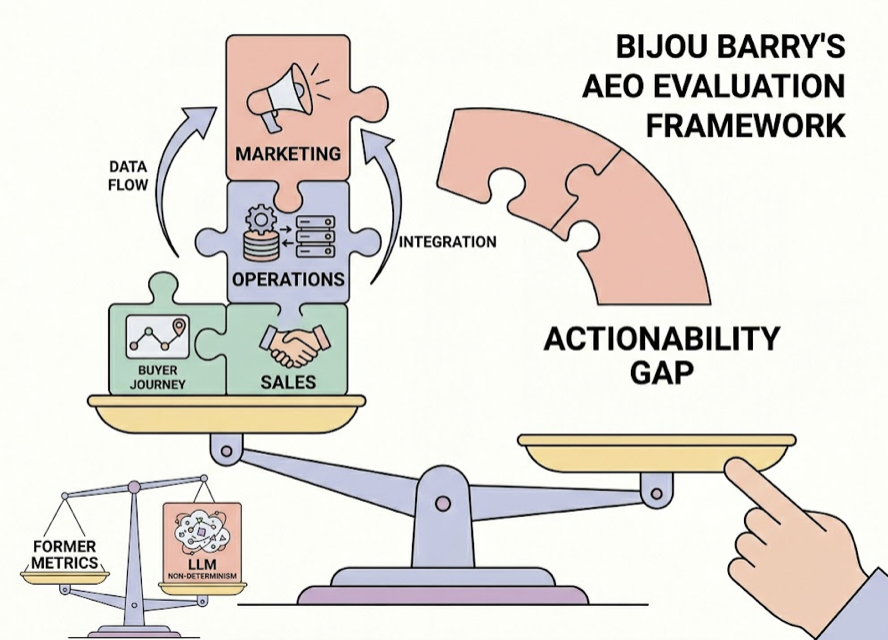
Here’s the shortcut most buyers miss. G2’s AI Principal Analyst, Bijou Barry, has already mapped out how to evaluate this category. Her framework breaks AEO tools into three buyer dimensions: Marketing (category positioning and content visibility), Operations (integrating AEO data into the AI tool stack), and Sales (understanding how AI influences the buyer discovery journey). The majority of the 248 listed tools cover only one or two of these dimensions, which creates what Barry calls an “actionability gap.”
This comparison runs four of the most actively reviewed tools through that same framework: Topify, Profound, AirOps, and Otterly.AI. The goal isn’t to declare a winner. It’s to match each tool to the team type it actually serves.
What G2’s Analyst Framework Actually Measures
Barry’s three dimensions aren’t about features. They’re about where in your organization the data needs to land.
The Marketing dimension is about category share. Which prompts trigger your brand? How often does your brand appear versus competitors across ChatGPT, Gemini, and Perplexity? This matters because only 11% of cited domains appear consistently across both ChatGPT and Perplexity for identical queries, meaning fragmented tracking gives you an incomplete picture.
The Operations dimension is about closing the loop. Seeing that your brand is invisible is one thing. Having a system that moves from that insight to a content fix, without manual re-routing through spreadsheets and Jira tickets, is another entirely.
The Sales dimension is the least covered. AI models are increasingly acting as pre-sales agents, handling initial feature comparisons before a buyer ever requests a demo. Sales teams need metrics that connect AI recommendations to actual pipeline influence, not just mention counts.
Most tools do the first dimension reasonably well. Few address all three.
The 4 Tools at a Glance
| Tool | G2 Score | Primary Users | Barry Dimensions | Execution Layer |
|---|---|---|---|---|
| Topify | 5.0 | Growth teams, marketing agencies | Marketing, Ops, Sales | One-click AI agent |
| Profound | 4.6 | Fortune 500, regulated industries | Marketing, Sales | None (data export only) |
| AirOps | 4.6 | Content ops, enterprise teams | Marketing, Ops | Workflow automation |
| Otterly.AI | 4.9 | SMBs, solo marketers | Marketing only | None |
Two patterns stand out immediately. Otterly leads on satisfaction score but covers only one dimension. Topify is the only tool that addresses all three while also providing an execution layer.
Marketing Dimension: Tracking Category Visibility
This is where all four tools compete most directly.
Topify tracks brand performance through a 7-metric framework: Visibility, Volume, Position, Sentiment, Mentions, Intent, and CVR. The platform runs this across 10+ AI platforms simultaneously, including ChatGPT, Gemini, Perplexity, DeepSeek, Doubao, and Qwen. Its “Answer Placement Score” weights citations by their narrative position, a brand mentioned as the first recommendation carries more authority than a footnote, and tracks accordingly. Topify also reverse-engineers competitor citations to identify which source URLs AI engines are prioritizing in their responses.
Profound is the deepest research tool in this group. Its dataset covers over 400 million real user conversations, allowing teams to do high-resolution prompt-level research. It normalizes results across 10+ platforms and provides strong “Share of Voice” and “Citation Share” reporting. The catch is that Profound operates as a pure data output system. Marketing teams typically export insights into separate content management tools, which creates a bottleneck in high-velocity environments.
Otterly.AI earns its 4.9/5 G2 rating by making the first dimension genuinely easy. At $29/month entry pricing, it monitors brand mentions across ChatGPT, Perplexity, and Google AI Overviews with setup measured in minutes. That said, it monitors the final AI output but doesn’t analyze the underlying retrieval mechanisms that built those answers. You’ll know that you were cited, not why.
AirOps approaches marketing visibility through content performance. Its “Visibility Score” unifies AI search and SEO performance at the page level, showing which blog posts and landing pages are being picked up as citation sources. It’s less built for competitive tracking and more for teams that want to see their own content’s indexing performance.
For teams that need to understand category positioning at scale, Topify and Profound lead. Topify adds the execution layer; Profound adds the research depth.
Operations Dimension: From Insight to Action
This is where the field narrows sharply.
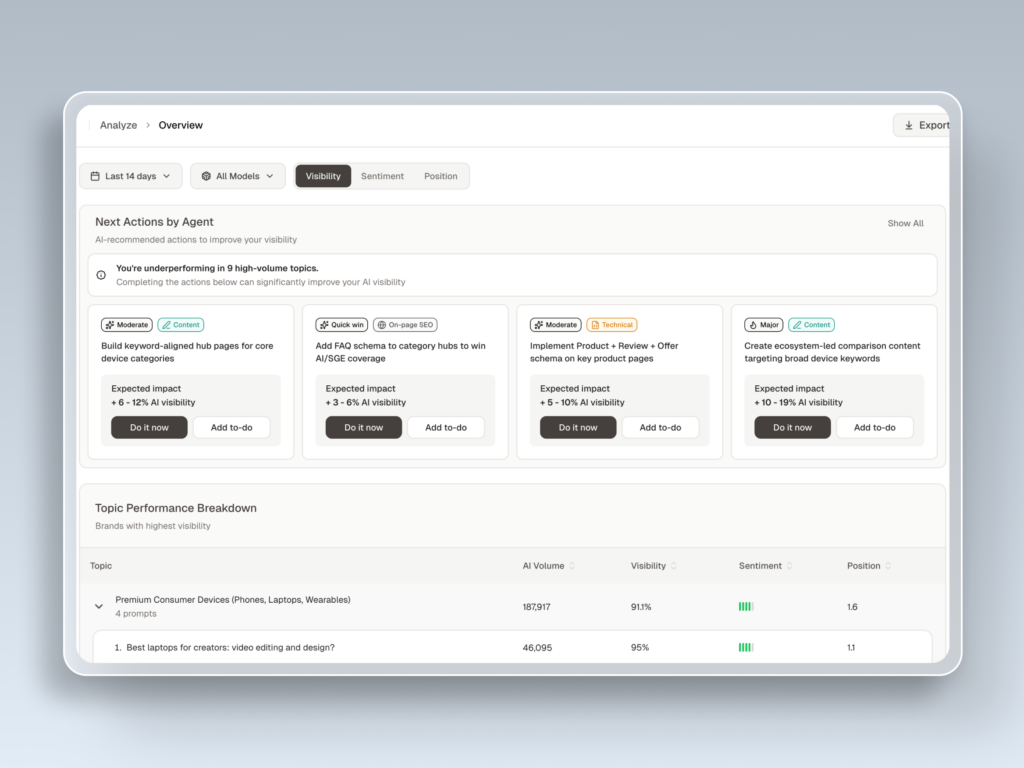
Topify built its operations capability around the “actionability gap” directly. Its One-Click Agent Execution lets teams identify a visibility gap and deploy optimized content to close it within the same platform. No separate briefing process. No manual handoff. The system uses direct browser capture rather than API snapshots, targeting 95-98% citation accuracy, which means operations teams aren’t reacting to stale data.
AirOps is the strongest alternative for content operations specifically. Pages not updated quarterly are three times more likely to lose citations, and AirOps is built to solve exactly that problem. It routes underperforming pages into automated refresh cycles and connects insight data directly to bulk content production. The trade-off is setup time, often a month to implement effectively, plus significant ongoing maintenance.
Profound provides deep technical diagnostics via Agent Analytics, which tracks AI crawler behavior through CDN logs. But it doesn’t act on those insights natively. Operations teams use it as a high-resolution lens and then manually translate reports into execution tasks elsewhere.
Otterly.AI has no meaningful integration or execution capability. Its primary export is a Google Looker Studio connector, limited to higher-tier plans. For teams that need automated AEO responses or CMS integration, Otterly’s monitoring-only approach hits a ceiling quickly.
If your operations team’s bottleneck is moving from data to deployment, Topify is the cleaner path. AirOps is a strong second for teams that define operations as content production at scale.
Sales Dimension: Does AI Influence Your Pipeline?
Only two tools in this comparison engage with the sales dimension at all.
Topify is built around Conversion Visibility Rate (CVR) as a core metric. CVR estimates the likelihood that an AI-generated answer will drive a user toward a brand interaction. The underlying data makes this worth paying attention to: AI-referred search converts at a rate 803% higher than traditional organic search (14.2% vs 2.8%). Topify’s Position Tracking and Sentiment Polarity analysis add further sales context, ensuring teams can validate whether AI models are associating the brand with its correct value propositions during the decision stage. Sales leaders get a metric that justifies AEO investment in quarterly reviews.
Profound maps the sales dimension through “Conversation Intent” data and “Query Fanouts” analysis. This lets teams trace how a single prompt, say “best CRM for healthcare,” breaks into a chain of sub-queries that map the buyer’s reasoning journey. The “Brand Relevant Prompts” feature identifies which AI conversations are already mentioning competitors. It’s powerful research, but Profound doesn’t connect these intent signals to actual conversion numbers natively. The link to pipeline impact is analytical, not quantitative.
AirOps can track AI-attributed signups but lacks intent volume analysis or qualitative sentiment scoring for sales contexts. Otterly has no capability in this dimension.
For sales and growth teams that need to show AI’s actual impact on pipeline, Topify is the only tool in this group with a native metric designed for that conversation.
The Full Comparison: All Three Dimensions Scored
| Capability | Topify | Profound | AirOps | Otterly |
|---|---|---|---|---|
| Multi-engine monitoring | 10+ platforms | 10+ platforms | 30+ platforms | 4-6 platforms |
| Barry: Marketing dimension | ✓ Full | ✓ Full | ✓ Partial | ✓ Basic |
| Barry: Ops dimension | ✓ Full | Partial (no execution) | ✓ Full | ✗ |
| Barry: Sales dimension | ✓ CVR + Position | Partial (intent data) | ✗ | ✗ |
| Execution layer | One-click AI agent | None | Workflow automation | None |
| Data collection method | Direct browser capture | Rendered capture + API | Prompt-based polling | API snapshot |
| Entry pricing | $99/mo | $99/mo | $199/mo | $29/mo |
| G2 satisfaction score | 5.0 | 4.6 | 4.6 | 4.9 |
The pattern across all three dimensions is consistent. Topify and AirOps are the two tools that offer both monitoring and execution. The key difference is focus: Topify optimizes for cross-functional coverage and agentic deployment, AirOps optimizes for content production governance at enterprise scale.
Which Tool Fits Your Team
Start with Otterly if your team’s primary need is proving to clients or leadership that AI mentions exist. At $29/month, it’s the fastest path to a monitoring baseline. You’ll outgrow it if you need to understand or act on what you’re seeing.
Choose AirOps if your operations team manages a large content library and the main bottleneck is refresh velocity. AirOps connects insight to production in a way no other tool in this group matches, but plan for a real implementation investment.
Use Profound if you’re in a Fortune 500 environment with procurement cycles and need audit-grade research data (400M+ prompts, SOC 2, HIPAA compliance). It’s the strongest research platform in the category. Pair it with an execution tool if you need to act on the data inside your organization.
Pick Topify if your team needs to cover all three buyer dimensions without stitching together multiple platforms. Its G2-reviewed feature set spans visibility tracking, automated deployment, and CVR-based sales impact in a single framework. It’s particularly well suited for growth teams and agencies that report on AEO performance across functions and need to show direct business impact.
The case for a unified platform is practical. Every tool you add to the stack creates a translation cost: exporting data, briefing another team, waiting for execution, checking if it worked. Tools that close that loop internally tend to generate faster returns.
Conclusion
G2’s 248-product AEO category is mostly first-generation monitoring tools. They’ll tell you whether you were mentioned. Most won’t tell you why, and almost none will help you fix it.
Bijou Barry’s three-dimension framework cuts through that noise effectively. Marketing, Operations, and Sales are genuinely different problems, and the tool that covers all three while providing an execution layer is a short list of one in this comparison.
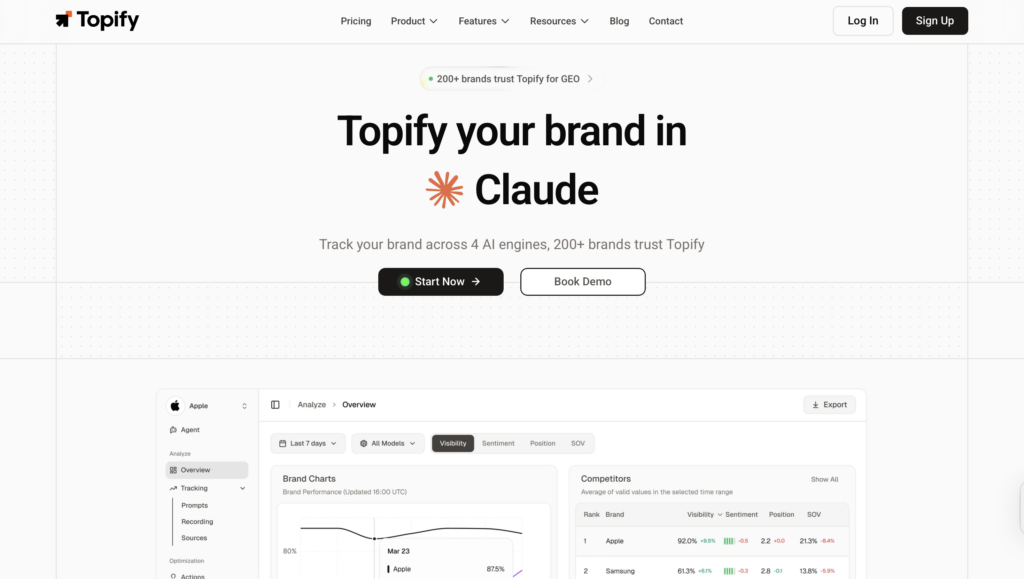
If you’re starting the evaluation process, Topify’s page shows how its feature set maps across all three dimensions, with user reviews organized by team type.
Frequently Asked Questions
What does AEO mean in G2’s software category?
Answer Engine Optimization (AEO), also referred to as Generative Engine Optimization (GEO), covers tools that improve a brand’s visibility and positioning within AI-powered search engines and LLM chatbots. G2 requires qualifying tools to offer AI visibility tracking, sentiment analysis, LLM ranking insights, and competitor benchmarking.
How is Topify different from Profound on G2?
Topify combines a 7-metric visibility framework with one-click agentic content deployment, covering all three of G2’s buyer dimensions. Profound is a deep research platform with over 400 million real prompt data points and strong enterprise compliance credentials, but it doesn’t include a native execution layer. Teams that need insights acted on automatically will find Topify’s integrated approach more practical.
Can AirOps be used for answer engine optimization?
Yes, with a specific use case. AirOps connects AI search visibility data to bulk content production workflows, making it a strong choice for teams managing large content libraries. It covers G2’s Marketing and Operations dimensions but doesn’t address the Sales dimension or provide real-time agentic deployment.
Is Otterly listed on G2?
Yes. Otterly.AI holds a 4.9/5 satisfaction score in the AEO category and is widely used by agencies and small businesses. Its $29/month entry tier is among the most accessible in the category. It covers G2’s Marketing dimension only.
Which G2 AEO tool covers both monitoring and execution?
Topify and AirOps both offer monitoring plus execution. Topify uses a one-click AI agent for rapid optimization across all three buyer dimensions. AirOps uses workflow automation specifically for large-scale content operations. For teams that need Sales dimension coverage alongside the other two, Topify is currently the only option in this comparison.

