

Most SEOs searching for a GEO score checker grab the first free tool that shows up and run a quick audit. The problem isn’t finding a tool. It’s not knowing what the score actually reflects.
These four tools each measure a different dimension of the same problem. Frase focuses on structural extraction. SnowSEO prioritizes trust signals. Keywordly embeds GEO into a full SEO workflow. Readdy flags the technical barriers that block AI crawlers entirely. They’re not interchangeable. And depending on what you’re trying to fix, picking the wrong one means you’re optimizing for the wrong layer.
Here’s a clear breakdown of what each tool actually does, and where each one stops.
Last Year’s GEO Playbook No Longer Explains AI Visibility
A year ago, “GEO optimization” largely meant cleaning up your headings and adding a few statistics. That still matters. But it doesn’t explain why brands that rank #1 on Google are consistently ignored by ChatGPT and Perplexity.
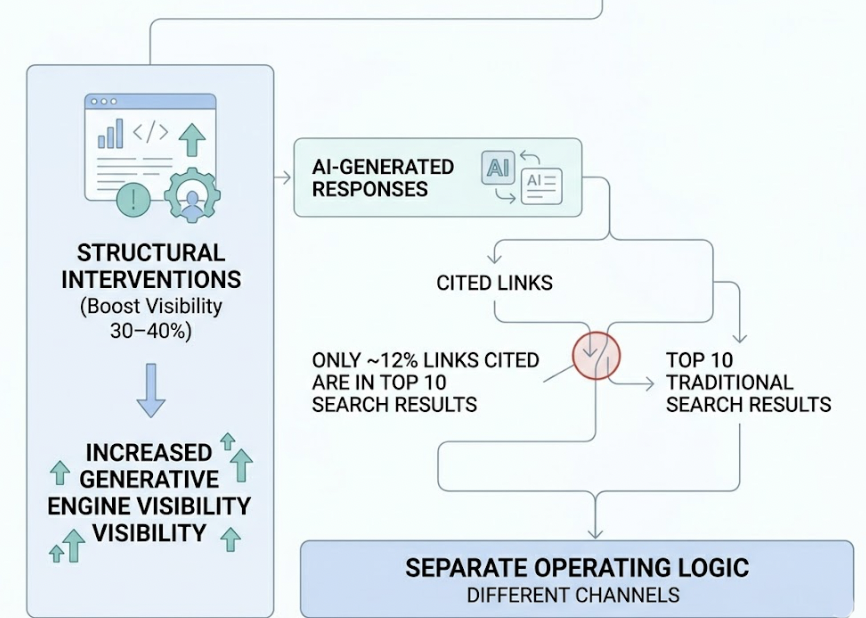
Research from Princeton University and Georgia Tech found that specific structural interventions can boost generative engine visibility by 30-40%. But they also surfaced a more uncomfortable finding: only about 12% of links cited in AI-generated responses also appear in the top 10 traditional search results. The two channels are operating on separate logic.
That’s the shift most free GEO checkers haven’t caught up to yet.
Generative engines run content through three distinct filters before a source ever gets cited. First, they parse the structure. Then, they evaluate credibility signals. Finally, and this is the layer most tools skip entirely, they check whether your brand has broader consensus across the web. A perfect score on layer one doesn’t protect you if layer three is empty.
The 4 Free GEO Score Checkers, Side by Side
| Tool | GEO Score Focus | E-E-A-T Analysis | Full SEO Workflow | Brand AI Citation Monitoring | Free Tier |
|---|---|---|---|---|---|
| Frase | Structural + citation-readiness | Limited (sourcing check) | Research to Brief | No | Yes |
| Keywordly | Multi-factor (0-100) | Moderate (Pillar 1 of 3) | Full SEO integration | No | Yes |
| SnowSEO | E-E-A-T-centric | Comprehensive (28 signals) | Audit to Fix Plan | No | Yes |
| Readdy | Technical extraction + crawlability | Minimal | Instant diagnostic | No | Yes |
| Topify GEO Score Checker | Brand + content layer combined | Consensus-based | Citation to Pipeline | Yes | Yes |
The “Brand AI Citation Monitoring” column is empty for the first four tools. That’s not a gap in their features. It’s a different product category. Content-layer checkers and brand-layer trackers solve different problems. The rest of this article explains both.
Frase: Built for Writers Who Need to Know If Their Content Will Get Cited
Frase scores your content against what a generative engine’s parser is actually looking for. Its free GEO checker produces five sub-scores: Citability (unique, quotable facts), Content Structure (heading hierarchy and modularity), Clear Definitions (explicit explanations designed for direct extraction), Key Takeaways (summary sections AI can pull verbatim), and Data & Citations (grounding in external research).
What makes Frase useful in practice is its competitive SERP layer. It identifies “content gaps,” questions that your competitors answer but your content doesn’t. Generative engines tend to skip thin pages that only partially cover a topic. Frase quantifies exactly how thin yours is.
Its limitation is scope. Frase audits what’s on your page. It has no view into whether AI engines are actually recommending your brand in live queries. For content editors doing pre-publish checks, it’s the right call. For teams troubleshooting why a well-ranked page isn’t appearing in AI answers, it stops short.
Keywordly Treats GEO as the Natural Next Step After SEO
Keywordly’s GEO Score Analyzer outputs a 0-100 rating across three pillars: Authority, Credibility, and Structure. It’s the most SEO-native tool in this comparison, built for teams that don’t want to manage a separate GEO workflow alongside their existing content operations.
Its standout feature is “fan-out query” detection. When a generative engine processes a prompt, it typically generates sub-questions to build a more complete answer. Keywordly identifies those latent queries, so writers can optimize for the full “prompt universe” around a topic rather than a single keyword. That shift from keyword-matching to semantic coverage is exactly how LLMs decide whether a page is comprehensive enough to cite.
The trade-off is depth on the GEO scoring side. Because Keywordly is integrating GEO into a broader SEO workflow, its brand visibility signals are moderate rather than comprehensive. It’s the right tool for volume-focused content teams making the transition to AI-first search. It’s not the right tool for diagnosing why your brand specifically isn’t appearing in ChatGPT responses.
SnowSEO Checks 28 E-E-A-T Signals. Most Tools Check Three.
SnowSEO is the most rigorous free option for brands where trust is a strategic requirement, including healthcare, finance, legal, and any YMYL category where AI models apply extra scrutiny to their sources.
Its GEO-Score audit runs across 22 factors grouped into 4 pillars, with a prioritized fix plan showing which signals to address first. The 28 individual E-E-A-T checks include author credentials and bylines, content freshness, non-stock imagery, and implementation of llms.txt, the machine-readable file that functions as a direct directive to AI crawlers for more efficient site-wide understanding.
SnowSEO also captures something important about how generative engines evaluate sources at scale. If a site has inconsistent entity definitions or outdated facts across multiple pages, the AI’s confidence in that domain drops across the board. A single optimized pillar page isn’t enough. SnowSEO flags the inconsistencies that undermine site-wide trust.
For editorial teams and regulated publishers, it’s the most thorough free audit available. For marketing teams troubleshooting brand-level AI visibility, it answers a different question than the one they’re actually asking.
Readdy Finds the Technical Blocks That Everything Else Ignores
Readdy’s GEO Score Checker focuses on a problem the other tools assume isn’t there: whether AI crawlers can actually access your site in the first place.
Their research found that approximately 30% of websites block AI crawlers including GPTBot, ClaudeBot, and PerplexityBot due to outdated robots.txt directives. A brand could score 92/100 on Frase and still be completely invisible to generative engines because the infrastructure never let them in. Readdy checks for that before anything else.
It’s the fastest option in this comparison. No account required, instant results, clear output. What it doesn’t offer is editorial depth. It won’t tell you whether your content is well-structured or whether your E-E-A-T signals are strong. It tells you whether the door is open.
Use Readdy as the first check in any technical SEO audit. Use one of the other tools for what comes after.
Your Content Score and Your Brand Visibility Are Two Separate Numbers
Here’s the finding that most content audits miss entirely.
A brand can score 87/100 on Frase. Clean structure, good fact density, no crawl blocks. And Topify’s tracking shows 0% Share of Voice across 40 category-level prompts in their industry. The content is optimized. The brand isn’t visible. Those are two different problems.
The reason is how generative engines actually select sources. According to data from AI citation analysis, consensus across third-party platforms has a predictive correlation of 0.664 with AI visibility. Brand search volume correlates at 0.334. Domain authority and backlinks? Between 0.08 and 0.18. Traditional authority metrics are poor predictors of AI citation behavior.
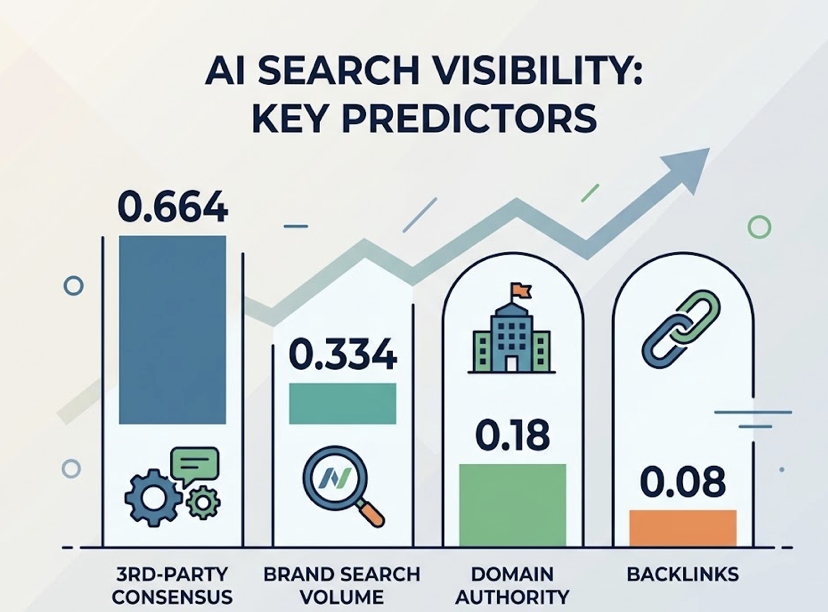
Generative engines prioritize sources that have demonstrated consensus across the web, Reddit threads, niche review sites, news coverage, and third-party comparisons. That’s not content GEO. That’s brand GEO. And no structural audit tool measures it.
GEO Score Checker
Topify’s GEO Score Checker is where that layer becomes measurable. It tracks actual brand mentions in generative responses across ChatGPT, Gemini, Perplexity, and other major AI platforms, calculating Share of Voice for specific buying-intent prompts. It also runs Sentiment Analysis alongside visibility, because a brand cited frequently in negative contexts (described as “expensive” or “complex”) suffers in recommendation environments even when the mention count is high.
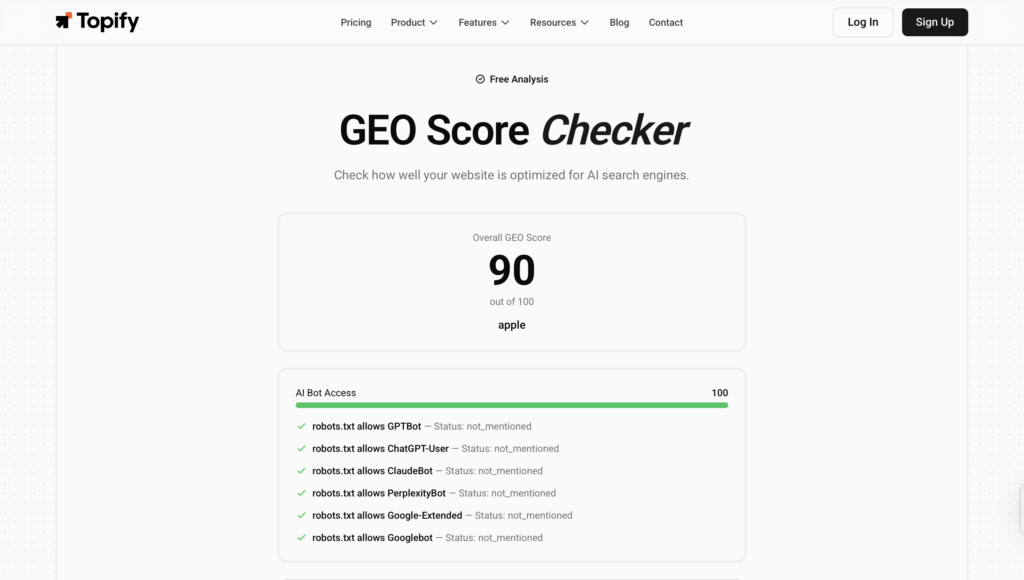
The Topify platform also reverse-engineers citations, showing exactly which third-party domains AI models pull from when recommending brands in your category. That tells you where your brand needs to show up in the broader web ecosystem, not just on your own site.
Early data suggests AI referral visitors convert at roughly 5x the rate of traditional search traffic. The brands that capture that channel aren’t necessarily the ones with the highest content GEO scores. They’re the ones with the strongest brand-layer presence.
Which Tool Should You Start With?
The right starting point depends on what you’re actually trying to diagnose.
| Scenario | Recommended Tool |
|---|---|
| Pre-publish audit on a single URL | Frase or Readdy |
| Suspected crawl block or technical barrier | Readdy first |
| GEO integrated into existing SEO content workflow | Keywordly |
| YMYL content or E-E-A-T is your primary concern | SnowSEO |
| Diagnosing why AI doesn’t recommend your brand | Topify GEO Score Checker |
| Ongoing brand visibility tracking across AI platforms | Topify |
In practice, most teams need more than one. Readdy and Frase cover the pre-publish content layer. Keywordly fits teams scaling content production with GEO built in. SnowSEO is the authority on trust signals. And Topify covers the dimension none of the others touch.
High content GEO scores are table stakes. Brand-level AI citation is the actual outcome.
Conclusion
The four free GEO score checkers in this comparison are all useful. They’re also measuring different things. Frase scores citation-readiness. Keywordly builds GEO into your SEO workflow. SnowSEO audits E-E-A-T at depth. Readdy catches the crawl blocks that silently exclude your site from AI discovery.
What none of them track is whether your brand actually appears when users ask AI engines to recommend a solution in your category. That’s the Topify GEO Score Checker’s purpose, and it’s a different data layer entirely.
Start with the tool that matches your bottleneck. Then ask the question the content scores don’t answer: when someone asks ChatGPT what to use, does your brand come up?
FAQ
What is a GEO score?
A GEO score rates how well your content is positioned to be extracted and cited by generative AI engines like ChatGPT, Gemini, and Perplexity. Most tools score factors like structural clarity, factual density, and E-E-A-T signals. Scores above 70 are generally considered solid; above 85 is strong. Below 60 usually means the content needs structural work before it’s citation-ready.
Is a GEO score the same as an SEO score?
No. An SEO score evaluates keyword relevance and backlink signals for traditional ranking. A GEO score evaluates “citable potential,” how easily an AI can extract and verify a specific fact from your content. A page can rank #1 on Google with a low GEO score, and vice versa. The two metrics reflect two separate algorithmic systems.
Can a high GEO score guarantee AI visibility?
No. A high score means your content is structurally eligible for citation. Actual visibility depends on the brand citation layer, whether the AI’s training data and web-consensus signals identify your brand as trustworthy. You can have a perfect content GEO score and zero AI recommendations if your brand lacks third-party consensus.
Do I need a paid tool to check my GEO score?
Free tools work well for auditing specific pages. Frase, SnowSEO, Readdy, and Keywordly all offer free tiers that cover content-layer analysis. Daily tracking across 100+ prompts, historical trend data, and sentiment monitoring typically require a paid platform.
What’s the difference between content GEO and brand GEO?
Content GEO is the structural and factual optimization of your own pages. Brand GEO is how your brand appears across the broader web, including news coverage, Reddit discussions, and third-party reviews. AI models weight consensus heavily when deciding what to recommend. You need both layers to be visible in generative search.

