

You’re ranking number one on Google. Your content team spent months on it. Your backlink profile is clean.
And ChatGPT has never mentioned your brand once.
That’s not a fringe scenario. It’s where a growing share of marketing budgets are quietly disappearing, and most teams don’t realize it until the traffic numbers start telling a different story.
Your Google Rank and Your AI Rank Are Two Different Things
Traditional SEO is built on crawling, indexing, and link authority. AI search is built on semantic reasoning, entity recognition, and consensus-based synthesis. These are not the same thing, and the gap between them is measurable.
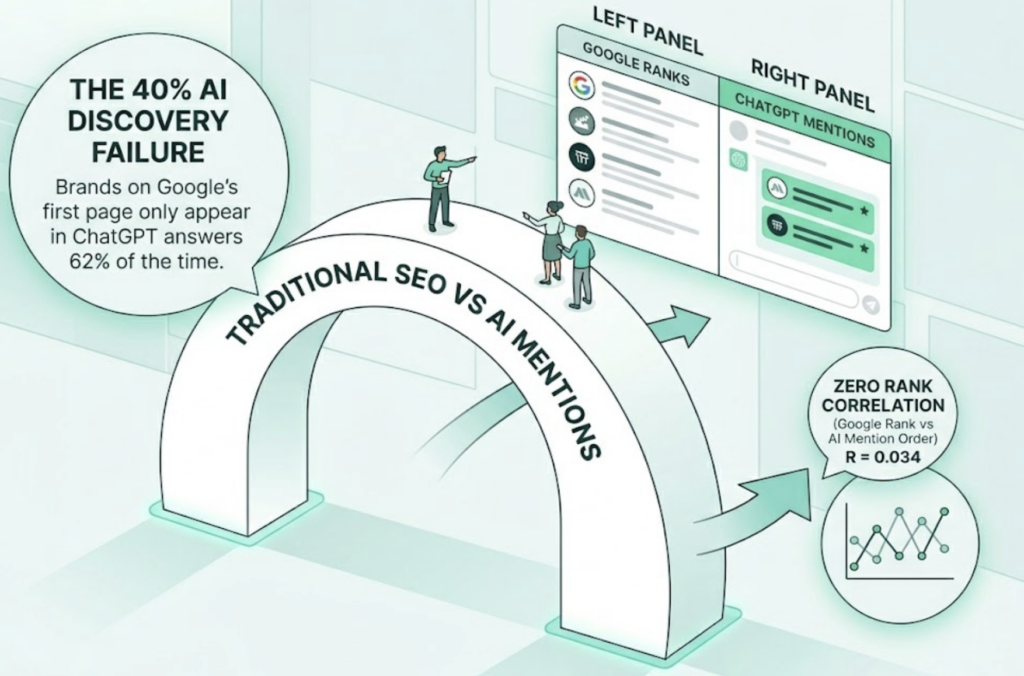
A study comparing Google rankings with ChatGPT mentions found that brands on Google’s first page appeared in ChatGPT answers only 62% of the time. That’s a nearly 40% failure rate for the brands that “won” traditional search. The rank correlation between a brand’s Google position and its order of mention in an AI response sits at roughly 0.034, which is effectively zero.
The divergence gets more stark when you look at commercial queries. Research by Profound on “Best men’s running shoes” found only an 8% overlap between Google’s top results and ChatGPT’s cited sources, with a negative correlation of -0.98. The more an AI favored a URL, the less likely it was to rank highly on Google. The reason: Google prefers direct brand pages; AI engines lean toward deep editorial reviews with high information density.
This isn’t a temporary gap. It’s structural.
| Platform / Metric | 2024 | 2025 | Change |
|---|---|---|---|
| ChatGPT Weekly Active Users | 400M | 900M | +2.25x |
| Perplexity Monthly Queries | 230M | 780M | +3.39x |
| AI Search Market Share | ~5% | 12-15% | ~2.5x |
| Google Market Share | >90% | 89.74% | First drop below 90% in a decade |
And the user behavior shift compounds this. In 2025, zero-click searches reached 58.5% in the US, rising to 83% when Google AI Overviews were active. For brands, that means the AI answer itself is the ad. There’s no click to fall back on.
What Answer Engine Optimization Actually Means
Answer Engine Optimization (AEO) is the discipline of structuring and positioning a brand’s digital content so AI platforms can understand, trust, and cite it as a definitive answer to specific user questions.
The goal isn’t traffic to a URL. It’s becoming the source the AI quotes.
AEO vs SEO: Not a Replacement, an Additional Layer
SEO establishes whether your content can be found and indexed. AEO determines whether it gets extracted and used once an AI agent finds it. Both matter, but they require different execution.
AEO and GEO (Generative Engine Optimization) are often used interchangeably. The practical distinction: GEO focuses on long-term citability within the conversational narratives of LLMs like ChatGPT and Claude; AEO focuses specifically on “answer-first” features like Google AI Overviews and Perplexity’s instant answers, where a single snippet satisfies the user’s query without a second click.
| Feature | Traditional SEO | AEO / GEO |
|---|---|---|
| Primary Goal | Clicks to website | Citations and brand mentions |
| Success Metric | SERP Ranking (1-10) | Citation Frequency and Share of Voice |
| Mechanism | Backlinks and keywords | Semantic structure and authority signals |
| User Journey | Discovery → Click → Site | Discovery → Answer (zero-click) |
Brands that ignore the AEO layer can rank on page one of Google and still lose the buyer to a competitor whose content is structured for AI extraction.
Which Platforms Count as “Answer Engines”
The answer layer of the internet has diversified fast. It now includes ChatGPT (900M+ weekly active users), Perplexity (favored by B2B researchers for its transparent citation model), Google AI Overviews (reaching 2 billion monthly users), Gemini, Claude, and Microsoft Copilot.
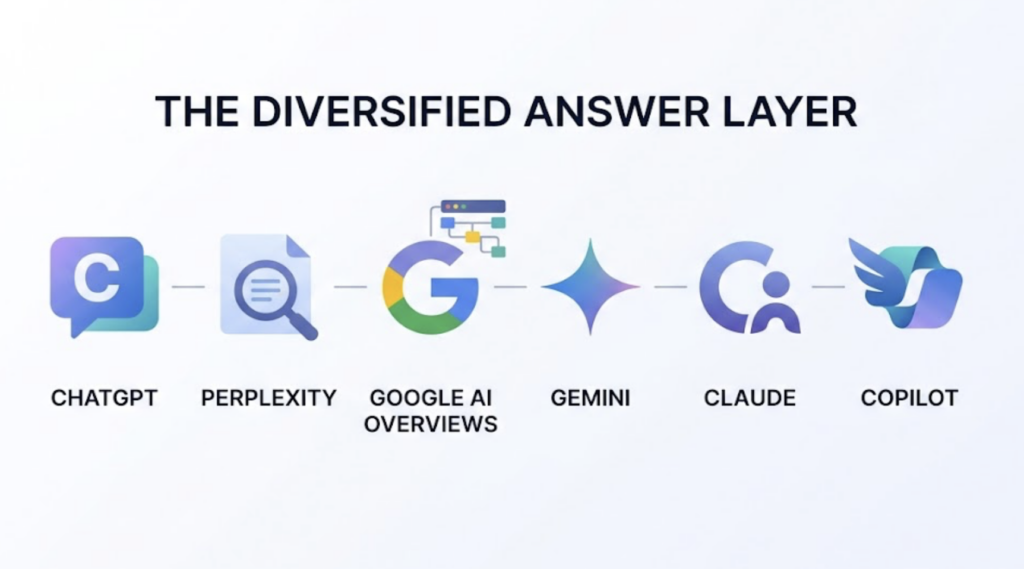
Each platform uses a different retrieval and citation logic. A strategy that only optimizes for one is already leaving coverage gaps.
4 Signals That Decide If AI Recommends Your Brand
AI engines don’t pick sources randomly. They evaluate content based on four signals that indicate relevance, authority, and what practitioners call “extractability.”
1. Structured Content. Technical structure often outweighs content depth. FAQ sections are cited 3.2 times more frequently than the same information in paragraph form. About 44% of all LLM citations are pulled from the first 30% of a page. An “inverted pyramid” structure, where the direct answer comes first and context follows, is a core AEO tactic.
2. Citation Sources. Brands are 6.5 times more likely to be cited by an AI through a third-party source than through their own website. Brand mentions correlate with AI visibility at 0.664. Backlinks, the traditional SEO gold standard, correlate at only 0.218. Reddit threads, Wikipedia, industry publications, and G2 reviews are stronger predictors of AI visibility than most link-building campaigns.
3. Brand Authority Signals. AI models evaluate brand entities, not just individual pages. Consistency and “validation density” across multiple credible sources saying the same things about your features, pricing, and positioning build entity authority. Fragmented or conflicting information across subdomains actively undermines it.
4. Prompt Coverage. AI users don’t search for keywords; they ask layered questions. Google and other AI systems use “query fan-out,” breaking a single prompt into multiple sub-queries. A search for “best accounting software for freelancers” generates simultaneous sub-queries like “freelancer accounting tools,” “Xero vs Quickbooks for freelancers,” and “best accounting software 2026.” AEO requires content that addresses the primary question and the inevitable fan-out queries that follow.
The Gap Most AEO Audits Miss
Most AEO audits stop at one binary question: Is the brand mentioned or not?
That’s the wrong question.
A brand can appear in 50% of relevant AI responses and still be losing to a competitor that appears in 30% of responses, if that competitor is always listed first and described favorably. Position and sentiment are what convert visibility into business value.
Position matters. A brand mentioned as the “top recommendation” receives substantially more trust than one referenced as a secondary alternative in the same response. Measuring “Answer Placement Score” (APS), which weights earlier mentions more heavily (first = 1.0, middle = 0.6, end = 0.3), gives a more accurate picture of competitive prominence than raw mention rate.
Sentiment matters more than most teams expect. AI engines don’t just list brands; they describe them. If training data or retrieved sources include hedging language (“popular but lacks enterprise support”) or common complaints, the citation can actively damage brand perception. Sentiment drift across AI platforms is a reputation risk that traditional brand monitoring tools aren’t designed to catch.
This is where Topify’s Visibility Tracking and Source Analysis address a gap that simpler audits miss. Instead of flagging whether a brand appears, Topify identifies the specific domains that are shaping the AI’s understanding of that brand: which Reddit threads, which comparison sites, which editorial reviews the model treats as authoritative. If a competitor is being cited in a “top 10” list the AI uses to formulate its answer, that specific URL shows up as a content gap, not a vague recommendation to “create more content.” That’s the difference between monitoring and actionable intelligence.
| Audit Metric | Definition | AEO Impact |
|---|---|---|
| Citation Rate | % of prompts where brand is mentioned | Foundational baseline |
| Share of Voice | Mentions relative to competitors | Competitive benchmarking |
| Answer Placement Score | Weighted score by mention order | “Top recommendation” status |
| Sentiment Polarity | Tone of AI description | Reputation and narrative risk |
How to Start Building an AEO Strategy
AEO isn’t a one-time content refresh. It’s an ongoing tracking and iteration cycle, because roughly 40-60% of AI-cited sources rotate monthly.
Step 1: Audit your current AI presence across real buyer questions. Don’t just search your brand name. Search for the solutions you provide. Run 20-50 high-value buyer questions (“What’s the best [category] tool for [use case]?”) across ChatGPT, Perplexity, Gemini, and Google AI Overviews. This reveals your AI Inclusion Rate and surfaces exactly which competitors own your category in LLM responses.
Step 2: Identify which sources AI is pulling from, not just whether you appear. Source analysis tells you what information the AI trusts about your space. If it’s citing a three-year-old blog post or a specific subreddit to describe your product category, that’s the pool you need to influence. Compare those cited sources against your own content: Is your content too sales-heavy? Does it lack direct, scannable data that AI agents can extract? That gap is your roadmap.
Step 3: Fix content structure and build third-party authority. Restructure high-traffic pages with TL;DR summaries at the start of each section and headings formatted as natural-language questions. Deploy FAQPage and HowTo schema, which increase citation likelihood by 40-42%. Semantic URLs with descriptive slugs generate 11.4% more citations than generic ones. On the authority side, get subject matter experts quoted in cited publications and engage actively in relevant Reddit communities to create fresh, positive signals in the AI retrieval pool.
Then track. Re-run your core prompt set weekly or monthly, because the AI answer landscape moves faster than most content calendars.
FAQ
Q: Is AEO the same as GEO?
Not exactly. AEO focuses specifically on “answer-first” features like Google AI Overviews and Perplexity’s direct answers. GEO covers the broader challenge of being cited within the conversational narratives of LLMs. In practice, the strategies overlap significantly, and most teams treat them as part of the same discipline.
Q: Does AEO work for small brands?
Often yes. AI engines favor topical depth and expert accuracy over raw domain authority. A small business with the most comprehensive, direct answer to a niche question can outperform larger brands that produce generic or sales-heavy content. The playing field is less skewed by budget than traditional SEO.
Q: How long does it take to see results from AEO?
Technical signals like schema validation show up quickly. Most sites with a solid content foundation see initial citations and ranking shifts within 4-8 weeks. Consistent, meaningful visibility across multiple AI platforms typically takes 3-6 months as models build confidence in the brand’s authority.
Q: What’s the first metric I should track?
AI Citation Rate: the percentage of relevant industry queries where your brand is cited as a source. Track it alongside Share of Voice to understand how you’re performing relative to direct competitors, not just in isolation.
Conclusion
Search is splitting into two parallel systems. Traditional search returns a list; AI search returns an answer. Brands optimizing only for the first system are invisible in the second.
AEO is the discipline that bridges that gap. It’s not about abandoning what works in SEO. It’s about adding a layer that ensures the content you’ve already built can be understood, trusted, and cited by the AI systems that are increasingly intercepting your buyers before they ever reach a search results page.
In a zero-click economy, the most valuable digital real estate isn’t a high-ranking link. It’s being the source the AI chooses to quote.

