

Your dashboard looks clean. Keyword rankings are holding. Domain authority is up. Organic traffic is steady.
And yet, when a potential customer asks ChatGPT to recommend tools in your category, your brand doesn’t show up. Your competitors do.
That’s not a technical glitch. That’s an AI visibility problem. And your SEO tool won’t catch it.
SEO Measures Search Engines. AI Has Its Own Rules.
Traditional SEO is built around one assumption: users search, Google returns links, users click. Your job is to rank high in that list. It’s a system based on keyword matching, backlink graphs, and domain authority scores.
Generative AI doesn’t work that way. When someone asks ChatGPT a question, it doesn’t return a ranked list of URLs. It synthesizes an answer, pulls from multiple sources, and presents a conclusion. The user never has to click anywhere.
Here’s what makes this a structural problem, not just a tactical one. Research shows the correlation between Google rankings and ChatGPT citations is approximately 0.034. That’s essentially zero. A brand that dominates Google search has no statistical guarantee of appearing in AI-generated answers.
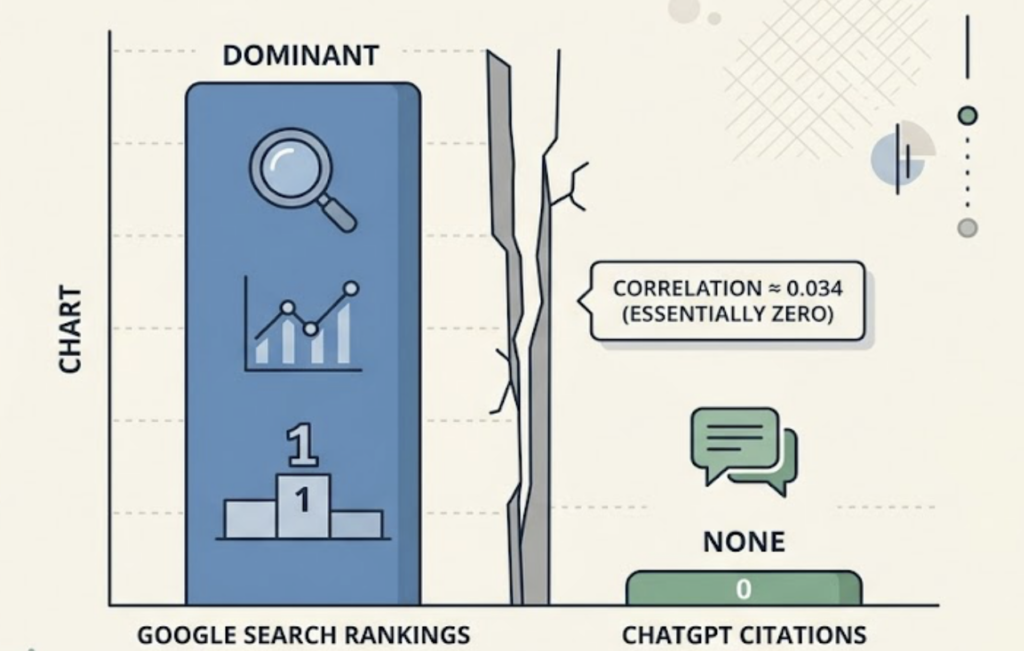
SEO optimizes for the index layer. AI operates on the synthesis layer. These are two different games.
So What Exactly Is AI Brand Visibility?
AI brand visibility is how often, how prominently, and how positively your brand appears in answers generated by AI systems like ChatGPT, Perplexity, Gemini, and DeepSeek.
It’s not a single number. It’s a multi-dimensional signal made up of three core components.
Mention frequency measures how often your brand appears across hundreds of relevant prompts in your category. Because AI outputs are probabilistic, one test query tells you almost nothing. You need to simulate the full range of questions your buyers actually ask.
Sentiment measures how AI describes you when you do appear. Being mentioned as “a budget option” versus “an industry-recognized leader” are both mentions, but they produce very different buyer perceptions. A high mention rate paired with weak or negative descriptors can actively work against you.
Position measures where in the answer your brand appears. The first recommendation in an AI response carries significantly more weight than a brand listed third with no elaboration. AI doesn’t just mention brands, it ranks them implicitly through the structure of its answer.
Platforms like Topify formalize this into seven trackable metrics: visibility rate, total mentions, sentiment score, position index, prompt volume, intent match, and conversion visibility rate (CVR). Each one connects AI-end performance to downstream business outcomes.
The Brands Winning in AI Aren’t Always Winning in Google
This is where things get counterintuitive.
Approximately 88% of AI citations come from sources that don’t appear in the top ten Google results for the same query. The brands AI chooses to recommend are often not the brands ranking highest in traditional search.
Why? Because AI systems don’t optimize for backlinks or page authority. They optimize for entity clarity, third-party consensus, and structured, extractable information. A domain authority 40 vertical media site that was cited once by The Verge can outrank a DA 80 competitor in AI-generated answers if its content is clearer, more data-rich, and more frequently referenced across independent sources.
There’s also what researchers call “AI consensus verification.” If your brand claims to be the fastest or most secure option but that claim only lives on your own website, AI models discount it. They’re looking for corroboration from Reddit threads, industry publications, analyst reports, and structured review platforms. Without that external validation, the claim doesn’t register as credible.
A B2B CRM query illustrates this well. Google’s top result is typically a high-DA media site optimized for keywords. ChatGPT’s top source for the same query is often a vertical industry association’s annual report, chosen for entity accuracy and multi-source consensus. Perplexity favors content updated within the last 30 days. Three platforms, three entirely different selection logics.
5 Signs Your Brand Has an AI Visibility Gap
Most brands don’t know they have this problem until a sales rep mentions that prospects arrived already having eliminated them from consideration. By then, the damage is done.
Here are the signals to watch.
AI uses your data but not your name. If your research or statistics appear in AI answers without attribution, your content lacks identity markers. A report titled “2025 Industry Trends” gets treated as common knowledge. A report titled “Topify AI Search Report 2025” gives AI a named source to cite.
Aggregators are standing in for you. If AI recommends your product by citing a G2 review page or a Wikipedia entry rather than your own domain, your owned content doesn’t register as authoritative enough to be a primary source.
Your SEO share of voice is 30%. Your AI citation share is under 5%. This is the clearest signal. Content optimized heavily for traditional search algorithms tends to be too verbose, too keyword-dense, and too difficult for AI systems to extract clean “atomic facts” from.
You rank on page one. AI still skips you. This happens when your pages are built to maximize time-on-site rather than to answer questions directly. AI prioritizes content where the core answer appears in the first 40-60 words. Long-winded introductions and buried conclusions are extraction dead ends for AI.
Sales is hearing it before data is. When prospects tell your team they “already looked into you and moved on,” they often mean they asked an AI and your brand didn’t make the recommended list. This loss is invisible in your analytics. No click, no session, no bounce rate. Just a deal that never started.
What Actually Drives AI Brand Visibility
About 63% of your current AI visibility is determined by your historical brand footprint: how consistently you’ve been mentioned, cited, and referenced across the web before any AI model was trained. That part is slow to change.
The remaining 37% can be moved in weeks, not months, through targeted content and citation strategies.
Research from Princeton University and IIT Delhi formalized this into what they call GEO (Generative Engine Optimization). Their findings show that adding authoritative citations to a page can boost AI visibility by up to 115% for lower-authority sites. Restructuring content to place the direct answer first improves visibility by roughly 32.5%. These aren’t abstract recommendations. They’re structural changes to how you present information.
The underlying mechanism is AI’s preference for “token efficiency.” Content that delivers a clear, fact-dense answer in the opening sentences gets extracted and cited more often than content that builds slowly toward a conclusion. If your page starts with “In today’s competitive landscape…” you’ve already lost the AI’s attention.
Third-party consensus matters just as much. A brand that appears consistently across G2, Capterra, relevant Reddit threads, and two or three industry publications signals to AI that its authority is real, not self-declared. That cross-platform presence is what AI uses as a proxy for credibility.
You Can’t Improve What You Can’t See
Here’s the practical problem: none of this shows up in Google Search Console, Semrush, or Ahrefs. Those tools are measuring the index layer. AI visibility lives in the synthesis layer, and it requires a completely different measurement approach.
Topify is built specifically for this. Rather than tracking keyword positions, it simulates hundreds of buyer prompts across ChatGPT, Perplexity, Gemini, and other platforms, then measures where and how your brand appears across all of them.
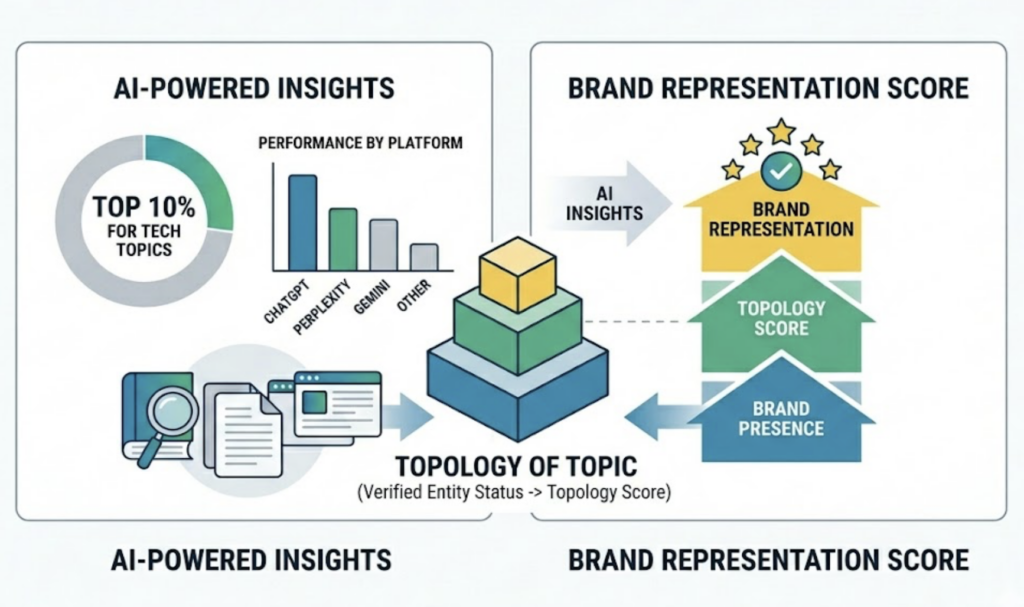
A B2B marketing team used this approach to audit their AI presence and found their visibility for the prompt “most secure collaboration tool” was 15%. Their main competitor was at 60%. Topify’s Source Analysis revealed why: AI was pulling from a Reddit thread and two 2023 industry comparison articles, none of which mentioned the brand.
The team didn’t respond by writing more blog posts. They updated relevant wiki entries, launched an expert Q&A program on Reddit, and restructured their core product page to front-load their security certifications. Within a month, their AI mention share had climbed to 45%, and the sentiment descriptor had shifted from “unknown” to “highly trusted.”
That’s the operational loop: measure, identify the source gap, fix the specific content structure, remeasure.
Conclusion
SEO tells you how visible you are to Google’s algorithm. AI brand visibility tells you whether you exist in the answers that buyers are actually using to make decisions.
They’re not competing priorities. They’re parallel ones. SEO is your passport to traditional search. AI visibility is your presence in the new layer of discovery that’s growing alongside it.
The brands that win in this environment aren’t necessarily the biggest or the best-funded. They’re the ones with the clearest, most credible, most consistently cited digital footprint. That’s a game that smaller brands can compete in, if they know the rules and can measure their position.
Right now, most brands are flying blind. That’s the actual problem. Not that AI visibility is hard to build, but that most teams don’t yet know where they stand.
FAQ
Is AI brand visibility the same as GEO?
Not exactly. AI brand visibility is the outcome, how often and how well your brand appears in AI-generated answers. GEO (Generative Engine Optimization) is the set of techniques used to improve that outcome. Think of visibility as the metric and GEO as the strategy.
Does good SEO help with AI visibility at all?
It helps, but indirectly. Research suggests that 76-86% of AI citations do appear somewhere in traditional search results, so SEO gets your content into the pool AI can pull from. What SEO doesn’t do is ensure your content gets selected and synthesized into an answer. That’s where GEO-specific structure and third-party consensus matter.
How quickly does AI visibility change?
Faster than most teams expect. Real-time retrieval platforms like Perplexity can shift citation sources within days based on fresh content. Core model-based visibility (in ChatGPT, for instance) changes more slowly, but remains responsive to structured content updates. The practical recommendation is to audit your top brand prompts on at least a 30-day cycle.
Can a smaller brand compete with established players in AI answers?
Yes. AI systems weight content quality and third-party corroboration more than brand size. A focused brand with structured, data-rich content that’s cited across a handful of credible third-party sources can outrank a much larger competitor whose content is optimized for traditional search but poorly structured for AI extraction.

