

Your brand could have five-star reviews on G2, a strong social presence, and stable organic traffic — and still be completely invisible when a potential customer asks ChatGPT to recommend a solution in your category.
That’s not a hypothetical. It’s happening to most brands right now, and traditional monitoring tools won’t catch it.
AI brand monitoring exists to close that gap. But it tracks something fundamentally different from what most marketers expect.
Your Brand Might Have Great Reviews. AI Still Might Not Recommend You.
Traditional brand monitoring was built for a different internet. Tools like Google Alerts, Brandwatch, and Mention were designed to crawl static web pages and real-time social feeds — and flag any time your brand name appeared.
The problem is that AI doesn’t work that way.
When a user asks Perplexity “what’s the best CRM for startups,” the answer is generated on-the-fly through a process called Retrieval-Augmented Generation (RAG). That synthesized response doesn’t exist as an indexable webpage. It’s private, dynamic, and invisible to any crawling-based tool. Your brand could be omitted from thousands of high-intent recommendations every day without triggering a single alert on a traditional dashboard.
The scale of this blind spot is larger than most teams realize. AI search queries now average 23 words compared to four for traditional search, and sessions run about six minutes on average. These are deeper, more intent-rich conversations — exactly the kind where buying decisions get made. And up to 70.6% of AI referral traffic gets misclassified as “Direct” in Google Analytics because AI platforms frequently strip referrer headers.
That’s why the gap is so easy to miss. Traffic looks fine. The problem is invisible.
The 5 Core Signal Types AI Brand Monitoring Actually Tracks
AI brand monitoring doesn’t track mentions. It tracks recommendation signals — the specific data points that determine whether, how, and how favorably an AI describes your brand in response to a user query.
Here’s what a complete monitoring setup measures.
1. Visibility Rate
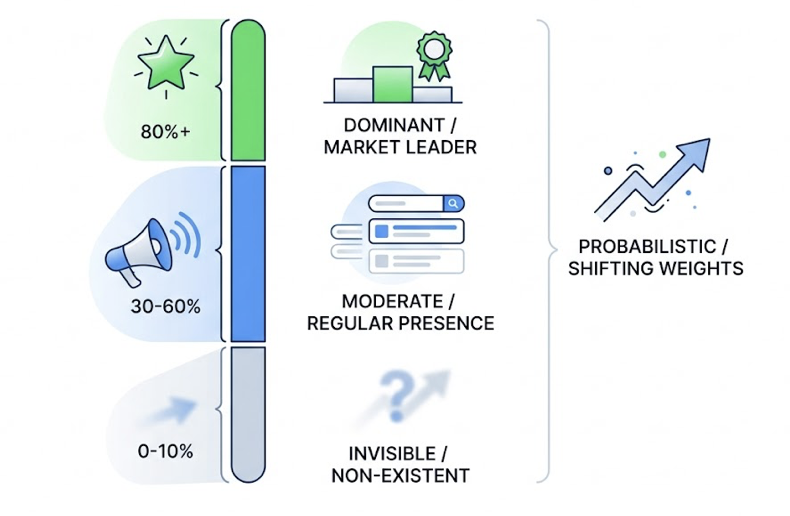
This is the percentage of relevant prompts where your brand appears in the AI response. Think of it as your “inclusion probability” across a defined set of queries.
It’s probabilistic, not binary. A brand might appear in 40% of responses to a specific prompt one week and 60% the next, depending on how the model’s retrieval weights shift. Research suggests a clear benchmarking scale: 0-10% means your brand is essentially invisible in AI search; 30-60% is moderate; 80%+ puts you in dominant territory.
2. Sentiment Score
Being mentioned isn’t enough. The framing matters.
An AI might describe your brand as “reliable but expensive” or “a solid alternative for teams that don’t need advanced integrations.” Those aren’t neutral statements — they’re shaping the buyer’s first impression. Sentiment analysis in AI monitoring uses NLP to quantify whether the AI is acting as an advocate or quietly steering users toward a competitor.
High visibility with consistently negative framing is a reputation problem. And it’s one that traditional social listening tools typically won’t catch before it affects your pipeline.
3. Position Tracking
In a list of AI recommendations, order carries real weight. Being the first brand mentioned in a ChatGPT response is meaningfully different from appearing fifth in a “you might also consider” list.
Position tracking also includes Word Count Share: how much of the AI’s response is dedicated to your brand versus a competitor. That ratio tells you a lot about the model’s perceived preference.
4. Source Citation Analysis
AI models ground their answers by pulling from specific domains and URLs. Source analysis tracks which sites the AI is actually citing when it mentions your brand.
The data here is striking. Third-party sources are cited 6.5 times more often than brand-owned pages. Earned media — coverage in outlets like TechCrunch or the Wall Street Journal — accounts for roughly 48% of AI citations. Review platforms like G2 account for another 11%. If the AI is citing an outdated forum thread or a competitor-authored comparison post when it references your brand, that’s a strategic problem with a specific fix.
5. Conversion Visibility Rate (CVR)
CVR is a predictive metric that estimates how likely an AI recommendation is to drive a user toward a brand interaction. It accounts for the prominence of the recommendation, the intent alignment of the prompt, and whether the AI’s answer is “summarized” (no reason to click) or “referential” (user is directed to your site for more detail).
The value is significant: AI-referred traffic converts at 4.4 to 11 times the rate of traditional search traffic. CVR helps you understand how much of that opportunity you’re actually capturing.
The Platforms AI Brand Monitoring Needs to Cover
Different AI platforms don’t produce the same answers. A brand that ranks first in ChatGPT responses might not appear at all in Perplexity — because each model has different retrieval logic, training data, and citation preferences.
This makes platform coverage a foundational decision in any AI brand monitoring setup. Monitoring one platform and assuming it represents your overall AI visibility is the same mistake as checking one social network and calling it “brand monitoring.”
A meaningful setup covers at minimum: ChatGPT, Gemini, Perplexity, and AI Overviews. For brands with global reach, platforms like DeepSeek and Doubao are increasingly relevant. Topify, for example, tracks brand performance across all major AI platforms in a single dashboard — so you’re comparing signal across the same prompt set, not guessing whether platform differences explain your results.
How AI Brand Monitoring Differs from Social Listening
These two disciplines are often conflated. They shouldn’t be.
Social listening is reactive. It monitors what humans are writing — on X, Reddit, review sites, and forums — and alerts you when your brand gets mentioned. It’s well-suited for crisis response, community engagement, and trend detection.
AI brand monitoring is proactive. It queries generative models directly to understand how your brand is being synthesized and recommended during the discovery phase. It doesn’t read what people write. It tracks what AI has learned.
| Dimension | Traditional Social Listening | AI Brand Monitoring |
|---|---|---|
| Data Source | Human-authored content | AI-synthesized responses |
| Data Environment | Public social feeds, indexed pages | Dynamic, private user sessions |
| Primary Method | Web crawling, keyword matching | Prompt probing across LLM APIs |
| Visibility Goal | Brand mentions | AI recommendations |
| Funnel Position | Top of funnel awareness | Bottom of funnel decision |
The two tools belong in the same stack. They don’t replace each other — they cover different layers of how your brand is perceived and discovered.
What AI Brand Monitoring Looks Like in Practice
The mechanics are clearer with a real example.
A B2B SaaS company selling CRM software for startups had stable organic traffic and no obvious signals of a problem. When they set up AI brand monitoring for the first time, they found their Visibility Rate for “best CRM for startups” was only 22%. A major competitor was at 54%.
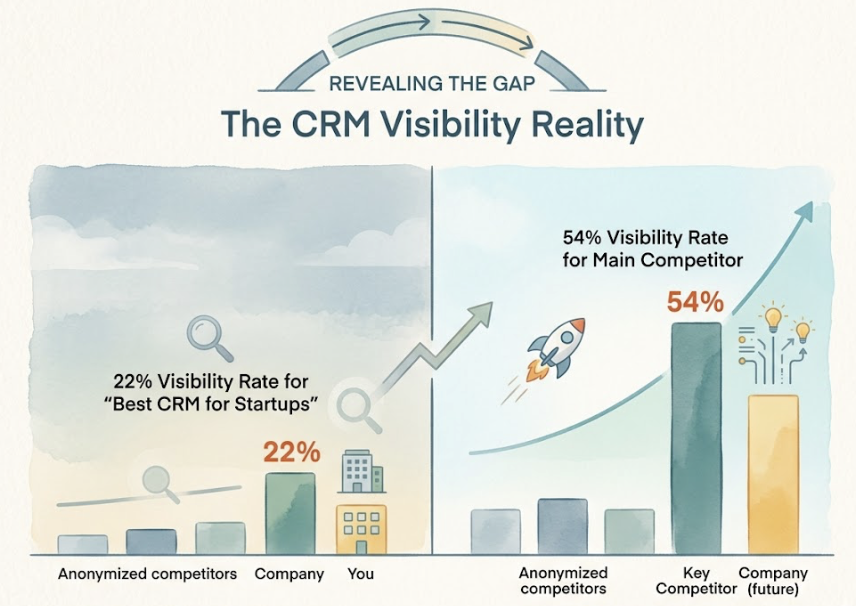
Source analysis revealed why. For 65% of AI recommendations in that category, the model was citing a specific TechCrunch article and G2 profiles. The competitor had a G2 Leader badge and 500+ recent reviews. The brand’s G2 presence was outdated.
They ran a three-part fix over six weeks: schema markup for entity clarity, 100 new G2 reviews targeting the startup keyword cluster, and content restructuring to front-load answers and increase information density.
The results: Visibility Rate moved from 22% to 38%. Position improved from 4th to 2nd recommendation on average. CVR increased 115%. And they saw a 25% increase in “Direct” traffic converting at 10.21% — the behavioral fingerprint of pre-qualified AI referral traffic.
That’s what monitoring enables. Not just a report, but a clear signal chain from gap to fix to outcome.
A complete setup with Topify starts at $99/month for the Basic plan, which covers 100 prompts and 9,000 AI answer analyses across ChatGPT, Perplexity, and AI Overviews — enough to establish a meaningful baseline for most teams.
Conclusion
AI brand monitoring tracks five core signal types: Visibility Rate, Sentiment, Position, Source Citations, and Conversion Visibility Rate. It covers multiple AI platforms simultaneously. And it operates on a fundamentally different data layer than social listening or traditional SEO tools.
The brands that understand this distinction aren’t just better informed. They’re building in a place where most competitors are still blind.
If you’re not sure where to start, pick one question your customers actually ask — “what’s the best [your category] for [your use case]” — and run it manually across ChatGPT, Gemini, and Perplexity. Record what appears. That first look at your AI visibility baseline will tell you more about your brand’s discovery problem than a month of social monitoring reports.
FAQ
What does AI brand monitoring actually track?
It tracks how your brand appears in AI-generated responses: whether you’re included (Visibility Rate), how you’re described (Sentiment), where you rank in recommendations (Position), which sources the AI cites (Source Analysis), and how likely the recommendation is to drive a conversion (CVR).
Is AI brand monitoring the same as social listening?
No. Social listening tracks human-authored content on social media and the web. AI brand monitoring directly queries generative models to understand how your brand is synthesized and recommended during the discovery phase. They’re complementary tools that work on different data layers.
How often should I run AI brand monitoring?
A weekly-monthly-quarterly rhythm works well for most teams. Weekly checks catch volatile shifts or competitor surges at the prompt level. Monthly reviews track sentiment trends and citation changes to guide content updates. Quarterly audits inform executive strategy and budget decisions.
Which AI platforms should I monitor?
At minimum: ChatGPT, Gemini, Perplexity, and Google AI Overviews. For global brands, DeepSeek and other regional platforms are increasingly worth including. Each platform uses different retrieval logic, so your visibility can vary significantly across them.
Can AI brand monitoring show me why a competitor ranks higher?
Yes. Source analysis reveals which third-party domains the AI is pulling from for competitor recommendations that it’s ignoring for yours. That gap tells you exactly where to focus PR, review generation, and content restructuring efforts.

