

A SaaS buyer asks ChatGPT to recommend a project management tool. ChatGPT responds with three names. Yours isn’t one of them.
Not because your product is worse. Because the agent couldn’t find enough consistent, authoritative signals to include you.
That’s the Agentic SEO problem. And most SaaS teams don’t know they have it.
AI Agents Don’t Search Like Humans. Your SEO Strategy Doesn’t Know That Yet.
Traditional SEO optimizes for ranking on a results page. GEO (Generative Engine Optimization) optimizes for being cited in an AI-generated answer. Agentic SEO is the layer above both: getting your product into the workflow of an AI agent that’s executing a task on a buyer’s behalf.
These aren’t interchangeable. They’re a stack. And most SaaS teams are still working on layer one.
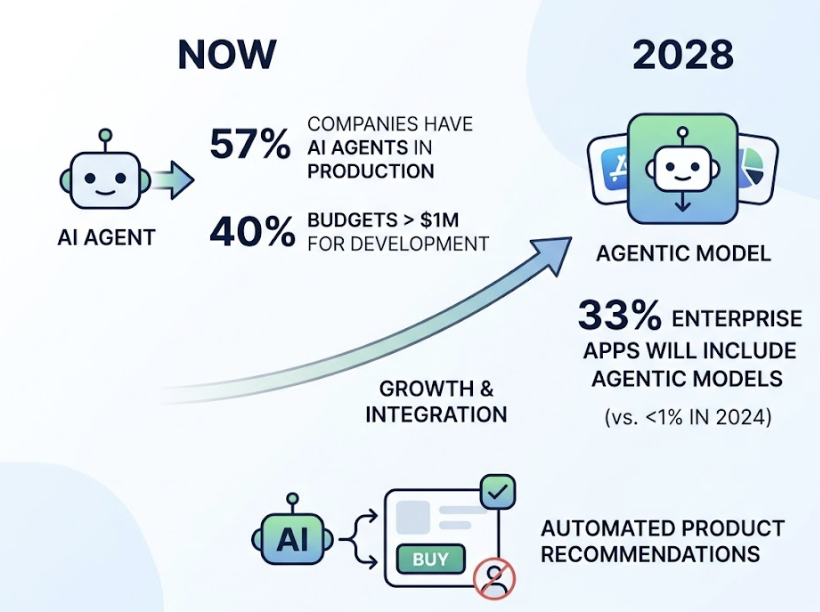
As of 2026, 57% of companies already have AI agents in production, with 40% allocating budgets exceeding $1 million specifically for agentic AI development. Gartner projects that by 2028, 33% of enterprise applications will include agentic models, up from less than 1% in 2024. The agent isn’t coming. It’s already making product recommendations right now, often without a human in the loop.
If your brand isn’t optimized for how agents discover and evaluate SaaS products, you’re not in the conversation.
The Agentic SEO Gap Most SaaS Brands Haven’t Found Yet
Most SaaS content is written for human readers.
That’s increasingly a liability. When an AI agent evaluates which analytics platform, CRM, or security tool to recommend, it doesn’t read your homepage the way a prospect does. It parses signals across multiple sources, scores your brand’s authority and consistency, and synthesizes a recommendation in seconds.
The sourcing logic varies by platform, and the differences are significant. Google Gemini draws 52.15% of its citations from brand-owned content, which means your structured, schema-optimized website carries real weight. ChatGPT relies more heavily on third-party consensus, with 48.73% of citations pulling from directories and review platforms like G2, Capterra, and Reddit. Perplexity favors niche experts and mid-tier industry publications.
One product. Three platforms. Three completely different discovery paths.
If you’re only optimizing one of them, you’re leaving most of your AI visibility on the table.
How AI Agents Actually Decide What to Recommend
Forget keyword ranking. Agents work through a four-stage reasoning cycle: perception, reasoning, action, and learning.
In the perception phase, the agent gathers available signals about your product category. In the reasoning phase, it evaluates which brands have consistent, cross-platform presence. It then acts by surfacing the most credible options, and refines its outputs as it processes feedback from tool calls and user interactions.
What this means practically: the agent isn’t looking for the product with the most features. It’s looking for the brand it can confidently recommend.
That confidence is built through what researchers call the “Consensus Pattern”: AI models cross-reference claims across vendor sites, third-party editorial, review platforms, and community discussions before including a brand in a recommendation. If your homepage says one thing, G2 describes something slightly different, and Reddit users share a third experience, the agent’s confidence drops. Inconsistency is a visibility killer.
Reddit, specifically, has become a high-trust signal for LLMs, accounting for over 40% of AI citations in some product categories. That’s not noise. That’s a distribution channel most SaaS marketing teams still don’t treat seriously enough.
3 Signals That Determine Your Agentic SEO Visibility
Signal 1: Source Authority
Agents prioritize brands that appear consistently across the platforms they pull from. Pages with attribute-rich schema markup earn citation rates above 60%, while pages with missing or generic schema are often skipped entirely. That means your product listing, structured data, and third-party coverage on G2, Capterra, and relevant subreddits aren’t optional extras. They’re your agent-facing distribution layer.
FAQPage schema alone increases citation rates by up to 2.7 times, because it directly maps to how LLMs answer questions. If you haven’t implemented it across your key product and category pages, that’s a gap worth closing today.
Signal 2: Semantic Precision
Can an agent accurately describe what your product does after reading your content?
If your positioning relies on vague language like “powerful,” “intuitive,” or “next-generation,” an agent has nothing concrete to extract. Semantic precision means writing in direct, exact terms: “a pipeline analytics tool that tracks deal velocity by rep and segment” is machine-readable. “An innovative sales intelligence platform” is not.
There’s also a freshness factor. AI-cited content is, on average, 25.7% fresher than traditional search results. RAG systems filter by recency. A product page or comparison article that hasn’t been updated in 18 months is being actively deprioritized across agentic workflows.
Signal 3: Prompt-to-Brand Alignment
This is the gap most SaaS teams don’t see until it’s pointed out.
When a buyer asks an agent “what’s the best tool for tracking AI search visibility across platforms,” the agent retrieves content that maps to that exact question pattern. If your content covers the concept but uses different terminology, the alignment score drops, and your brand doesn’t surface.
Discovering which prompts agents actually use in your product category, and making sure your content maps to them directly, is foundational Agentic SEO work.
How to Build an Agentic SEO Strategy for Your SaaS Product
Step 1: Audit your current AI visibility
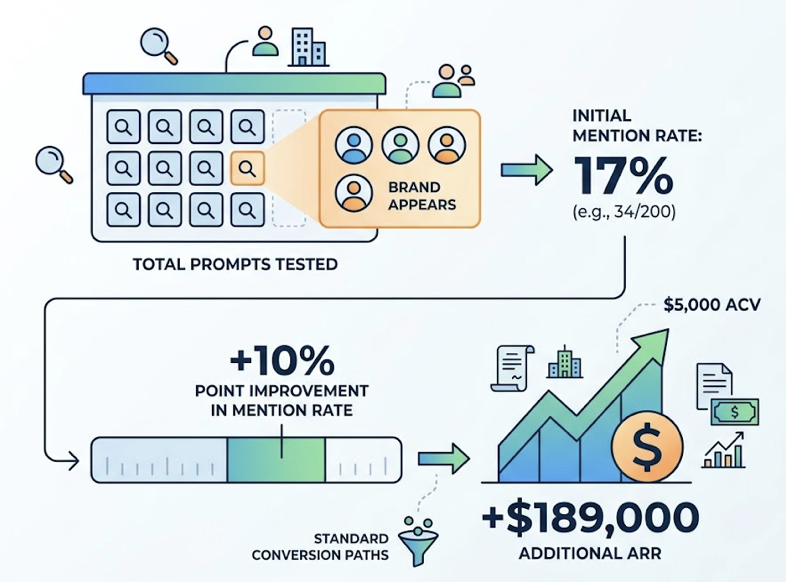
Before optimizing, you need to know where you stand. Build a set of 100-200 category-level prompts and run them across ChatGPT, Gemini, Perplexity, and other platforms. Track how often your brand appears. That’s your mention rate baseline.
To put it in concrete terms: if you test 200 prompts and your brand appears in 34 of them, you have a 17% mention rate. That number is your starting point. A 10-percentage-point improvement in mention rate, for a SaaS product with a $5,000 average contract value, can translate to roughly $189,000 in additional ARR, assuming standard referral-to-paid conversion paths.
Step 2: Map the prompts agents use in your category
These aren’t keyword searches. They’re conversational, task-framed, and often comparative: “which tool should I use to monitor my brand in AI responses” or “compare options for GEO tracking for a mid-size B2B team.” Your content needs to answer those questions, using that language, in a format agents can parse and cite.
Step 3: Build distributed source coverage
No single piece of content gives you visibility across all agents. You need consistent presence across the platforms each agent trusts: accurate G2 and Capterra listings, brand mentions in relevant subreddits, citations in industry publications, and schema-optimized pages on your own domain.
For SaaS teams building this out, Topify provides the infrastructure to track exactly where you’re visible and where you’re not, across ChatGPT, Gemini, Perplexity, DeepSeek, and other major AI platforms. Its Source Analysis feature reverse-engineers which domains AI engines are actually citing in your product category, so you know where to invest instead of guessing.
Topify’s Visibility Tracking maps your brand’s performance across seven metrics: visibility, sentiment, position, volume, mentions, intent, and CVR (Conversion Visibility Rate). CVR estimates the likelihood that an AI recommendation leads to actual brand engagement, which is increasingly the metric SaaS marketing teams need to justify Agentic SEO investment to leadership.
Measuring Agentic SEO: What the Right Metrics Actually Look Like
Traditional SEO KPIs won’t tell you whether an AI agent is recommending your product or silently leaving you off the shortlist.
Mention Rate measures the percentage of relevant prompts that result in your brand being named. Share of Voice compares your mention volume to competitors’. Citation Rate tracks how often a mention includes a source link back to your content, and linked citations increase reappearance likelihood by 40%. Position tracks where in the response your brand appears: first mention, buried in a list, or absent entirely.
Sentiment monitoring isn’t optional. Mentions with inaccurate or negative framing are often worse than no mention at all. If an AI model describes your product as discontinued, or mischaracterizes what it does, that incorrect signal can get reinforced across the agent ecosystem. It’s damage control infrastructure, not a nice-to-have.
A practical tracking rhythm for most SaaS teams: review mention rate and position monthly, audit source coverage and schema quarterly, and run a full competitive Share of Voice analysis every six months.
Conclusion
Most SaaS brands are optimizing for page-one rankings while AI agents are making product recommendations with zero clicks involved.
Agentic SEO isn’t a rebrand of GEO. It’s the optimization layer for autonomous AI workflows, the ones that run when a buyer says “help me find the right tool” and an agent goes off to figure it out. Those workflows have their own sourcing logic, their own trust signals, and their own citation patterns.
You either show up in them or you don’t.
The window to build early agent visibility is open right now. Most competitors haven’t started. That won’t be true in 12 months.
If you want to see where your SaaS brand currently stands across AI agent workflows, Topify’s Visibility Tracking gives you the cross-platform data to find out, and the Source Analysis to act on it.
FAQ
What’s the difference between Agentic SEO, GEO, and traditional SEO?
Traditional SEO optimizes for keyword rankings on search engine results pages. GEO optimizes for being cited in AI-generated answers. Agentic SEO goes a step further, optimizing for visibility in the workflows of autonomous AI agents completing tasks on a user’s behalf. Each layer builds on the previous one.
Which AI platforms matter most for SaaS brand visibility?
ChatGPT, Google Gemini, and Perplexity are the highest-priority platforms for most SaaS brands right now. Each has different sourcing preferences: Gemini favors brand-owned structured content, ChatGPT relies more on third-party directories and consensus, and Perplexity pulls from niche experts and mid-tier industry sources. Tracking all three gives you the complete picture.
How long does it take to see Agentic SEO results?
It depends on your starting point. AI RAG systems filter by content recency, which means fresh, well-structured content can gain visibility within weeks of publishing. Building source authority across third-party platforms takes longer, typically 2-4 months of consistent presence before citation patterns shift meaningfully.
Do I need to change my entire content strategy?
Not entirely, but significantly. The core shift is from writing for human readers only to writing for machine extractability as well. That means direct language, structured formatting, schema markup, and content organized around the exact question patterns AI agents use in your category.
How do I know if my product is being recommended by AI agents?
The most reliable method is systematic testing. Build a set of 100-200 category-level prompts and run them across major platforms, tracking where your brand appears and where it doesn’t. Topify automates this monitoring at scale, flagging visibility gaps and tracking mention rate, sentiment, and competitive position over time.

